Category Archives: Projects

Spectra Watermaker

I bought a Spectra Cape Horn watermaker at the 2014 Seattle Boat Show. I chose the Cape Horn because of its simplicity (manual control) and built-in redundancy (can run off 1 of the 2 pumps). With both pumps running, it can produce 14GPH at 18A (or 1.3 Ahrs/gal).

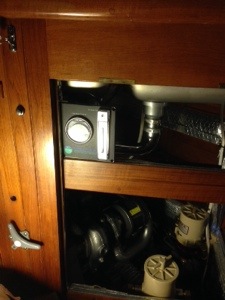
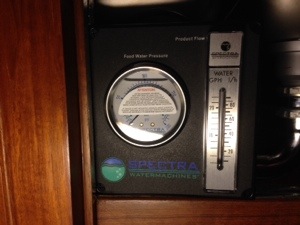
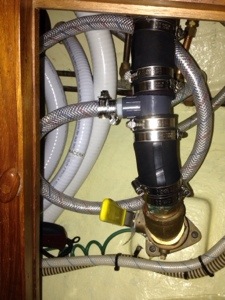
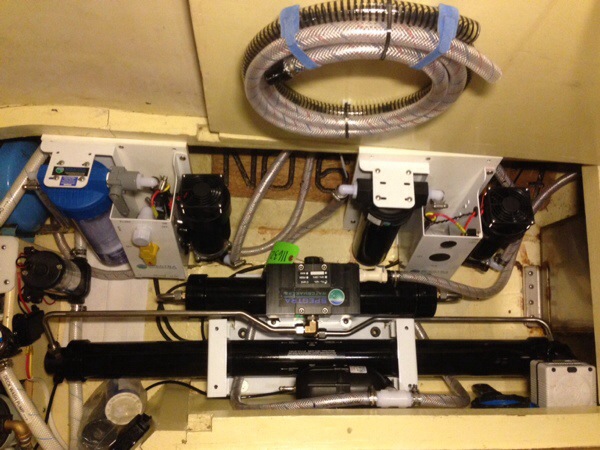
Installation–The Cape Horn is a modular system. The 3 largest components are the Clark pump/membrane, filter/pump1, and filter/pump 2. There’s also an accumulator tank, remote monitoring panel, product water valve, and test port to install. I had only a few options for the install location. Under the V-berth or under the port-side settee. Since accessibility is important for changing filters and throwing manual valves, I decided under the port-side settee would be the best location. The largest module (Clark pump) just fit after relocating a deck wash pump. The two filter/pump modules were slightly too tall so I modified a few hose fittings to allow them to fit within the available height and mounted them securely on starboard. I ran about 30′ of #4 AWG wire from the watermaker to a 30A breaker on my DC panel. I installed a brass spout at the galley sink for testing the product water and filling drinking bottles. Also in the galley is a valve for selecting the sink spout or the forward 60 gallon tank for product water. I installed a Tee in the sea water input hose for the head and piped the brine water output to the head sink drain. I also Tee’d into the pressure fresh water for the flush cleaning input. For filling the water tank, I drilled and tapped a hole in the top of the SS tank and installed a Parker fitting. The Parker fittings and 1/4″ tubing used on the product water side were easy to work with. The most difficult was running the 5/8″ tubing to the head and tying it into the 1-1/2″ sink drain. Since I couldn’t find an ideal place to mount the remote monitoring panel that didn’t require cutting into teak, I decided to mount it inside the galley engine access door. This was a convenient place since the valve was also mounted in that area. The panel has a flow rate gauge and a pressure gauge that should be monitored from time to time.

Completed Installation20140306-213515.jpg
Monitor Gauge and Manual Valve
20140306-213529.jpg

Monitor Gauge20140306-213538.jpg

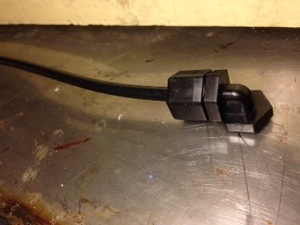
Watermaker Output to SS Water Tank20140306-213545.jpg

Brine Discharge to Head Sink Drain20140307-171226.jpg

Video Showing Clark Pump Operating

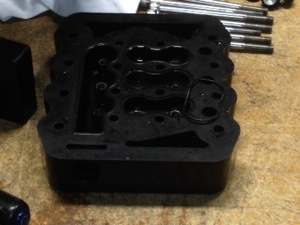
Hands-On Taking Apart a Clark Pump20140407-232722.jpg
Lots of Seals and Gaskets20140407-232733.jpg

Share

Mast steps

To make it easier to inspect and work on the main masthead, I installed two folding steps about 4 feet below the top of the mast. I’m building a 3:1 system from Harken hexaratchet blocks to be able to pull myself up. Once up there I will be able to stand on the steps, tie off, and work at chest level to inspect, change anchor bulbs, VHF antenna, windvane, etc. Trying to do this from a bosun chair is difficult because you’re working above your head and can’t see the very top. First project will be to change the anchor bulb to LED.

Share

Installing AIS Transceiver

An Automatic Identification System (AIS)  is an electronic device that allows you to see other vessels (who also have AIS) on a chartplotter.  Ships and ferries are required to have AIS, and it’s becoming more common for smaller vessels.  AIS for smaller vessels comes in two types–receive only that allows you to see others, and transmit/receive that allows you to see other and for them to see you.  AIS uses a combination of GPS and VHF to transmit and receive information.  A chartplotter will display a triangular mark for each vessel it is receiving a signal from.  Selecting a mark then brings up a screen showing information such as vessel name, home port, vessel speed and for ships, it shows what cargo it’s carrying.

The main reasons for having AIS aboard is for safety.  It’s kinda like an modern form of radar since it allows you to see other vessels electronically.  Radar of course also allows you to see land and rain squalls.   We’ve been in thick fog where we relied on our radar  to locate ships that were blasting foghorns.  Having a more accurate system at the helm will add redundancy and safety.  Also, on ocean passages the AIS can be used as a warning to sound an alarm when a vessel broadcasting AIS gets within a certain distance.

I decided on a class B AIS from West Marine that transmits and receives information.  It has a “silent” button on the case that allows you to silence the transmit function.  The installation involved lots of wiring–coaxial wire to a VHF antenna (fortunately my boat had a spare VHF antenna installed on the main mast with the wire coiled and labeled in the bilge–shows somebody was thinking ahead!), a cable to a GPS antenna (not sure where I will mount this antenna yet), PWR/GND wires to the electrical panel, and 2 strands on NMEA cable to the chartplotter.  I decided to tie the AIS into the Garmin chartplotter at the helm.  When I installed the cable for this chartplotter, I ran the data cables near the electrical panel so they will be easy to get to.

Share

New Dickinson Stove

Finished installing the new Dickinson 3-burner Mediterranean propane stove.  This replaced an older HilleRange model that now sits at Second Wave Marine, a consignment boating store.  The new Dickinson is 100% stainless steel, has dual 7000 BTU burners and 1-11000 BTU stove burner.  The oven is larger than our old one and has a7000 BTU burner plus a 4500 BTU broiler.  Other features:  electronic ignition (no more matches!), gimbaled mount kit, safety flame-out protection, removable cutting-board on top, and pot-holders.  The hardest part of the installation was fitting it through the companionway since it was both heavy and bulky.  There was about 1″ of clearance!

For photos, see “Latest Pics from my iPhone”

Share

Fleming Wind Vane

A Fleming mechanical self-steering wind vane came with Apropos and has been kept in my garage the past 4 years.  It’s an older model built in the 1980’s, but appears to be in great shape.  The system is a bulky stainless steel mechanical marvel that weighs a ton.  It attaches to the stern with 4 struts and its purpose is to steer the boat in a desired direction using only the wind.  It has a wind vane, a small rudder attached to a pendulum, and a drum that connects to the wheel.  Once the boat is heading in a desired direction with respect to the wind, the pendulum will make adjustments to the wheel whenever the heading (with respect to the wind) changes.  A linkage (two 6 mil nylon lines) goes from the pendulum to a wheel adapter, which is a drum fastened to the wheel.  The drum is wrapped 3-4 times with 8 mil nylon rope that has eyes on both ends.  These systems are very helpful for offshore cruising so you don’t have to sit behind the wheel hand steering all the time.  I recently took the system apart and freed the toothed adjusting disc that had seized from years of sitting around.  It took lots of WD-40 solvent and some time before it finally turned easily.  The only piece I believe is missing is the drum that connects onto the wheel.  Tonight I finally got thru to Fleming (based in Australia) and ordered a new stainless steel wheel adapter and a storm vane (a smaller wind vane used when the wind is really blowing).  Both will be shipped to Sydney since we’re going there in a few weeks.  They were $643 AUS including shipping.  I plan on hooking it up to Apropos this summer and trying it out during our trip to the Gulf Islands in August.

Share

LED lighting

Apropos has 10 overhead dome lights and 6 floor-level courtesy lights that use incadescent bulbs. Each bulb is 10W which means each light draws about 1A of current. Replacing the bulb with LED lighting would reduce the current draw by 1/10th. It is important when cruising to keep the amp-hours to a minimum, and the conversion to LED would help.

One solution is to use HBLEDs (high-brightness LEDs).  A drive circuit is needed to source the proper current through a string of HBLEDs.  I want to use a PSoC chip since I’ve spent the past 10 years helping to design it at Cypress Semiconductor.  It’s a reconfigurable 8-bit micro-controller that can be configured for LED driving.  The driver would consist of a PWM (pulse width modulator) NFET gate drive.  Setting the PWM would control the brightness of the LEDs.  External components would be the NFET, an inductor, a flyback diode, a capacitor, and a voltage regulator.  These could be placed on a small board along with the 4-5 HBLEDs and the PSoC chip. An option would be to have 5 red LEDs and 5 white LEDs and a switch to select either red (for night-time cruising where you want to retain night vision when going below deck) or white.  One PSoC chip could drive both circuits.

Share