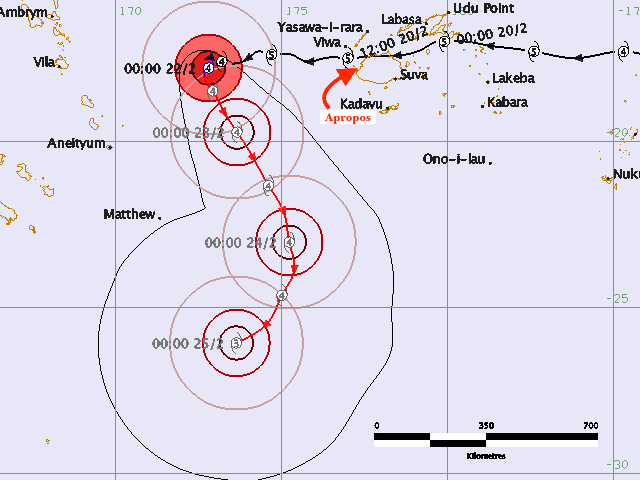
Tropical cyclone Winston meandered around the south pacific for a couple of weeks before striking Fiji as a category 5 system–meaning sustained winds in excess of 137 knots (157mph). The eye moved along the north coast of Viti Levu and wiped out villages in Viti Levu, Vanua Levu, and many of the smaller islands. Winston is being noted as the 2nd most powerful cyclone ever to make landfall, with winds in excess of 200 knots.
Past and predicted path of cyclone Winston
Video from NOAA showing cyclone passing through Fiji:
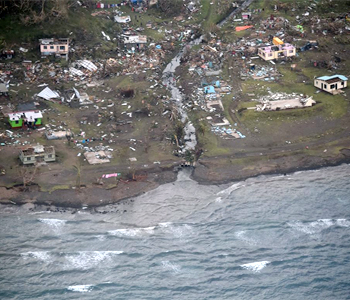
News is slowly getting out describing the severe damage all over Fiji. Many houses were leveled, lots of trees fallen, and flooding has washed out roads. Power has still not been restored for many people. Loss of life (21 as of this writing) was minimized by plenty of warning and a good system of emergency shelters on the islands.
Coastal village wiped out by the cyclone
Aid is slowly reaching Fiji, but getting it to the people in need will be a big challenge. Me and 3 crew members from Seattle will be flying to Fiji in 5 weeks and will be bringing as much as possible to help out those in need. Two helicopters are being supplied by the Australian government to help distribute food and supplies to different locations.
The eye passed within 25 miles of Vuda Point marina, where Apropos has been for the past 5 months in a ‘cyclone pit’. We were told by marina staff that only 2 boats that were on jack stands toppled over, and all the boats in pits are ok and just shifted by a few degrees. So structurally Apropos is fine but I’m still waiting to hear about any damage from flying debris. I think I’ll buy a new wind anemometer just in case!
Leaving your boat in the South Pacific during Cyclone season (November through April) can be a bit nerve-wracking! As Apropos sits in a cyclone pit at Vuda Point marina on Viti Levu in Fiji, a cyclone is moving towards it. As I write this, Cyclone Ula is approaching the Vava’u group in northern Tonga, a place where we spent 4 weeks and where some of our friends have left their boats.
Some cruisers leave their boat in the water with multiple anchors and lots of chain. There are harbors in Tonga and Fiji that have huge concrete blocks on the bottom to tie to. However, surge and stress on the tackle gear are still major concerns. The next level of protection is to haul the boat out and place it in a cyclone pit. Vuda Point marina has about 40 of these pits and they sell out every year. We reserved ours in July when there were only 3 remaining.
Regardless of where you leave your boat during the cyclone season, the best thing you can do is to remove as much as possible from above deck. We removed the solar panels, dodger, bimini, sails, BBQ, and everything else that was loose. We also hired a caretaker for Apropos who checks on the boat about once a week and sends me a email report with things like battery voltage and overall condition. Since he works at the marina and is there every day, he opens and closes the ports depending on the weather to keep the interior well ventilated. He is my “eyes” and emailed photos of the hull painting and, in the event of a cyclone, will show me how Apropos fared.
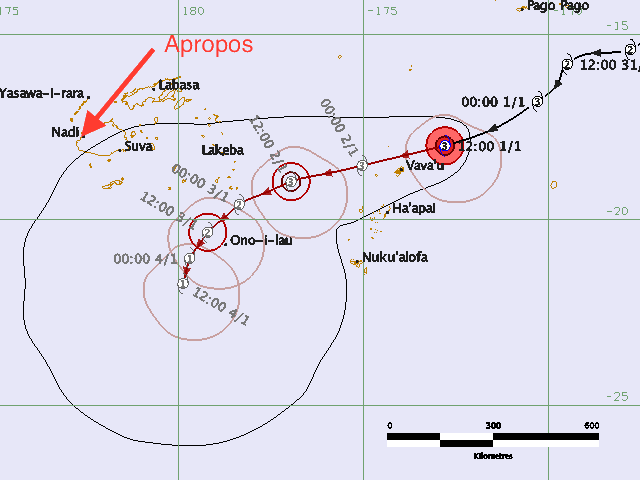
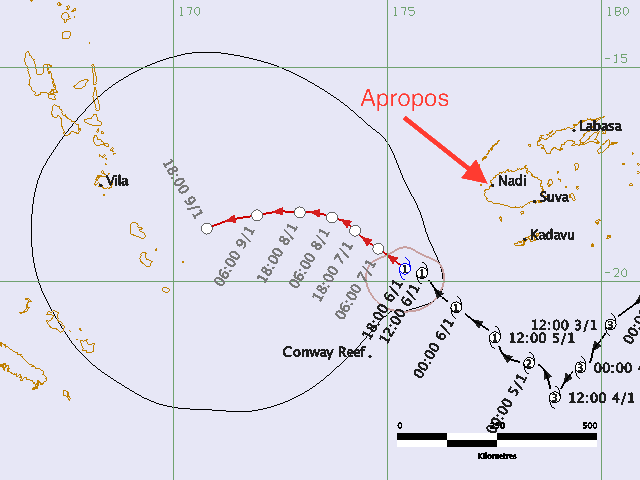
As shown below, Cyclone Ula is predicted to veer more south before reaching longitude 180. The red line is the predicted path and the outer black line indicates the range of tracks due to the uncertainty in modeling. As it looks now, the path would spare the western side of Viti Levu from the eye and strongest winds. This map is updated every 6 hours so I’ll be tracking Cyclone Ula over the next coupe of days.
Cyclone tracking by Fiji Meteorological services
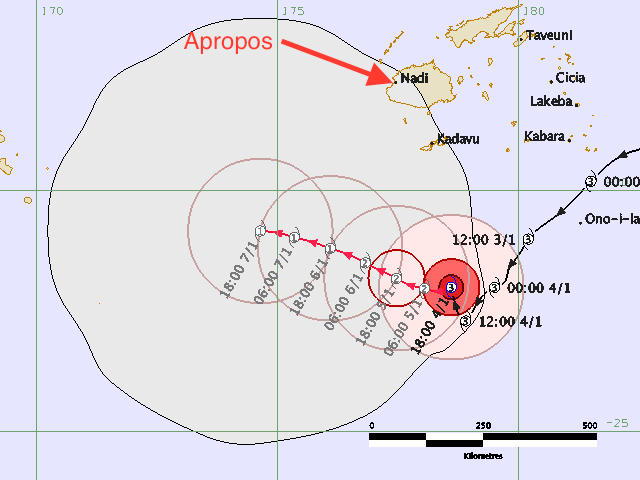
Update on Jan. 4, 2016–Cyclone Ula continued on its S-SW course as predicted, then decided to change course and head W-NW. Still a Cat3 system, it’s predicted to weaken over the next 2 days to Cat1. Nadi reporting heavy rain today, not sure how much wind.
Cyclone tracking updated on Jan. 4, 2016
Update on Jan. 6, 2016–Cyclone Ula continued moving west and is presently a Cat1 system.
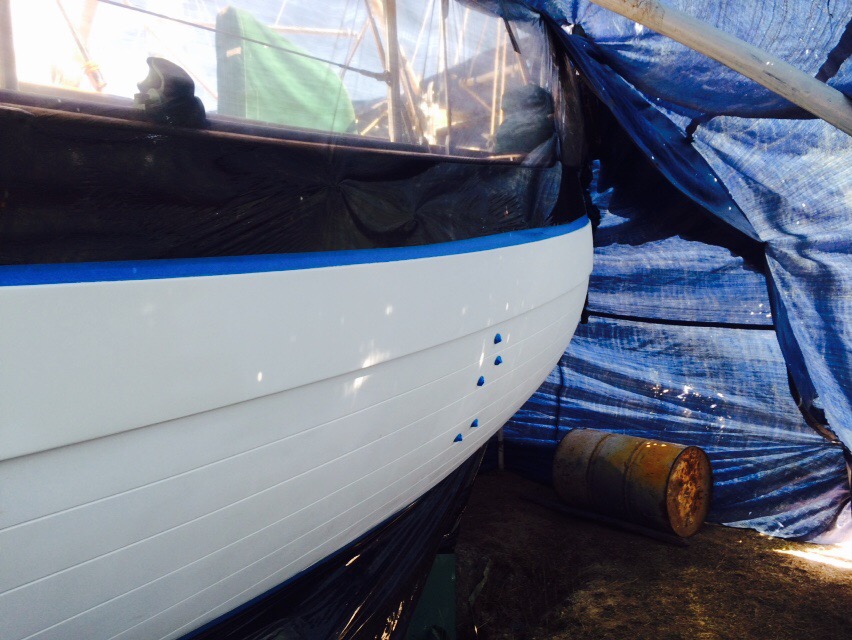
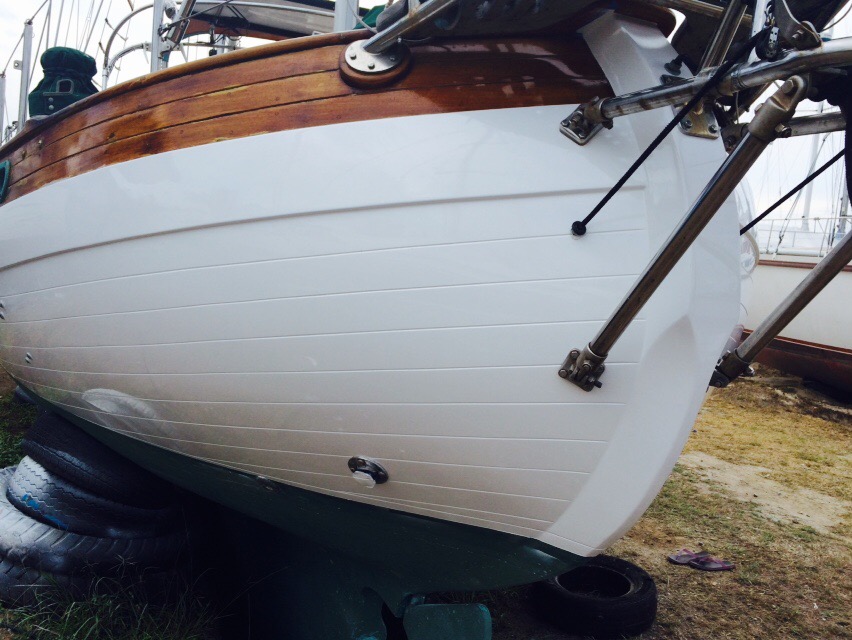
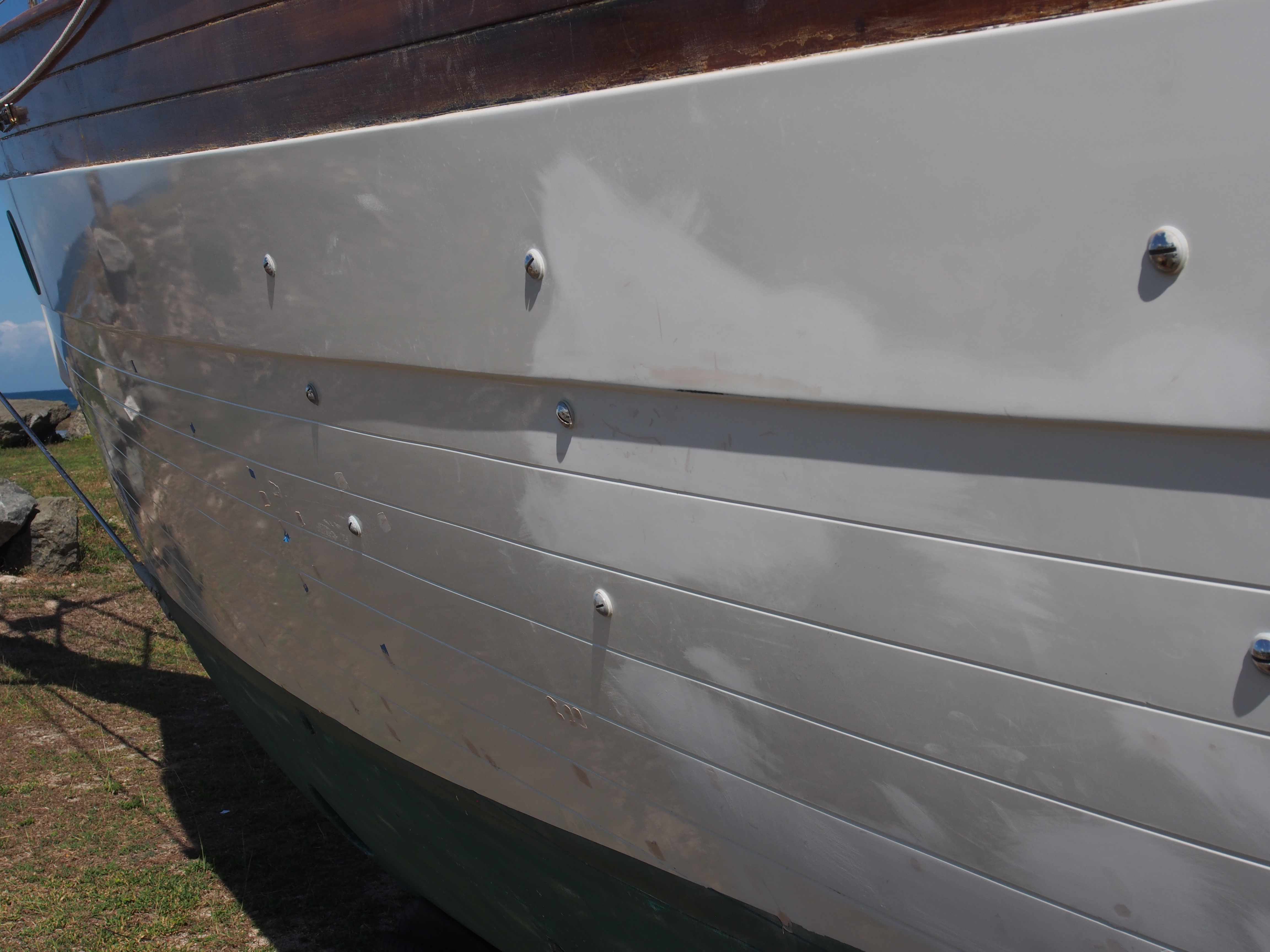
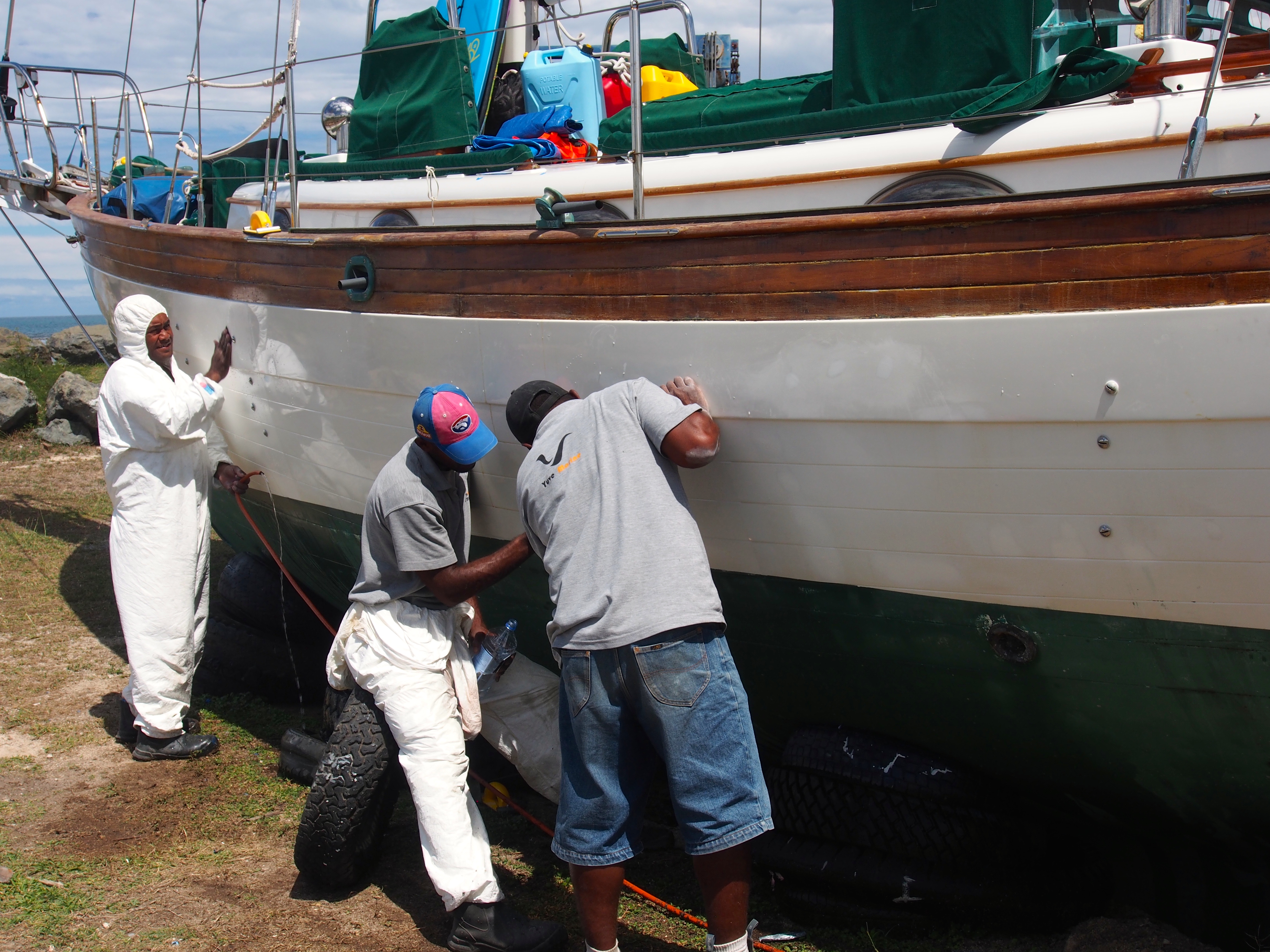
After getting a quote in Seattle for painting the hull, we decided to have it done in Fiji where labor rates are much less. To make up for the gelcoat mistake (see post from September 2015), they gave me a reduced price on labor and didn’t mark up the paint & supplies. I was confident in the painter’s skills and when I was in Fiji, he showed me another boat he had recently done.
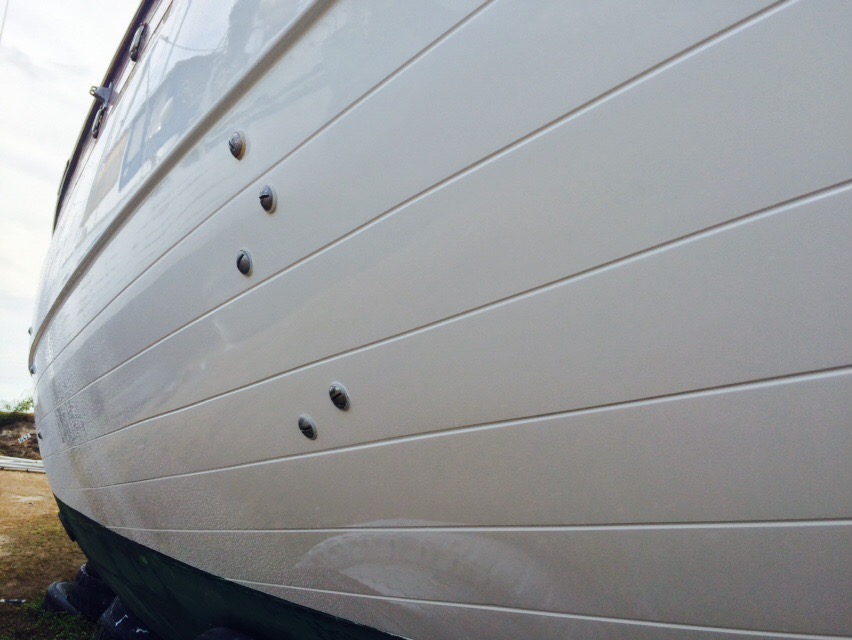
Instead of gelcoat, most boats are using a polyurethane paint nowadays. It has better UV protection and isn’t susceptible to chalking, discoloration, or leaching. Polyurethane also maintains a high gloss appearance and flexibility even in full sun exposure and harsh environments. Repair of surface damage is easier than with gelcoat.
One drawback with using polyurethane on the hull is that the topsides will still be gelcoat, so the boat won’t be uniform. Exact color matching isn’t an issue since the outer hull isn’t right next to the topsides.
Since I wasn’t there when it was painted, I won’t know how well it turned out until I return in April. I’ll have new decals made in Seattle to take along and apply them in Fiji.
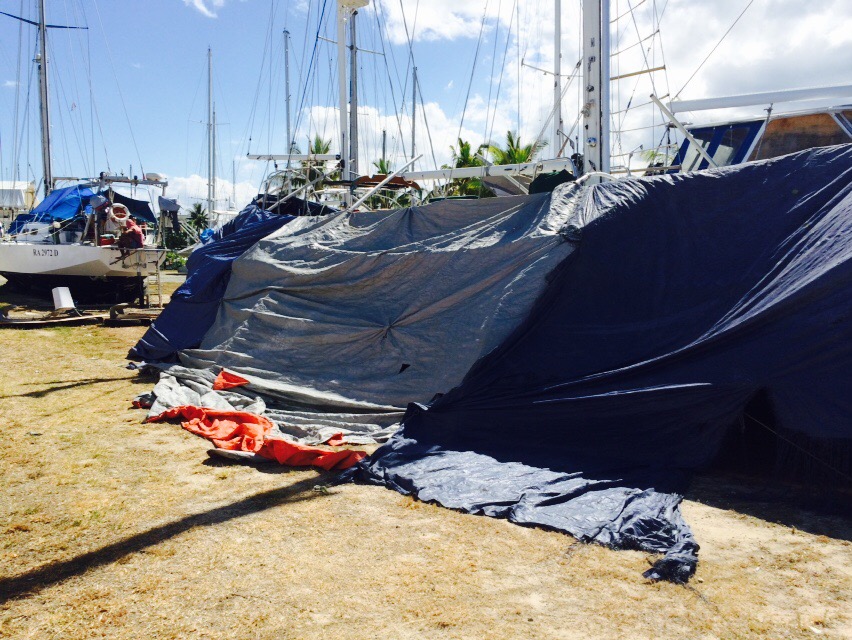
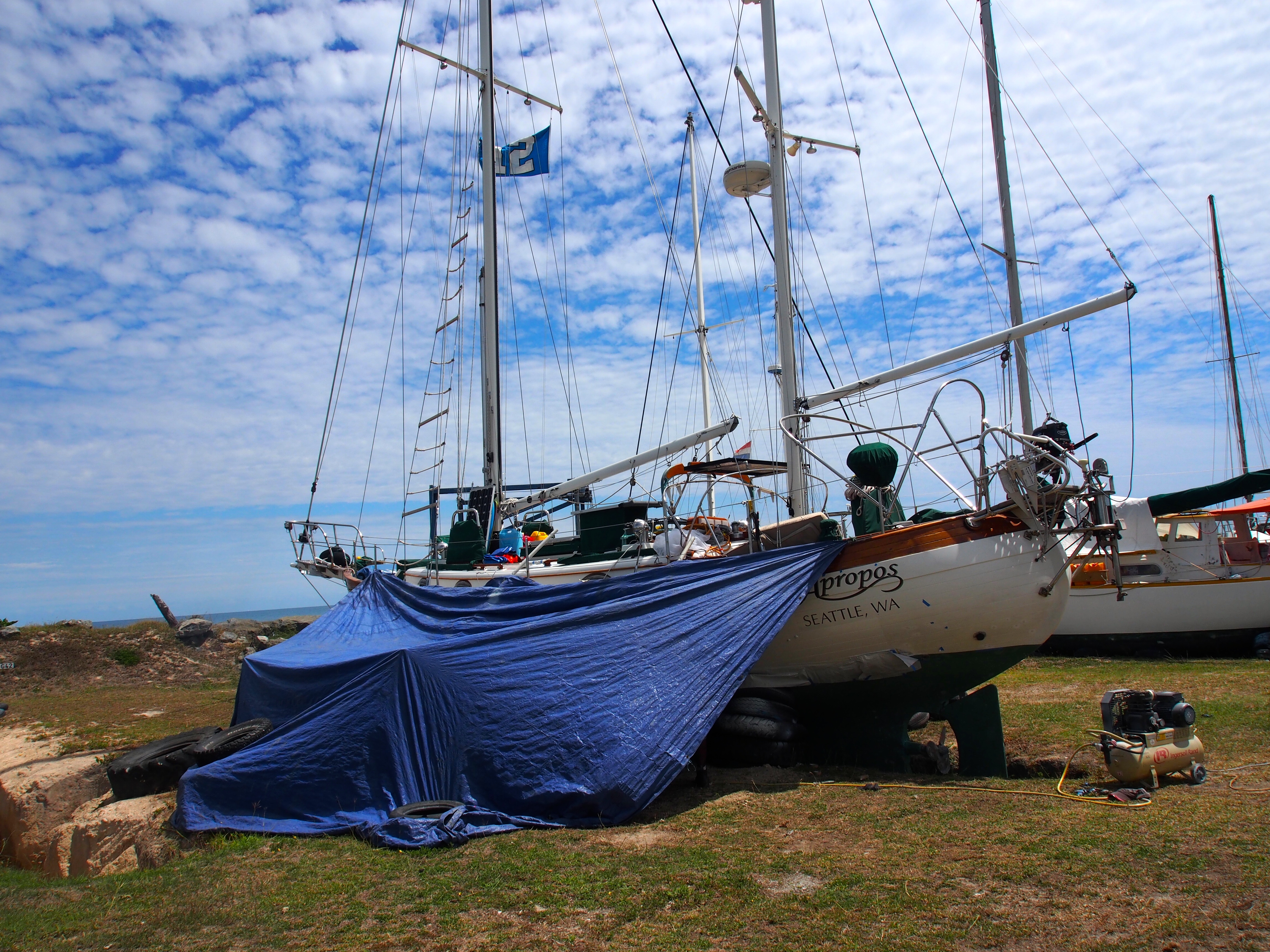
Tenting Apropos with tarpsUndercoat layer
Polyurethane after polishingPolyurethane after polishing
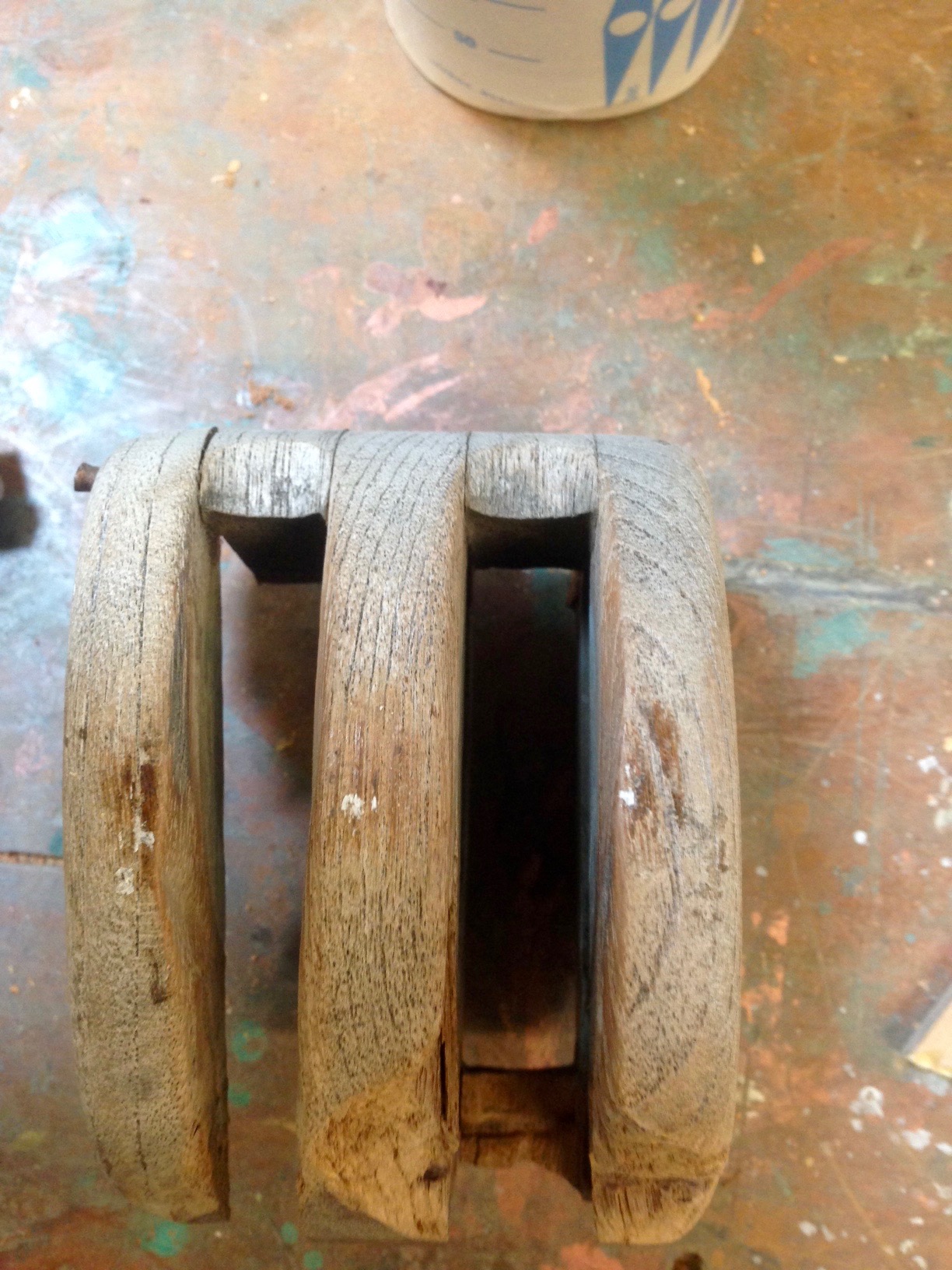
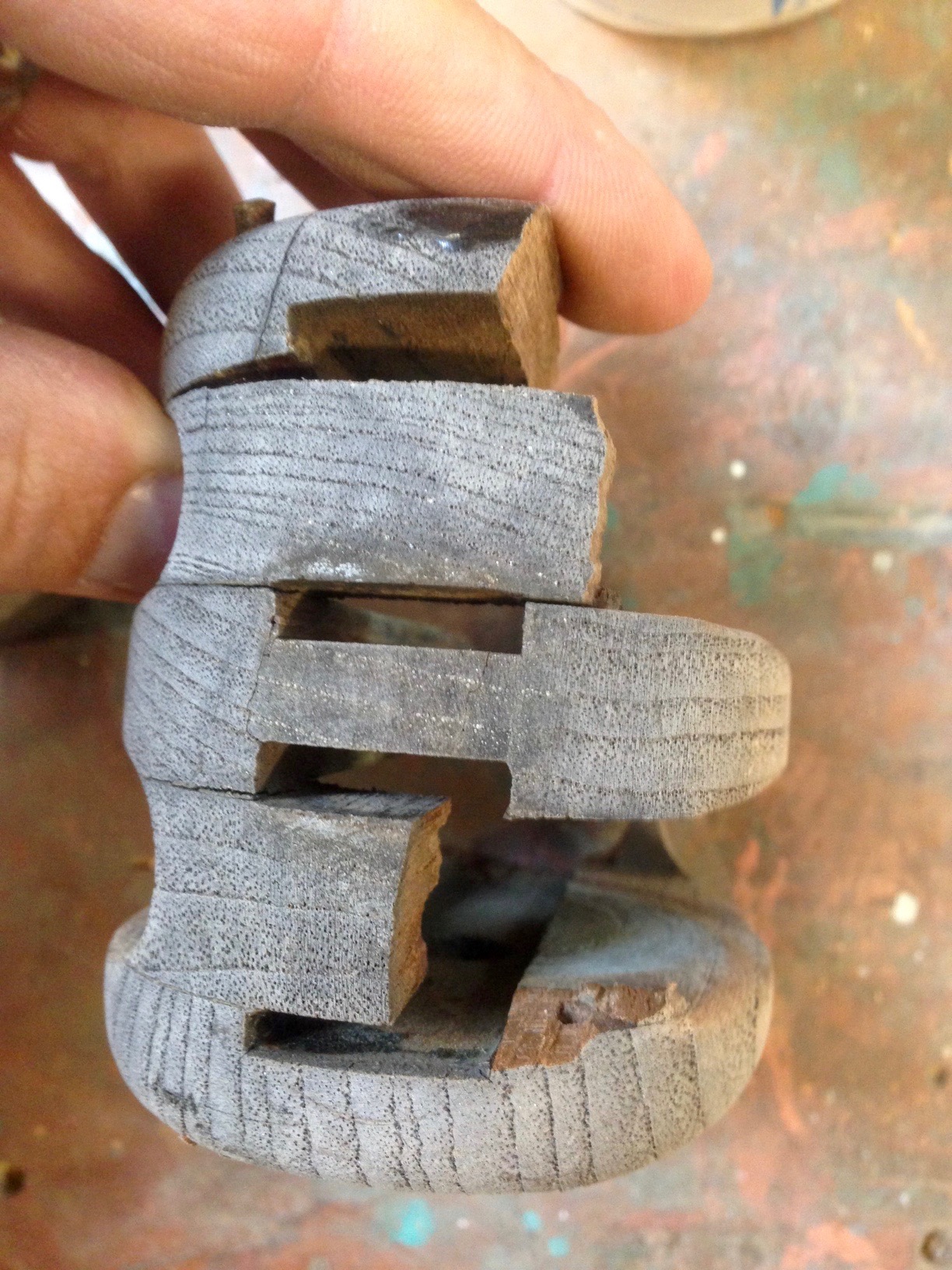
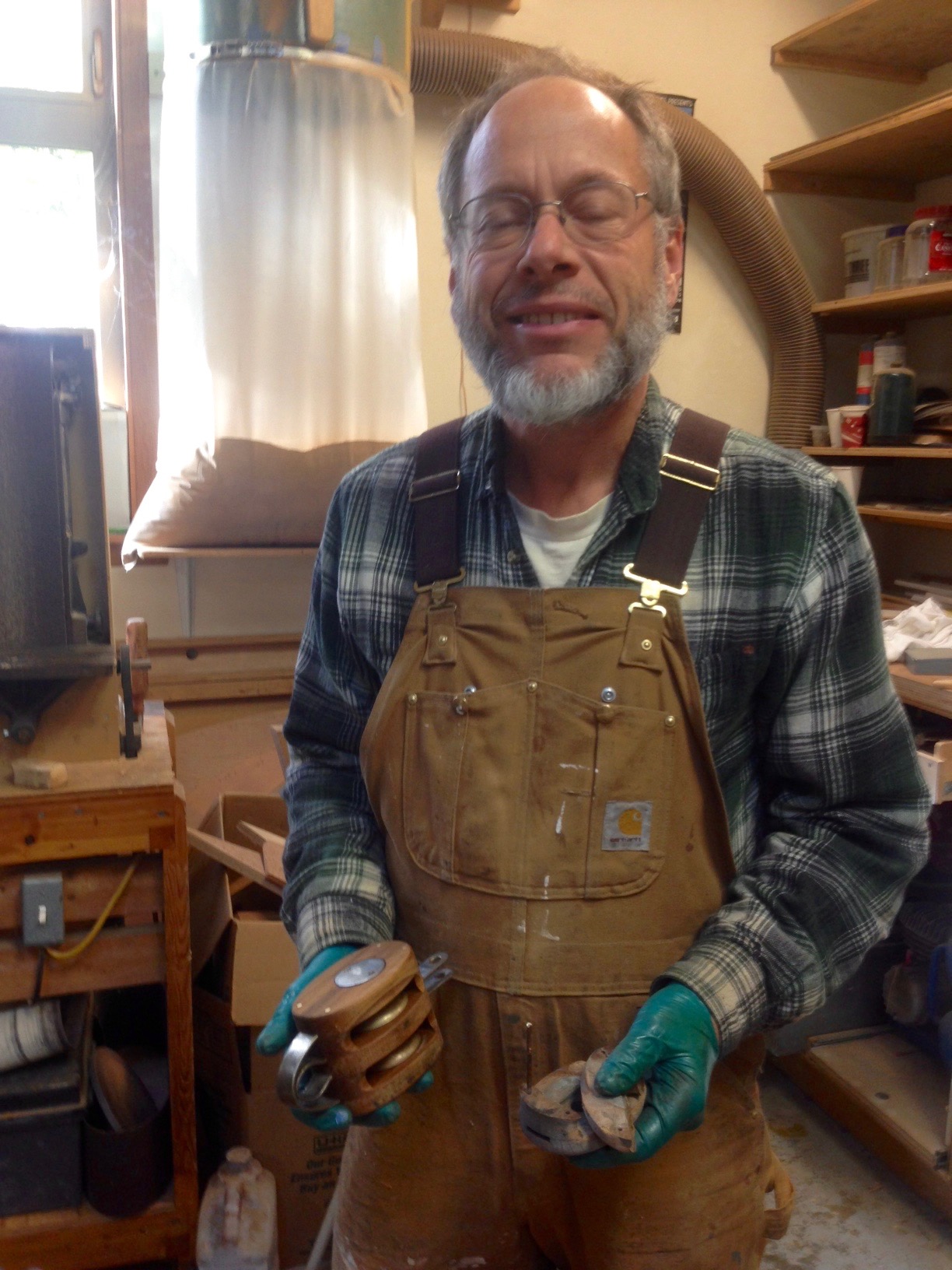
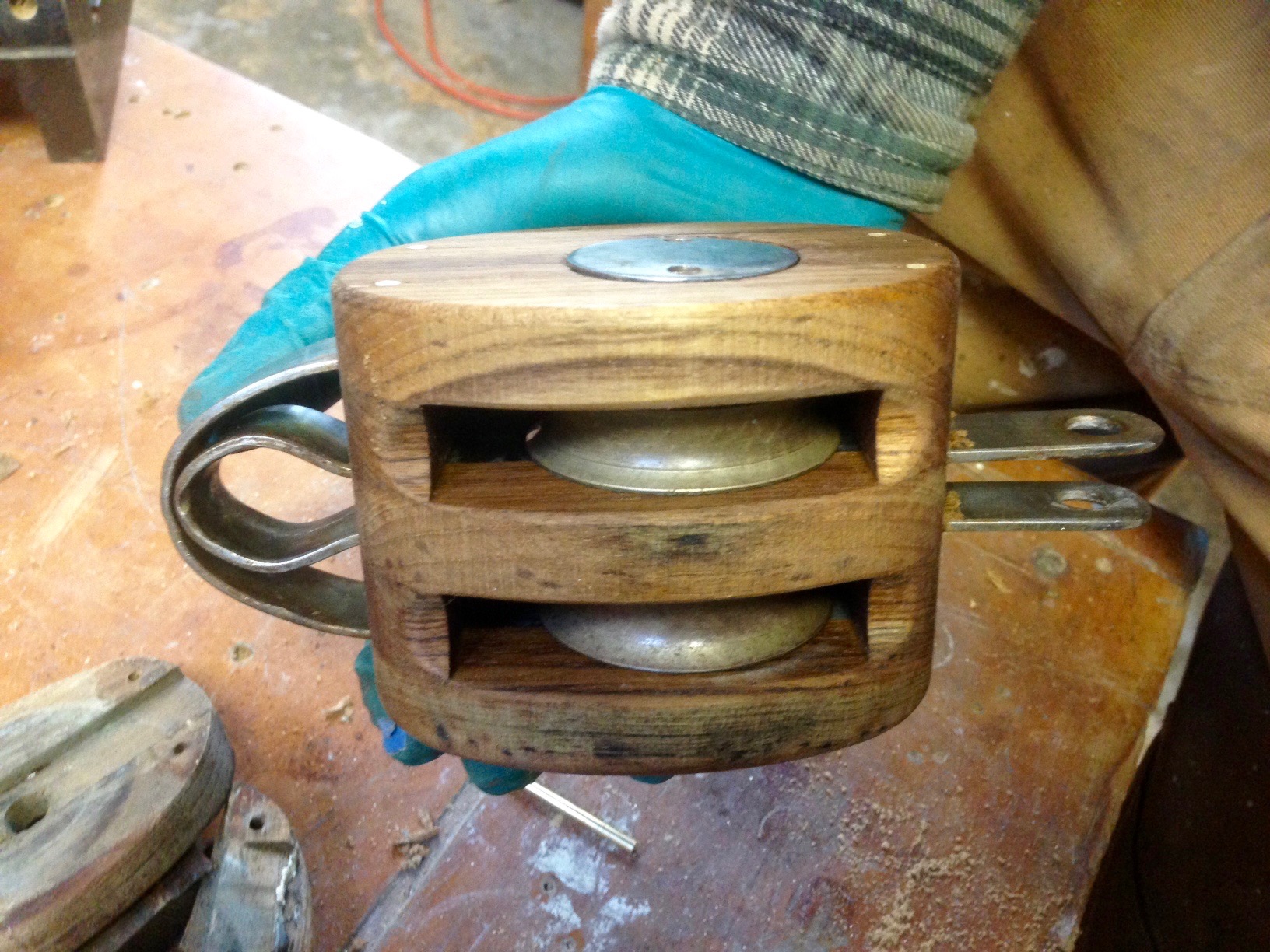
Apropos has 7 teak blocks that are used on the main and mizzen sheets. Somewhere between French Polynesia and Tonga, one of these blocks started coming apart. It was a teak double block with becket, used between the main boom and traveler. When sailing downwind with the boom way out, the sheet running through this block puts pressure on the side of the block, and after 30 years of use, the teak began to split. I found bits on the deck and was able to clamp it back together using 5200 marine adhesive, a short-term fix that lasted to Fiji. I carted the block with us back to Seattle to get it repaired since nowadays you can’t buy teak blocks like this at chandleries. I found a woodworker near Seattle and knew I had the right man when I went into his shop and there was a 23′ rowing sailboat that he was building. Although he never rebuilt a wooden block before, he had the woodworking skills and shop equipment to do it. Together we figured out how to disassemble the block into its components–a pin, 2 sheaves, 3 cheeks, inner and outer straps, and 4 swallows. As we took it apart, the teak cheeks and swallows broke apart and we realized they would all have to be replaced–a complete re-build. We were able to salvage enough to use as patterns for shaping the new parts. When I returned a few days later, Mark had all the teak pieces shaped and ready for assembly. I brought with me a bronze welding rod that we used for the 4 pins that, along with the main pin, help hold the 3 cheeks together. After assembling and driving in the 4 bronze pins, I gave it a quick coat of teak oil and it was finished–good as new!
Partially disassembled blockTeak was weathered and brittleThe master woodcrafter with rebuilt block in handFinished block with all new teak. The ends of the 4 bronze pins can be seen on the top.
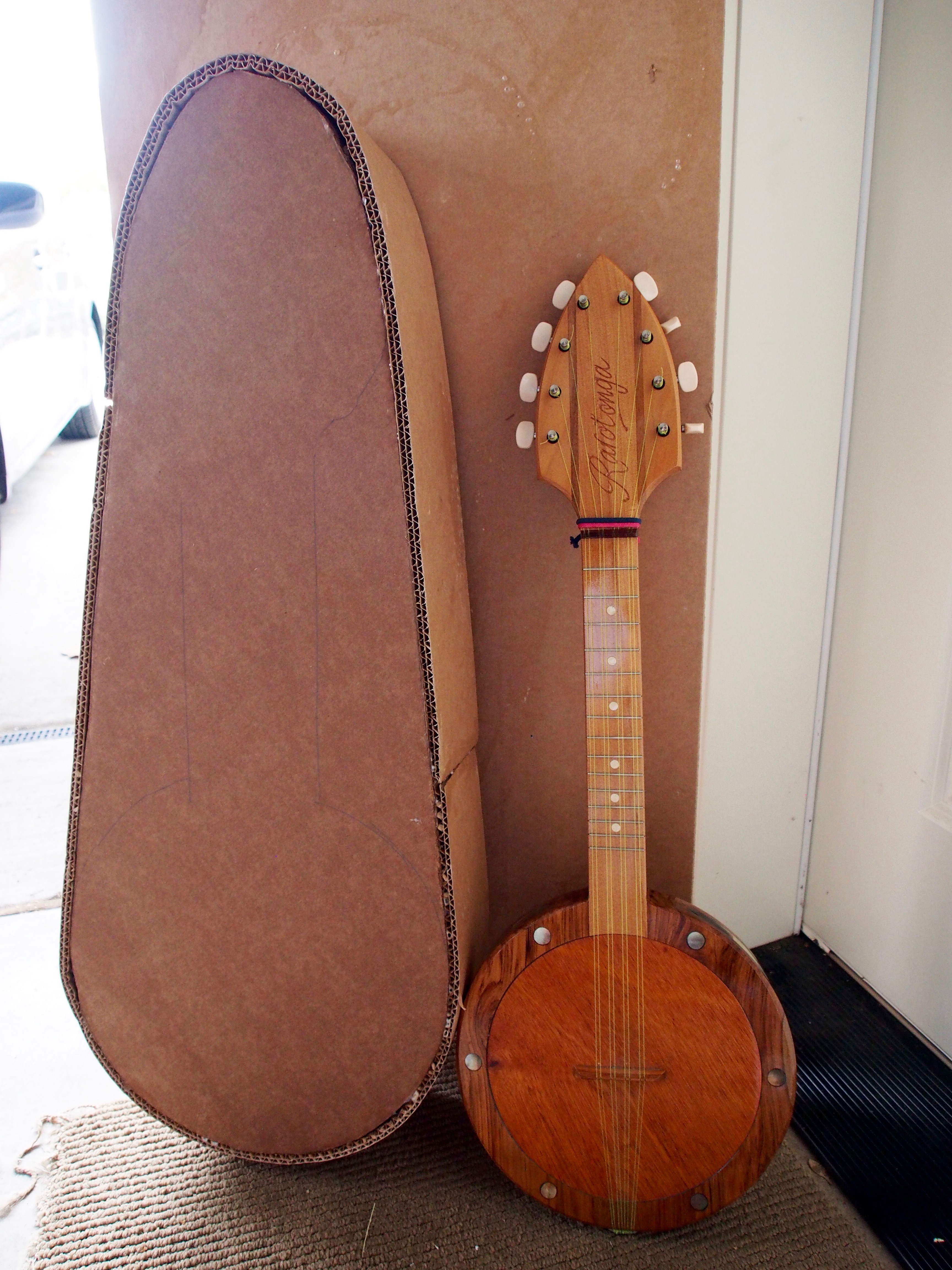
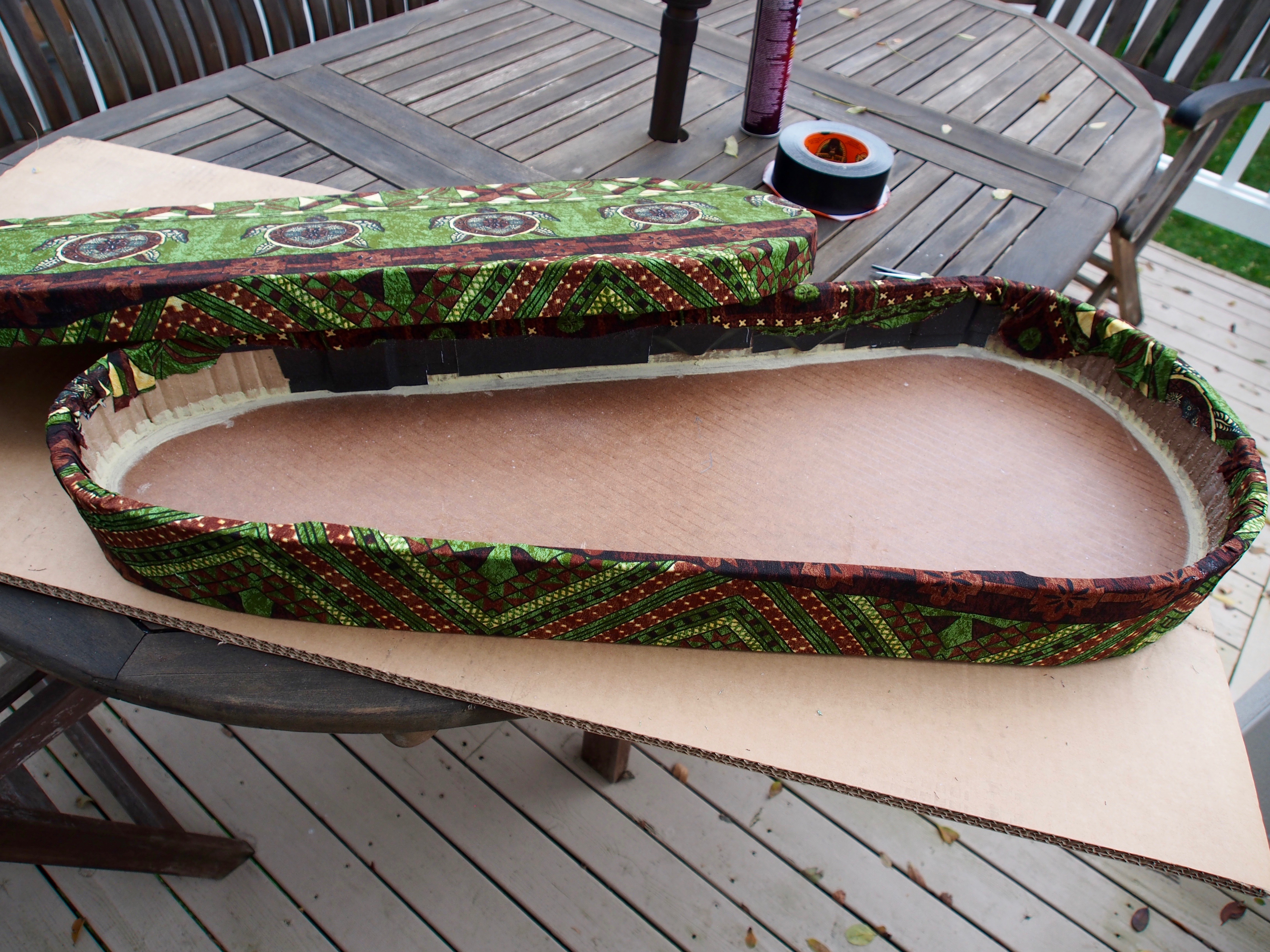
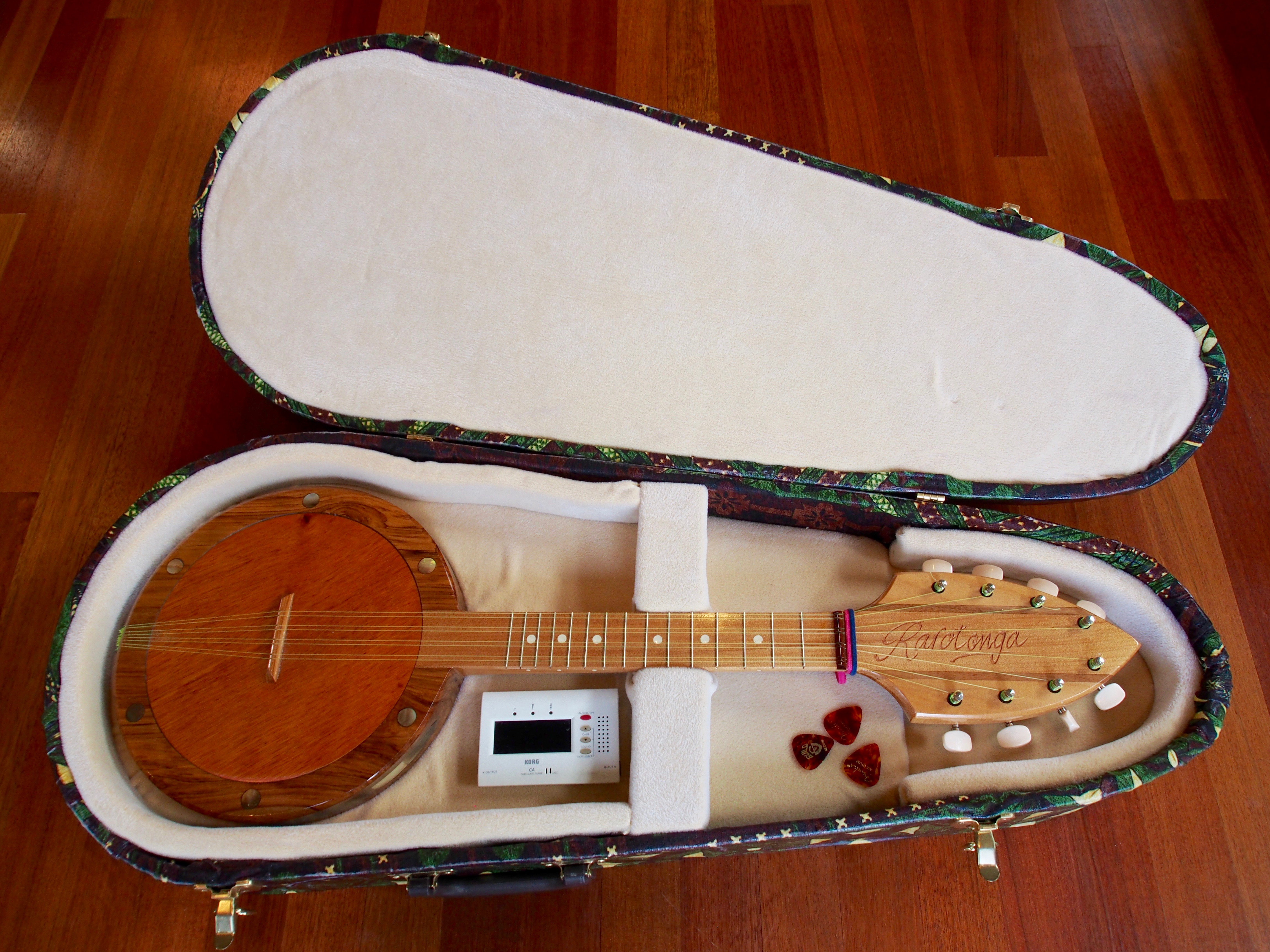
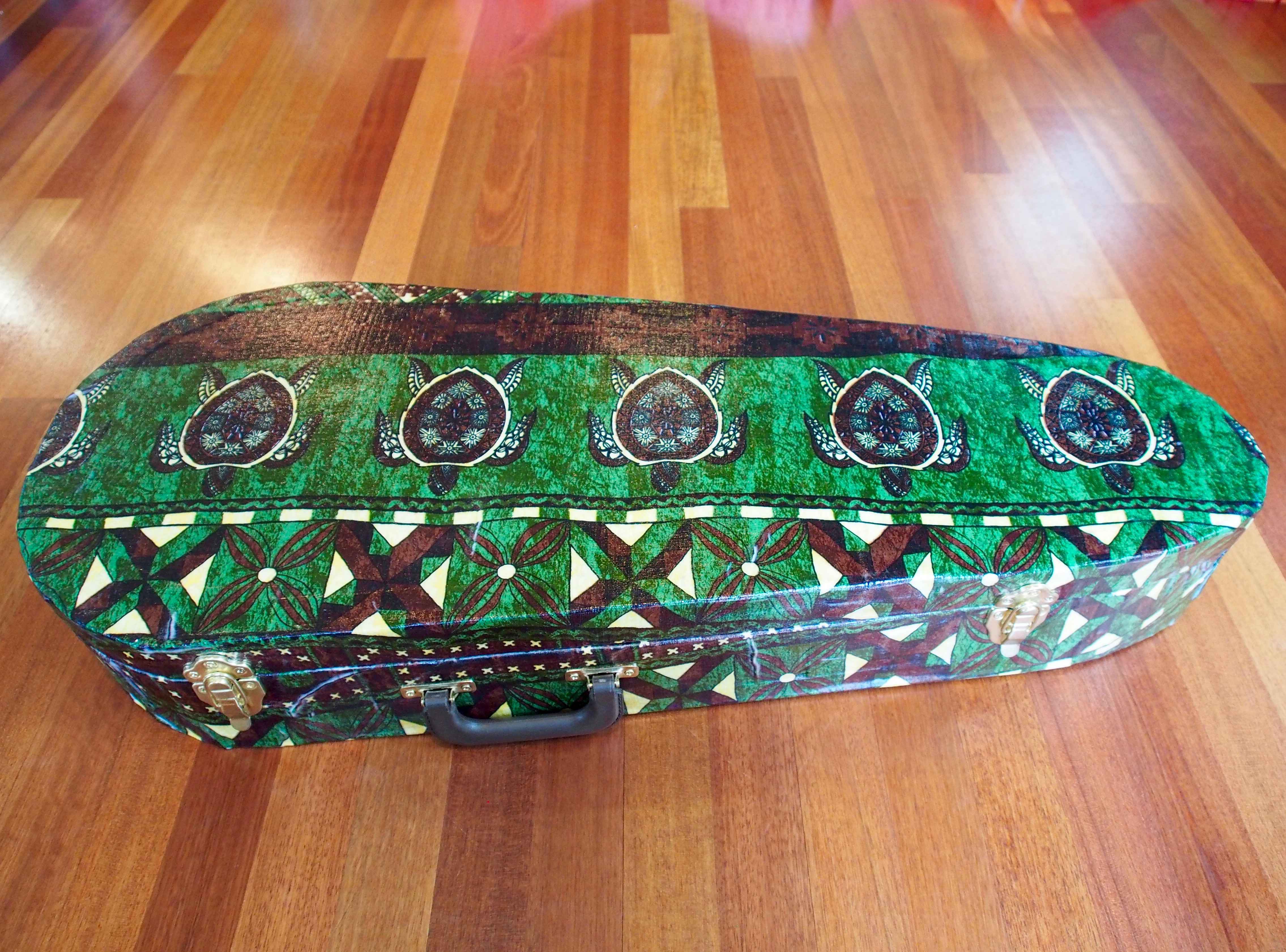
I built a case for my Tahitian ukulele to protect it when I travel and when it’s on the boat. I got the idea on the internet (http://www.instructables.com/id/a-cardboard-ukulele-case) and followed most of the steps for the cardboard case, then tailored the inside to fit my particular uke.
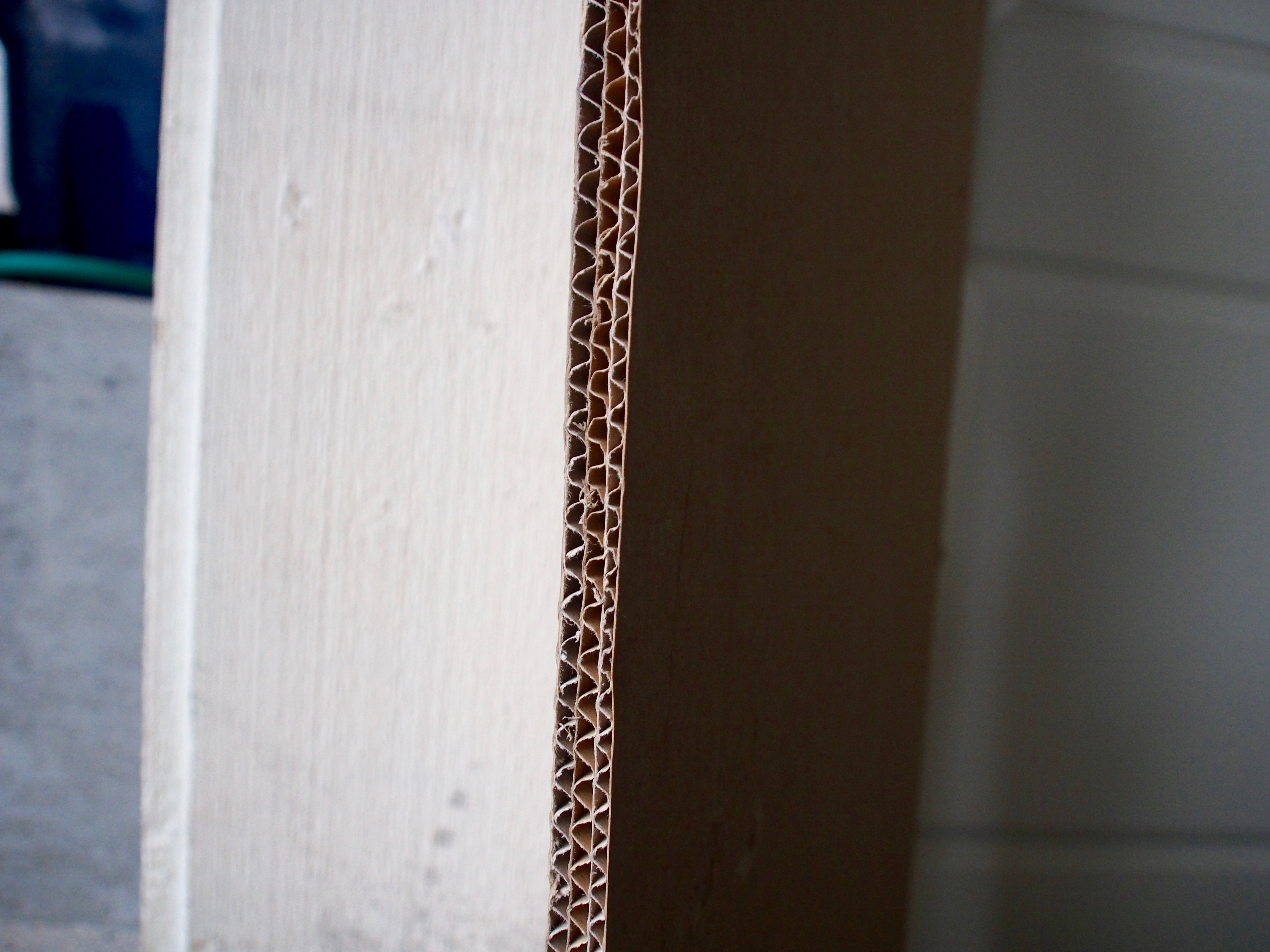
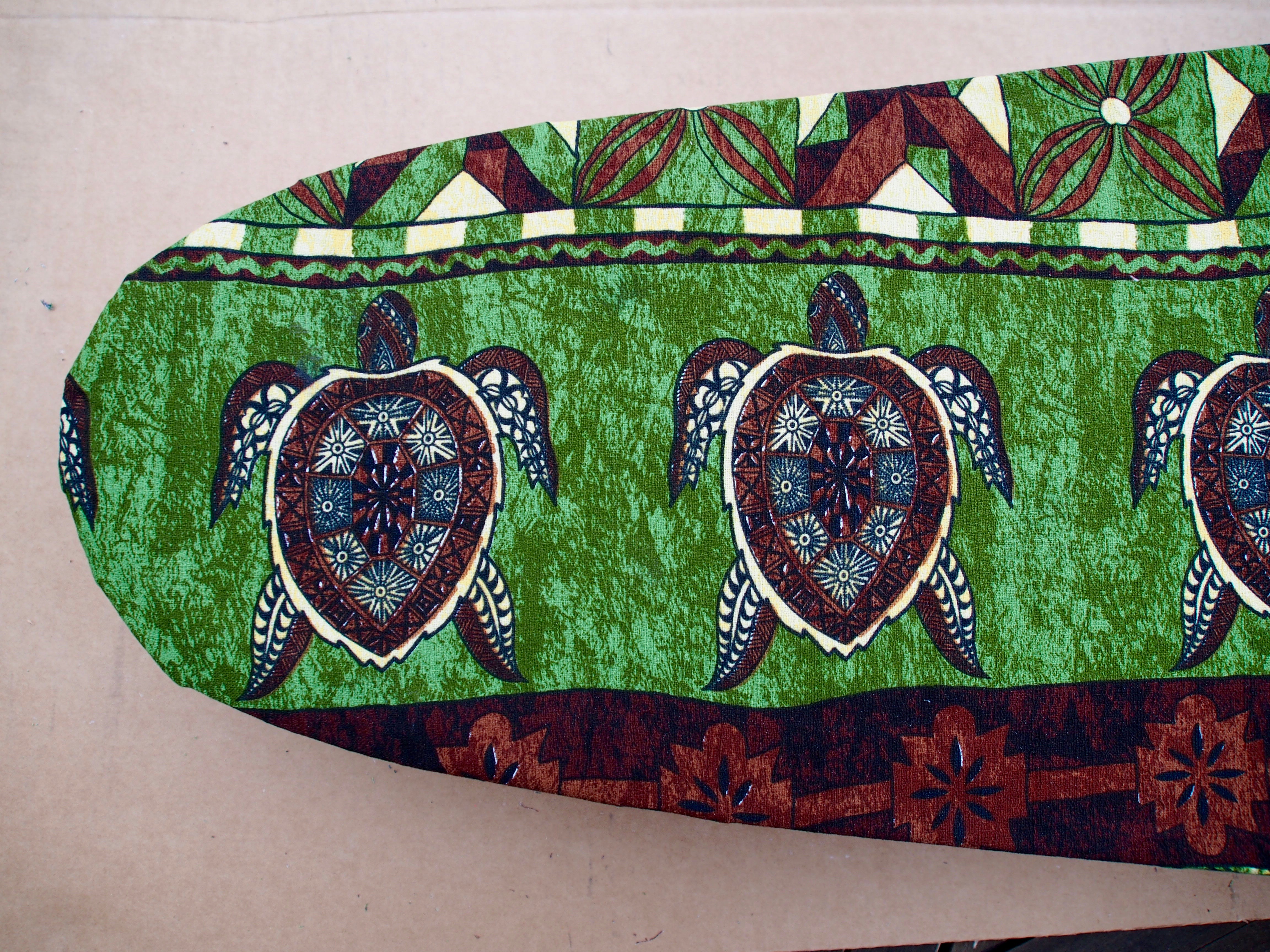
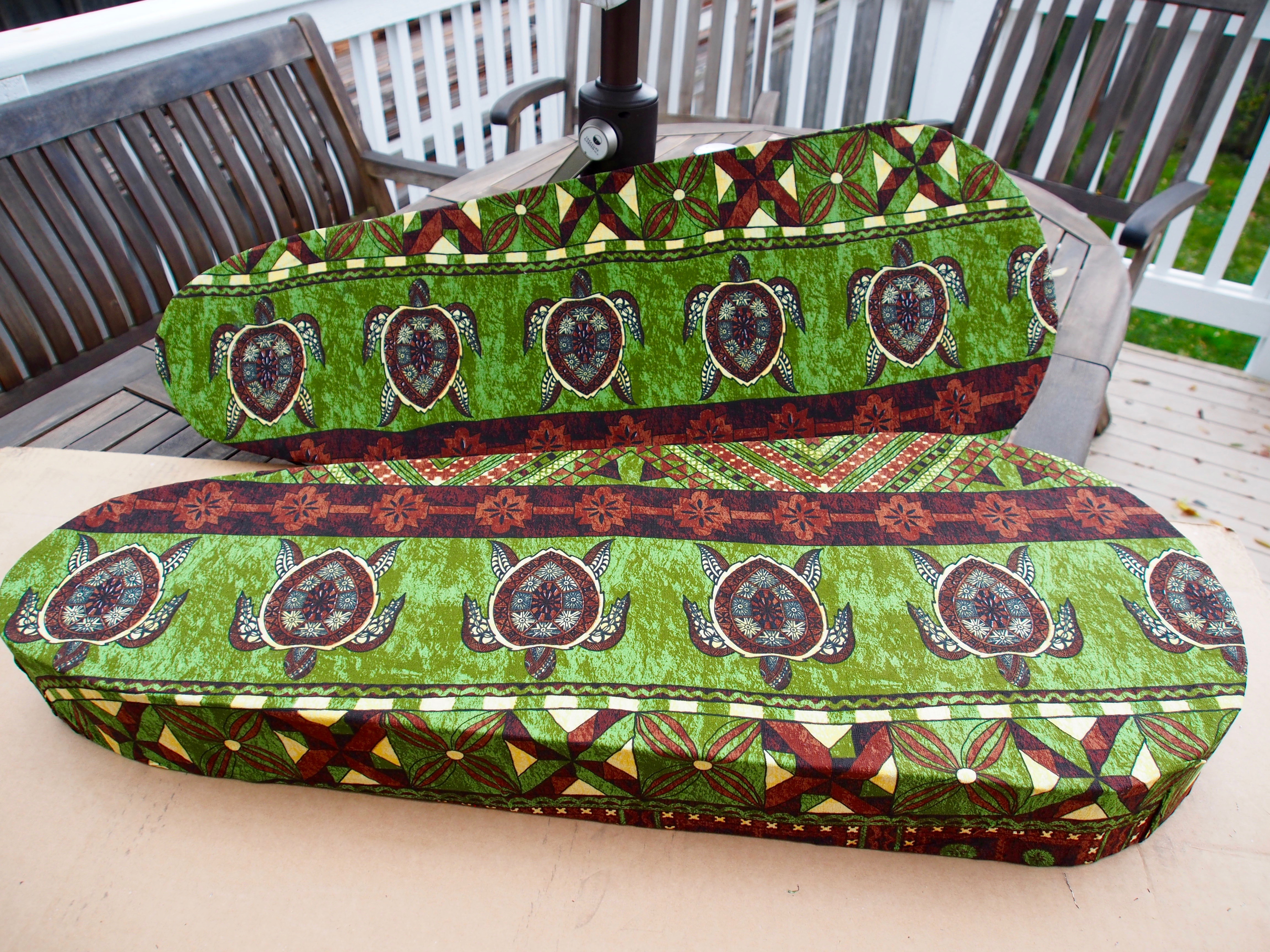
It’s a basic cardboard shaped box. I used heavy duty 3-ply cardboard which I got for free at an appliance store. After building the box and coating it with wood hardener, I filled the voids with wood putty http://thompsonmusicstudio.com/wcal/ol/levitra-prix.html. Next I used a table saw to cut off the lid, then I cut some patterned material we had bought in Fiji, and glued it to the outside of the case using a spray adhesive cheap viagra generic. Next I brushed 4 coats of mod podge onto the material to protect it. I found all the hardware (hinges, latches, handle) at Home Depot and put wood backings on the inside of the case for the screws to bite into. I lined the inside with 1″ foam, then cut some creme colored fleece from an old blanket and glued it onto the foam. Total cost was about $75 and now my uke will be protected when I travel and when it’s on the boat.
Heavy-duty 3-ply cardboardCompleted “rough” boxCovering outside case with a patterned materialMaterial was bought in FijiAfter several coats of mod podgeInside lined with foam and fleeceCompleted ukulele case
Jim has been asking me to add my paragraph to our blog but I don’t think I could sum it up in a little paragraph, so decided to do my own post. I’ve been behind the scenes with regards to the blog throughout our adventure as Jim seems to have taken a liking for writing, which has been great for me.
Things I have enjoyed this year:
It has been heavenly not working and not living to a schedule. I’ve not missed getting up before the sun rises to go to work and picking up Jacintha from after school care after the sun has set. I loved getting up with the sunrise, when my body was ready to wake up and sleeping when I wanted to. Our only schedule being when we needed to make a passage or whilst on watch on a long crossing.
Visiting so many different countries. I loved exploring different places, shopping in tiny little stores & markets, and wondering around the streets or exploring villages. Not to mention the wonderful sea life we’ve experienced, like swimming with the whale sharks in La Paz, the sea lions in Isla Perdita, the birds at Isla Isabella, the many dolphins who’ve jumped through our bow wave, the tired sea birds who’ve hitched a ride on our boat, swimming with the sting rays and sharks in the Rangiroa and Bora Bora, and the Humpback whales in Tonga. Each place that we’ve visited holds a special place in my heart for why it’s special, whether it was the crocodile in Marina Vallarta, the wonderful villagers of Nasea in Fiji, the amazing caves of Niue or the friendly hamburger stall worker in Rarotonga who gave me a ride to the laundromat and let her daughter play with Jacintha. Even boring Ixtapa marina wasn’t so bad as we watched the Seahawks win to qualify for a place in the Superbowl!
Spending time with Jim and Jacintha. There were times that were “challenging” between us and times that I’ve wanted to mutiny and jump ship, but overall I’m glad that I stuck it out and we got to do the things that we did. I’ve learnt a lot about Jim and about me and we’ve grown together as a couple. I’ve enjoyed watching Jacintha grow and blossom into a young lady. Apparently, we dragged her kicking and screaming across the Pacific, but when you see her paddling a kayak across the water with Ivan in Tonga, generously give away her art supplies and toys at the Tongan School and in Fiji before we left, screaming with excitement when swinging on the rigging with Ivan from Javalot when we had “circus time”, swinging on the rope with the other kids at Makogai Island or cuddling up with the baby pig at Nasea– I know she had a good time overall and will have many wonderful memories of our time away. She will be a better person for seeing how basic some of the villages are with no electricity, no running water, no toilets and no wifi, internet or computers.
I’ve loved the simplicity of life at sea. We took our home to many different places and brought all that we needed with us. Our typical day on the boat consisted of breakfast, lunch and dinner, what needed to get fixed on the boat, deciding whether we were staying put or are we moving on, and if we’re going, where to, how long and what provisions we needed. No distractions of bad news on TV, no traffic snarls and no commuting.
Meeting people. We have met a lot of fabulous people on other boats and also on the islands we visited. We have made some long-lasting friendships and hope that distance doesn’t weaken those bonds. Mabrouka now in Mexico, Pelagic in Ireland, Seahorse V in Panama, Maestro in Bora Bora, Daybreak on passage between Tonga and Australia, Korbut Rose in Tonga, Brahminy, Family Circus and Javalot in Fiji to name a few boats. We’ve enjoyed lunches and dinners with you, your company and your help at times.
The warm weather. I loved the tropical heat and the fresh rain. It reminded me of my childhood in Malaysia. The smells and the trees were similar to that of my youth.
The food in the markets and stores. The lunch stalls in Mexico, the food trucks in the Marquesas, the market in Papeete, the french baguattes in French Polynesia, the small restaurants in Tonga, and the marina restaurant in Fiji.
Now that we’re back in Seattle and starting to re-assimilate, here are some things that I missed whilst living on a boat.
Washing machine and dryer. Coin operated laundromats were easy to find in Mexico and I had time to sit around and wait for the washing to be done. And if there wasn’t one, then paying to have your laundry done was cheap enough. Throughout French Polynesia, laundry prices were exorbitant. I hand-washed our laundry for those 2 months and it always seemed to rain after I hung it up to dry. I would have loved to have a wonder washer with me and envied Rachel on Javalot with her washing machine aboard her catamaran. At least laundry was cheaper to have done in Tonga and Fiji.
Indoor hot water showers. As much as the novelty of showering on deck via our solar showers was a heap of fun in Mexico, the crossing, and French Polynesia. It started to get too much when we headed south for Rarotonga, Nuie, and Tonga where it was colder, windier and cloudier. Plus, I developed a body rash which I’m sure was from the mold growing in the solar bags as it got colder and we weren’t using them as often. It was lovely going home to Sydney and having long, hot showers!!! Such luxury as a shower a day is something I love. And Jacintha was having 2 baths a day in Sydney so she could warm up!!
Flushing toilets. Potty maintenance is all part of traveling on a boat. When do you divert it to the holding tank, when do you empty the tank, etc. At anchorage sometimes you have to think, should I poop now or take the dinghy into shore and do it in the flushing shore toilet. Or are we going into town where it’ll mean I don’t have to have a holding tank with poop. Poor Jacintha was always asking if it was OK to poop or not!! Having a flushing toilet means she can flush it herself and Jim and I don’t find little presents of poop in our toilet that we have to pump out!!! It’s the little things that matter.
Things I’ve learnt along the way:
I can cook, if I have time! I can actually put ingredients together and make a meal. It’s still very mea- based with less veggies due to the limited selection we’ve had but it’s doable. Not my favorite thing to do but I can do it. I managed it with 2 pots, 2 skillets, 1 cooks knife, and 1 meat cleaver (and no electrical implements, except occasionally I used a hand blender). I kneaded dough by hand, made cookies and cakes without a mixer, and chopped up veggies by hand. I made yoghurt from scratch and tried making some Polynesian dishes. We’ve learnt to crack a coconut quickly for drinking and to eat the meat, although I haven’t gone as far as scraping the meat of the coconut to cook (I still prefer to buy it in a can!).
We don’t need much to survive. I used a handful of clothes over and over and over again. Flip flops were our choice of shoes and I didn’t need half of the clothes I had carted halfway around the world with me and brought back. I brought a lot of Jacintha’s clothes with us as my plan was to give them away as she outgrew them and it was nice to see the appreciation in the faces of the villagers. They were so happy to get anything at all and I’m sure they’ll be used a lot as these people are so poor yet so content with what they have. I am already planning to send a suitcase of clothes back with Jim to give to villagers he encounters when he goes back to sail Apropos home.
If I plan to give up my day job I think I’ll move to the South Pacific and take up another vocation. My skills in canvas repair were much appreciated by a few people so I’m thinking that I could use that skill. There is also much need for skilled medical people in these places. The remuneration wouldn’t be as good as in Seattle but the smiles would more than make up for it!
We’re now in Sydney, Australia visiting Karen’s family, relatives, and friends. After 10 days we’ll fly back to Seattle where Jacintha will start 3rd grade at Villa Academy, Karen will return to Children’s Hospital, and I will start looking for a job.
Here’s some thoughts from each of us on the overall trip:
Jacintha:
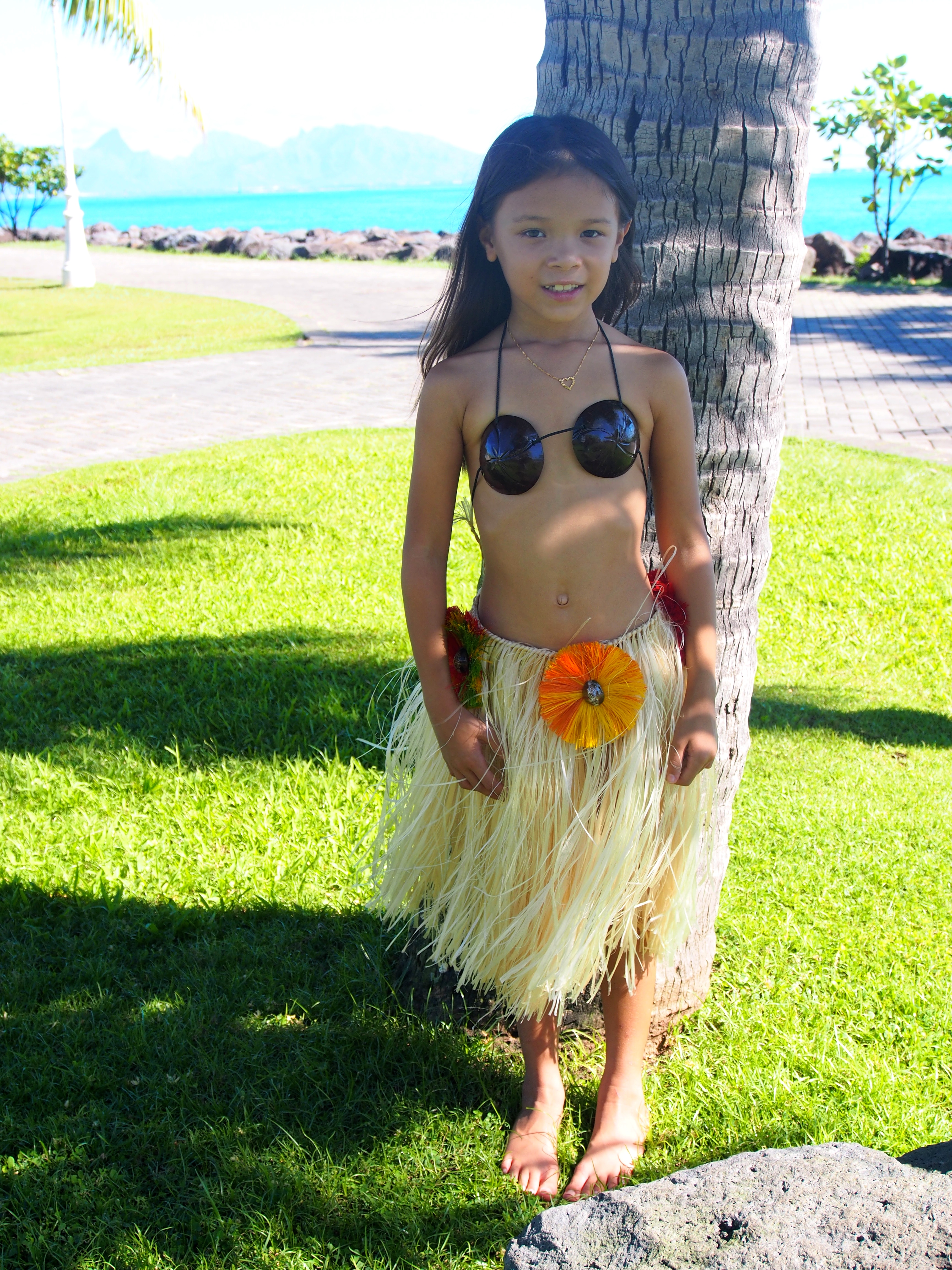
I loved playing with my friends Amia and Alina from Family Circus, Mathias and Luke from Bob The Cat, Ivan from Javelot, and Collie. Collie was a dog, Steven was a duckling, and I met a piglet who loved to eat coconuts in Fiji. In Mexico there was a place called Paradise Village. It had two pools and three water slides. Then we did the crossing and went to French Polynesia. In Tonga we swam with whales. In Fiji we played with a nice swing. It was my best year!
Taken in Tahiti
Jim:
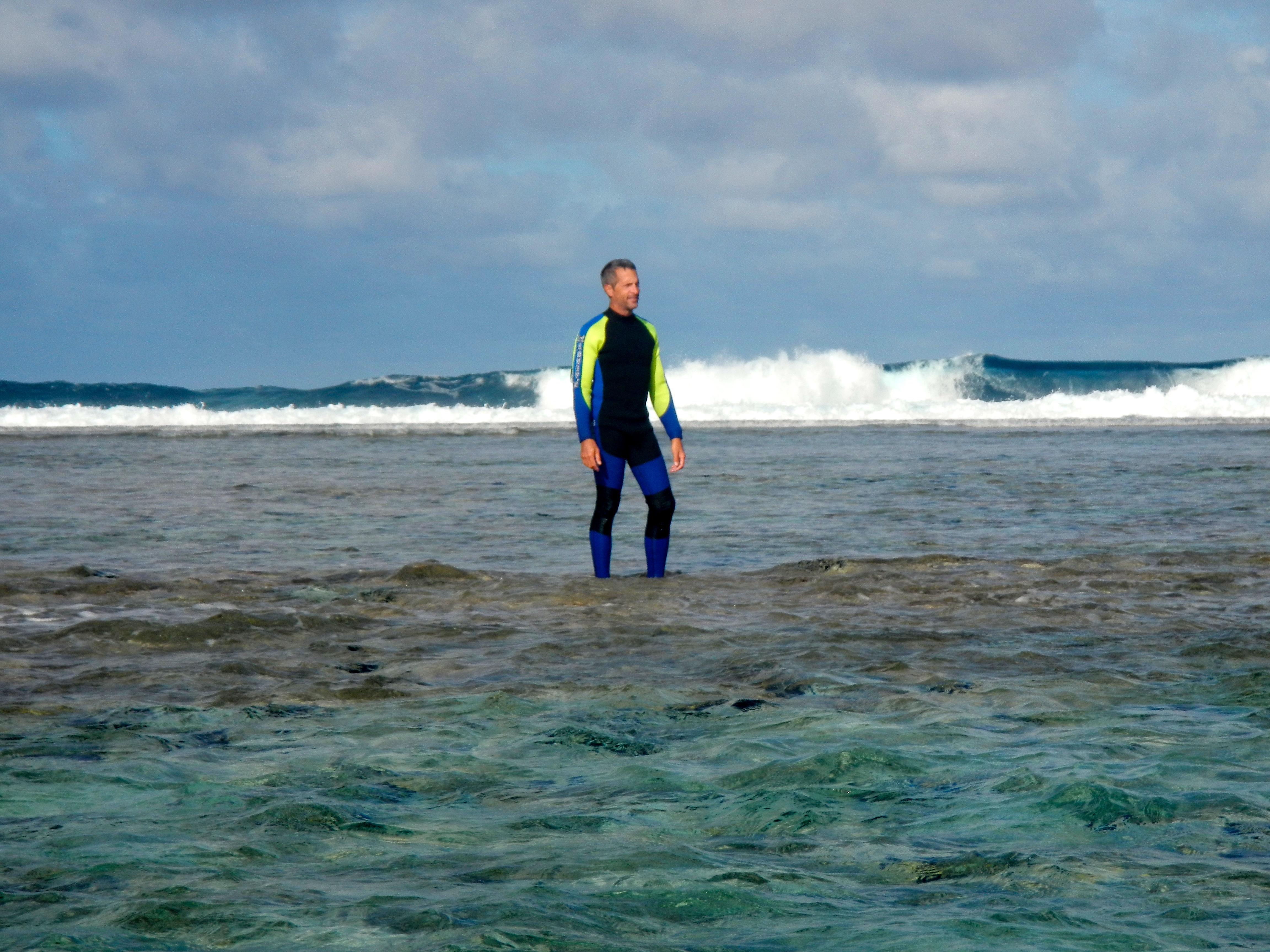
I have so many great memories of our trip down the west coast of the US, up the Sea of Cortez and down the west coast of Mexico, and across the South Pacific. Each area was a new experience with different cultures, languages, food, and scenery. It’s hard to pick a favorite place, but I could think of a favorite thing about each place: sailing under the Golden Gate bridge, cruising the California coast with my dad, swimming with whale sharks near La Paz, eating at the street loncherias in Mazatlan, hanging out with friends in Zihuatanejo, the music scene in La Cruz, the 23-day crossing and making landfall in the Marquesas, scuba diving in Rangiroa, the markets in Papeete, playing ukulele in Huahini, seeing the heiva festival in Bora Bora, buying a Tahitian uke in Rarotonga, standing on Beveridge Reef, exploring the caves and chasms of Niue, swimming with humpback whales in Tonga, and spending time in small villages in Fiji. The beaches and natural beauty, the friendships we made with other cruisers along the way, and the friendliness and generosity of natives will be remembered long after our trip. I’m thankful that Apropos protected us during the 10,000 miles of ocean sailing with only minor breakages. Seeing Jacintha grow and learn on our floating home for a year, even during some difficult passages, was truly amazing. I’m grateful we got to do this at this stage of our lives and hope to do it again sometime in the future!
Taken at Beveridge Reef
Karen: (see next blog post)
Trip Stats:
Distance Traveled: 9,925 nautical miles
Length of Trip: 13 months
Countries Visited: 6 (Mexico, French Polynesia, Cook Islands, Niue, Tonga, Fiji)
Islands Visited: 32
Diesel Fuel Consumed: 612 gallons
Engine Hours: 766 (0.8 GPH)
Longest Passage: 2280 nautical miles in 23 days (Puerto Vallarta, MX to Fatu Hiva, Marquesas)
Quantity of Water Desalinated: 1,958 gallons
Fish Caught: about 12
Groundings: 1 (sand bottom near La Paz, Mexico)
Equipment Failures: Garmin chartplotter (died), wind vane control lines (chafe), dinghy oar (smashed while docked), Racor diesel filter bowl (cracked), VHF cockpit mic (corrosion), Galley stove ignitor (failed),BBQ grill gas regulator (failed), Diesel tank fill hoses (had to replace in San Francisco), wind vane wheel drum locking mechanism (broken weld), wind van control line blocks (broken weld)
What We Missed:
Some Favorite Foods–Sushi, dumplings, salmon
Good coffee–I drank mostly instant coffee on the boat.
Hot showers–The solar shower bags worked ok but sometimes weren’t warm enough and hard to use on a rolling boat, most marina showers were cold and dirty.
Pack less clothing–There were large zip-locked bags of clothing that never even got opened.
Wind Generator–Our 500W of solar power wasn’t enough to keep our batteries happy. A wind generator would have made a great complement to solar since many of our anchorages in the south pacific were breezy.
What Worked Well:
Fleming Self-Steering Wind Vane–Aside from a few minor issues, our wind vane (Ian) was worth his weight in gold!
Spectra Water Maker–Made the trip much more comfortable by not having to lug water in jerry jugs. It just worked with no problems!
Dickinson Galley Stove & Oven–Used daily for boiling water for coffee & tea, made many pizzas, crepes, stews, noodles, etc. The electronic ignitor failed, but a lighter worked well.
Forespar Whisker Pole–An addition we made in San Diego, the whisker pole was invaluable for downwind sailing. A little bit difficult to set up and take down (takes 2 people), once up it allowed us to sail wing on wing with either the main or mizzen.
Lock-N-Lock Containers–Great for organizing food in the refrigerator, dry food storage, small electronics, etc.
Glacier Bay Refrigeration–I was worried about the 10-year old compressor failing, but it survived. Even though it was our biggest power draw, it kept our food and beer cold.
What Didn’t Work Well:
Freezer–The boat freezer cycled way too much and drew too much power from the batteries. We ended up shutting it down in Mexico and replaced it with a portable Dometic freezer.
House Batteries–Our 660AHr AGM house batteries were already 6 years old when we left on the trip. During long distance cruising, the high energy demands from refrigeration, laptops, and navigation electronics are hard on batteries. Apropos is a 120V boat, so the last time we plugged into shore power was in Mexico since the South Pacific uses 240V. Also marina docks are few and far between in the South Pacific. For 6 months we relied on solar panels, the engine alternator, and the Honda generator to charge the batteries, so they never got fully charged. Batteries go through 3 phases of charge–bulk, accept, float. The bulk and accept stages get the batteries to 80% charge, then the float stage takes many hours for the batteries to reach 100%. Therefore, it’s not economical to run the engine or generator for so many hours to get the batteries back up to 100%. When the boat was in the pit at Vuda Marina in Fiji, I borrowed a 240V to 120V transformer and charged the batteries overnight to 100%. I can’t say for sure whether the batteries are the problem or if it’s the way they were used and charged.
Final Week
Karen and Jacintha flew to Sydney while I remained in Fiji for another week to finish prepping the boat. I had a very busy 7 days doing most of the work myself and finding more tasks that needed done along the way. The remaining tasks to be completed (from the last blog post) mostly got done:
Change generator oil, STORE BELOW.
Remove BBQ grill, STORE BELOW.
Remove dodger and bimini canvas, STORE BELOW.
Remove jacklines.
Remove solar panels and STORE BELOW.
Run trace lines through masts and remove halyards.
Polish and wax hull.
Fix bilge pump leak.
Fix gelcoat dings, bubbles, and scratches (hire out).
The hull polishing/waxing didn’t get done because of the delay in the gelcoat repairs (see below), so the workers promised to do that after I left. Some of the stainless steel polishing got done and the rest will be done when I return.
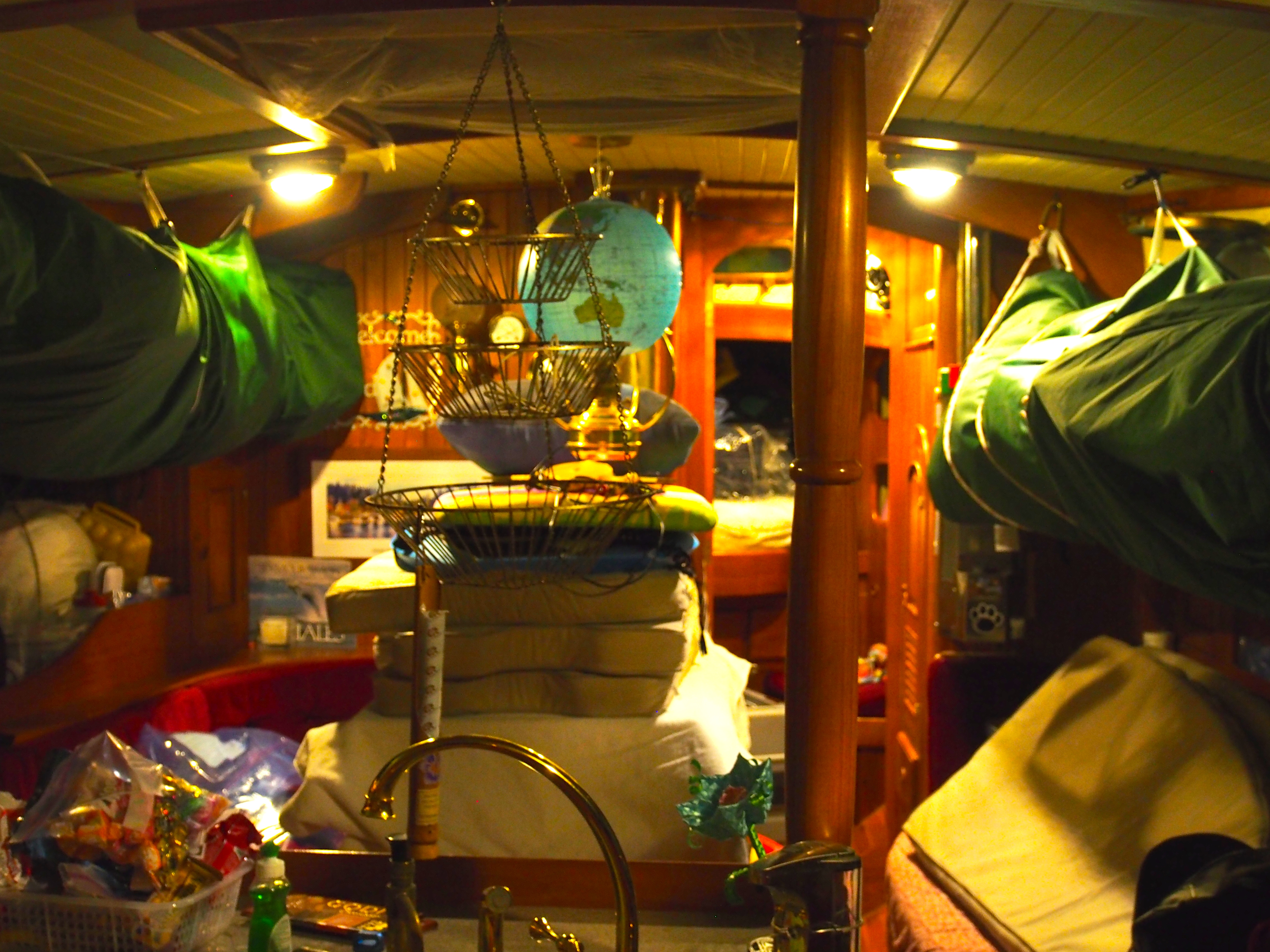
Crowded cabin–4 sails, 4 solar panels, cockpit cushions, generator, dinghy, outboard motor, dodger & bimini canvas, lines…..and much more!Above deck cyclone-ready–4 sails, solar panels, dodger & bimini canvas stripped and stowed below, anything loose put away.
Gelcoat Repairs
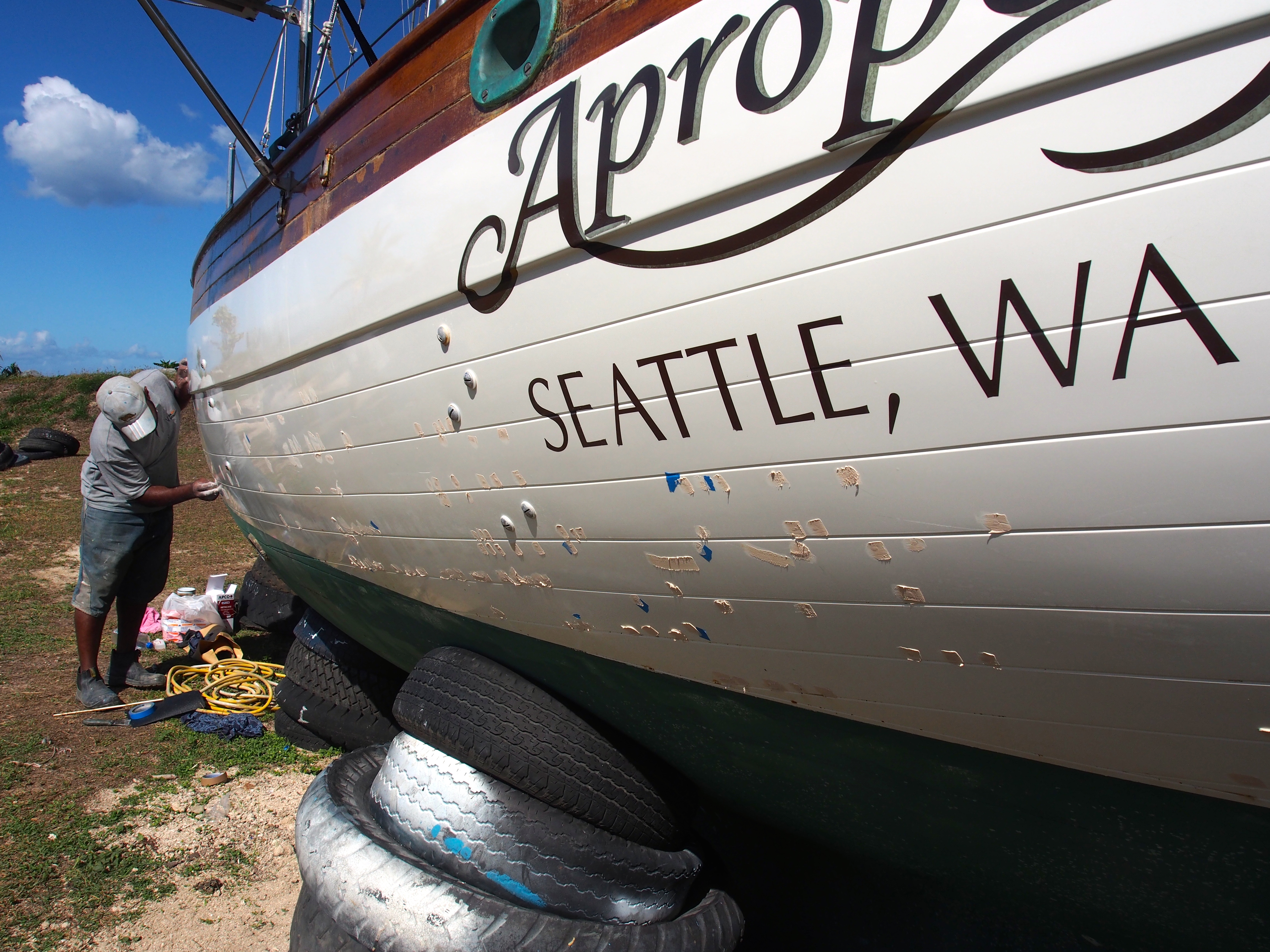
Ten years worth of docking and maneuvering and hoisting the dinghy into and out of the water, along with the new bubbles caused by the tropical heat, had all taken a toll on the once pristine gelcoat on the hull. I decided to have the repairs taken care while Apropos was in the pit and before I flew out. They first opened up the bubbles and found they were only in the gelcoat, not the fiberglass, so that was good news. These were mostly near the waterline and for some reason the majority were on the port side. After grinding and filling all the defects with a poly filler, they hand-sanded to get a smooth surface. Next they tinted the gelcoat and sprayed or brushed it on. After drying for 24 hours, they wet-sanded the gelcoat to blend in the edges. Unfortunately, the new gelcoat turned out to be way too bright which made all the repairs stand out. Apparently the gelcoat was not tinted enough for a good match, and the only way to fix it now is to gelcoat or paint the entire hull! My flight was leaving in less than 24 hours so there was not much I could do about it. I’ll have to have it re-done either when I return to Fiji or when I get the boat back to Seattle.
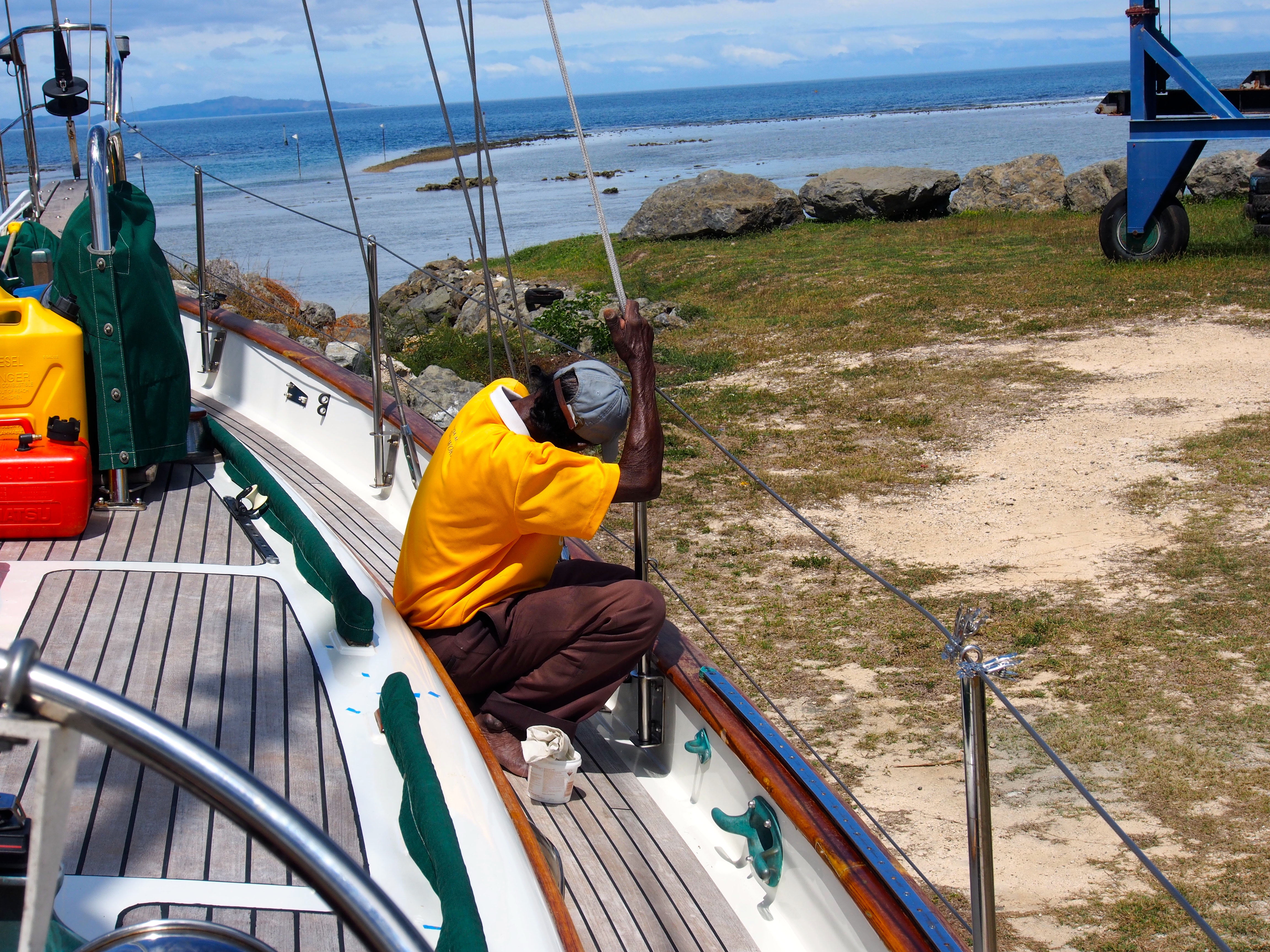
At the marina, there were day-laborers for hire at an hourly rate of $6Fiji (only $3US), so I hired Bruce to polish some of the stainless steel. There’s a lot of stainless steel on Apropos–stanchions, bowsprit, turnbuckles, pushpit, wind vane, etc. And to think I almost had it done in Mexico for $200US. He did a great job and got about 1/3 of it polished and it only cost $18US, talk about cheap labor!
Finally, I hired Moses as a caretaker of Apropos while I’m gone for 6-1/2 months. He will stop by once a week and open the hatches to air out the cabin, wash the decks, check the battery condition, and inform me of any problems.
After grinding the gelcoat bubbles and scratches, they filled them with a poly fillerAfter sanding the poly fillerSpraying on the gelcoatWet-sanding the new gelcoatBruce polishing some of the stainless steel
Some Final Thoughts on Fiji
We enjoyed spending over a month in Fiji. The people are so friendly and everyone greets you with a smile and cheery “Bula” (hello). From the remote and poor village of Nasea to the urban area of Lautoka, the Fijians are very welcoming and generous. Some of the best diving and the most beautiful beaches in the South Pacific are in Fiji. The cruising is more challenging here then in other South Pacific islands because of all the reefs and narrow passages, so we were more conservative with our planning and did no overnight passages. We saw and heard about several boats running aground, most escaping with little or no damage, but one that was a total loss.
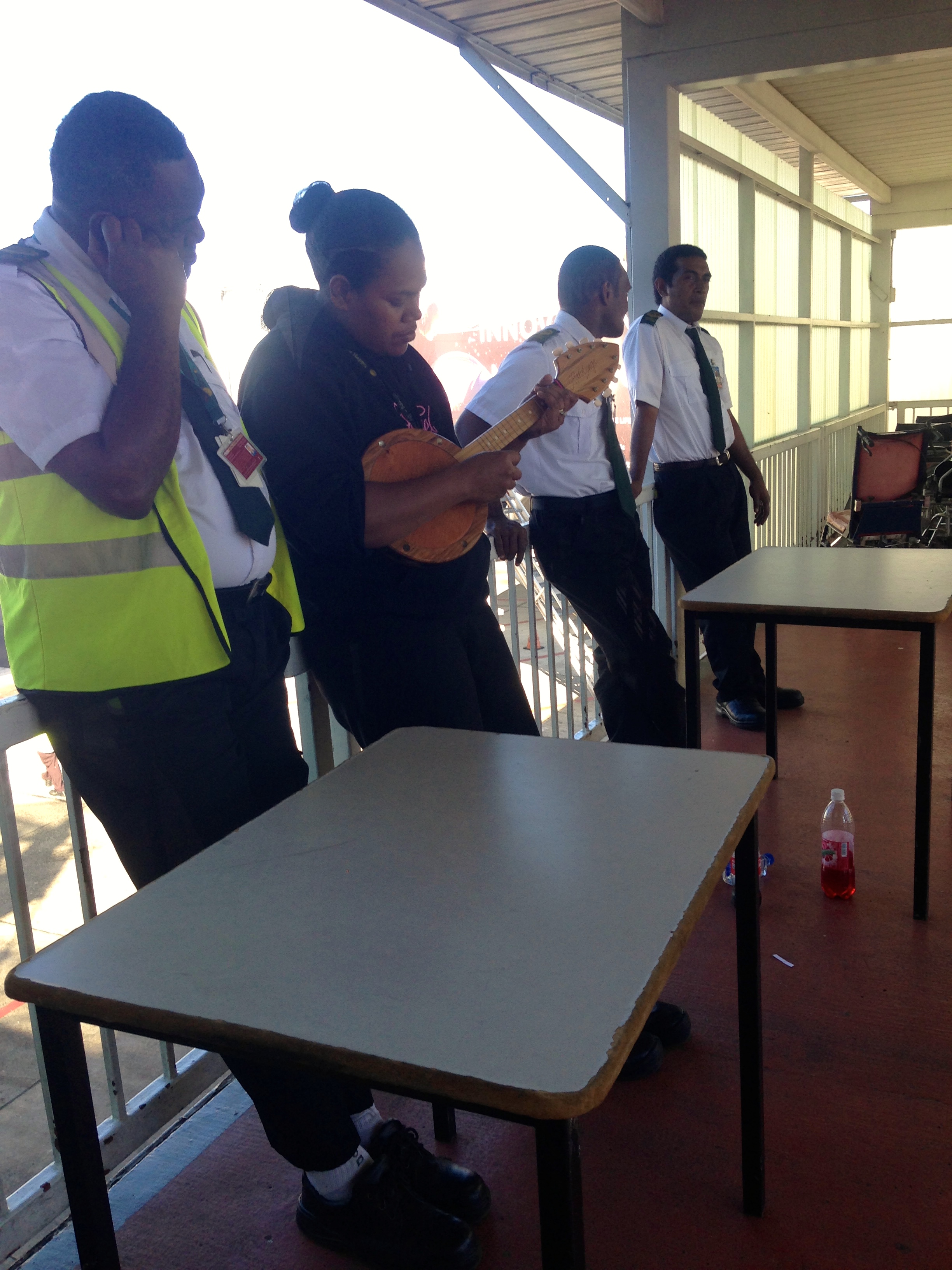
As I was about to step onto the airplane to leave Fiji, an airport employee saw me carrying my ukulele and asked if she could see it. I listened to her play it while finishing my coffee, thinking about how lucky I was to spend so much time in Fiji!
Musket Cove
We ended our year-long cruise with a nice relaxing stay at Musket Cove on Malolo Laila Island. Only 20 miles from Lautoka, we found the anchorage and marina full of yachts waiting for the big regatta coming up in a week. We spent 3 days there enjoying the resort pool and restaurants and for $5, became life-time members of the Musket Cove Yacht Club–the requirement to join is that you must have sailed here from a foreign port!
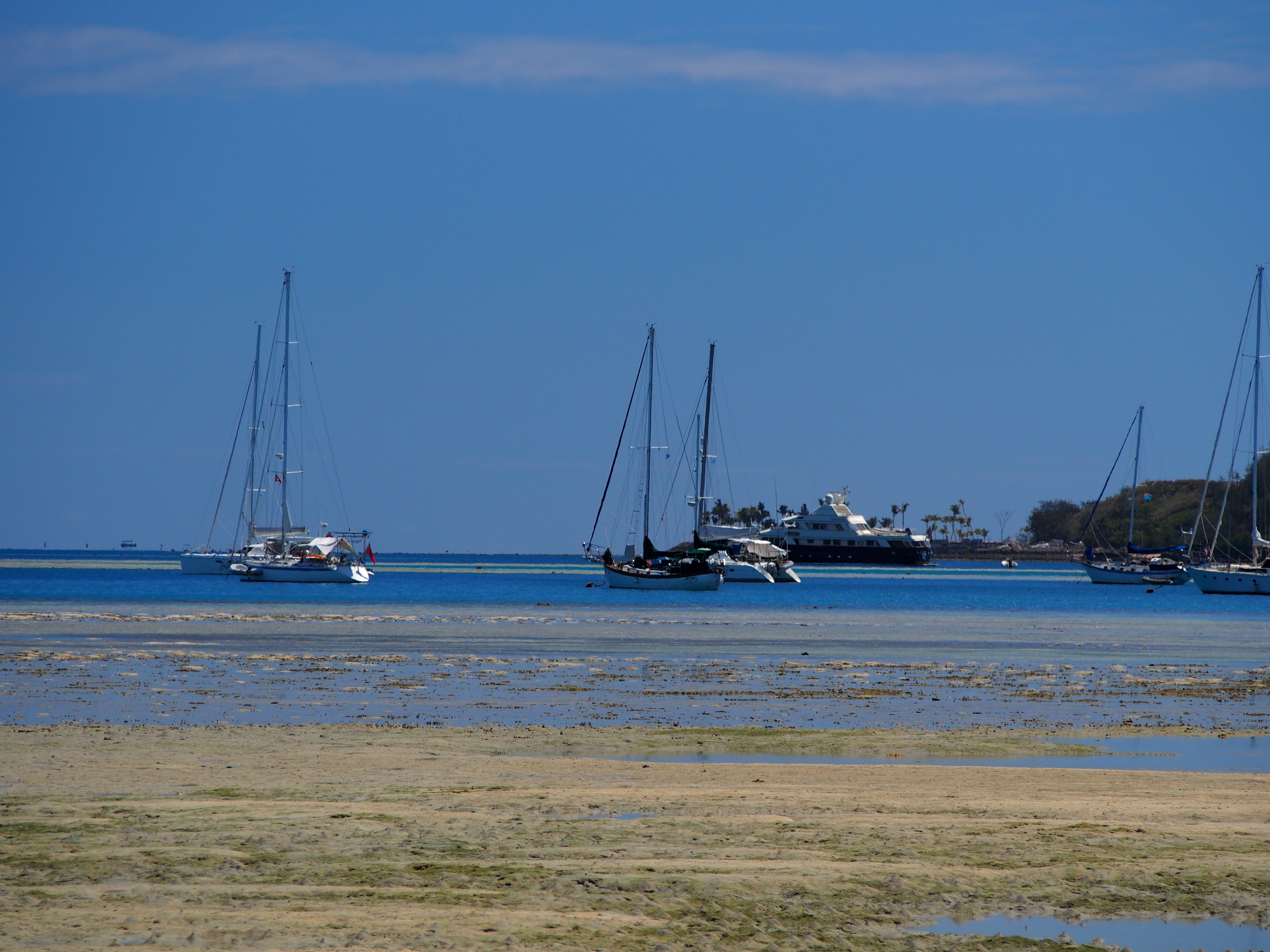
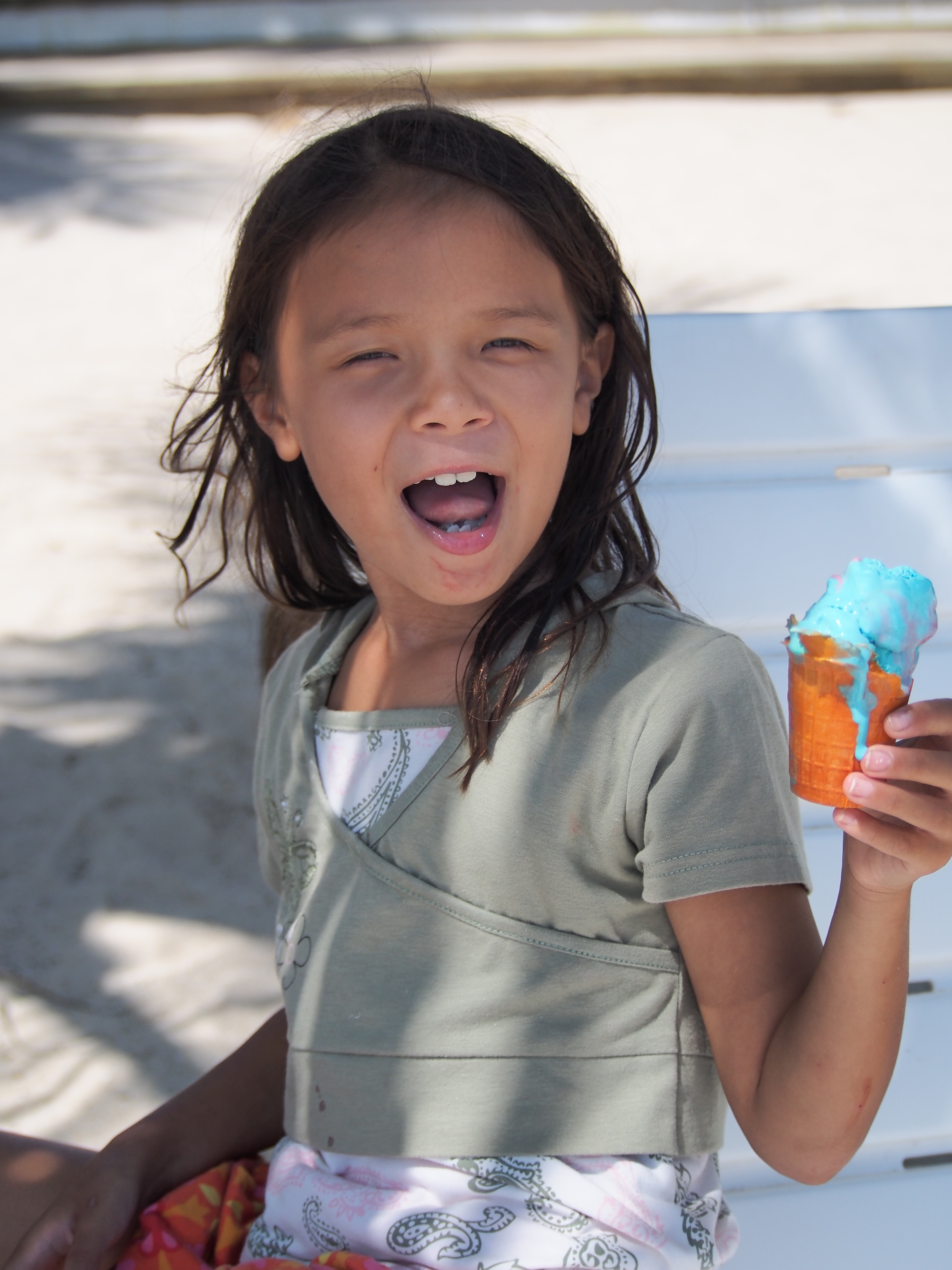
Apropos on a mooring at low tideAhhh, bubble gum flavored ice cream!
Vuda Point Marina
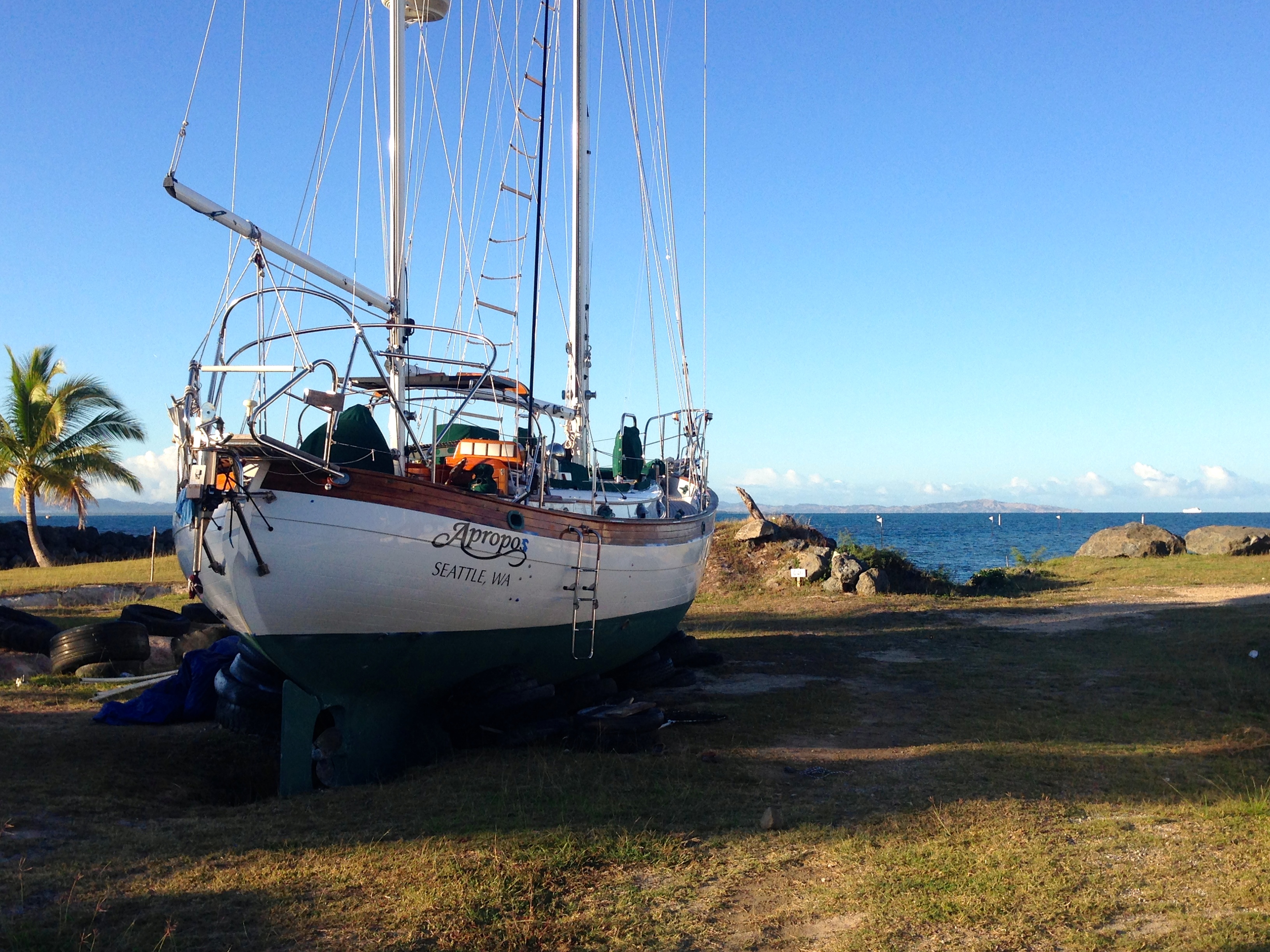
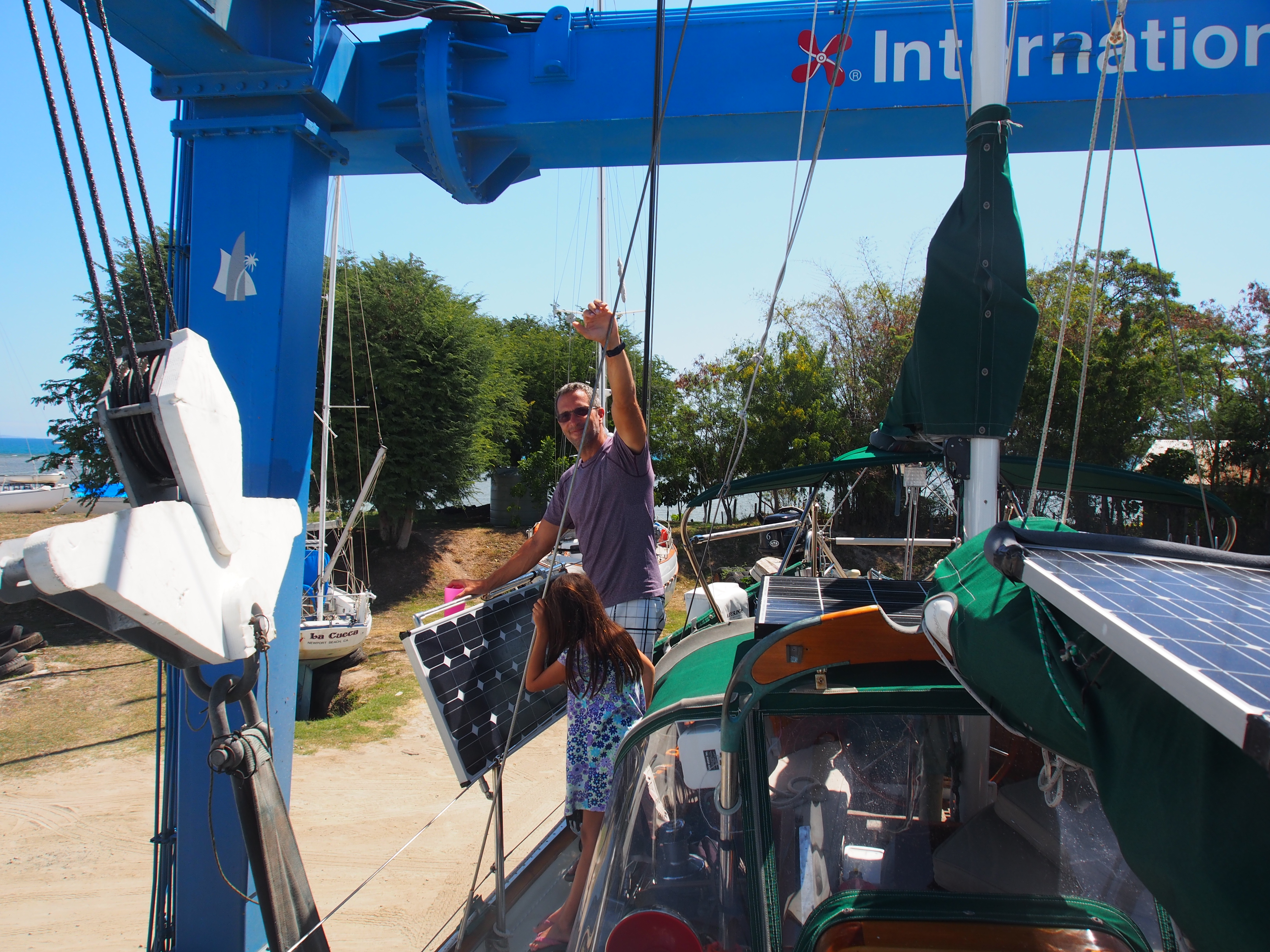
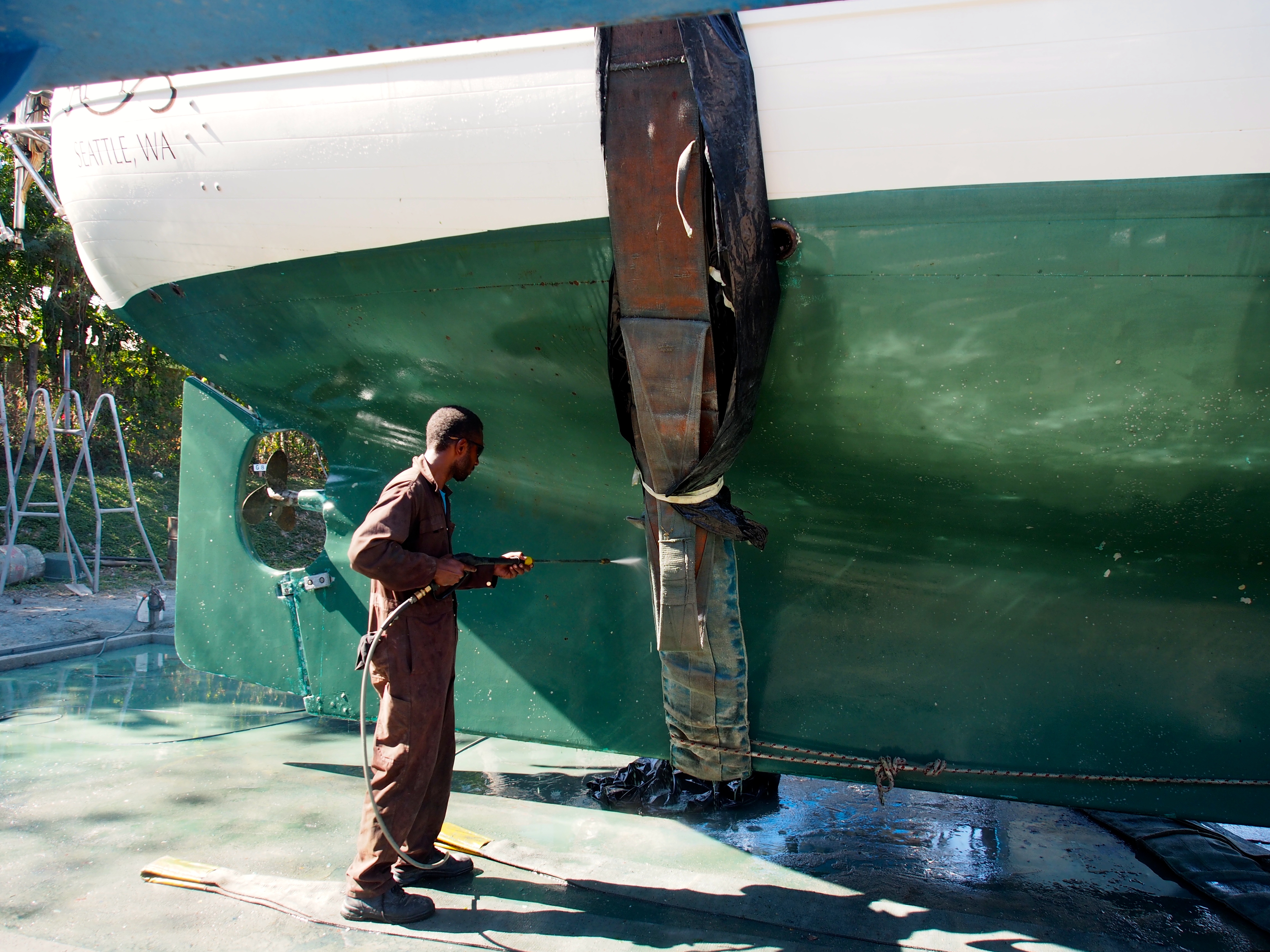
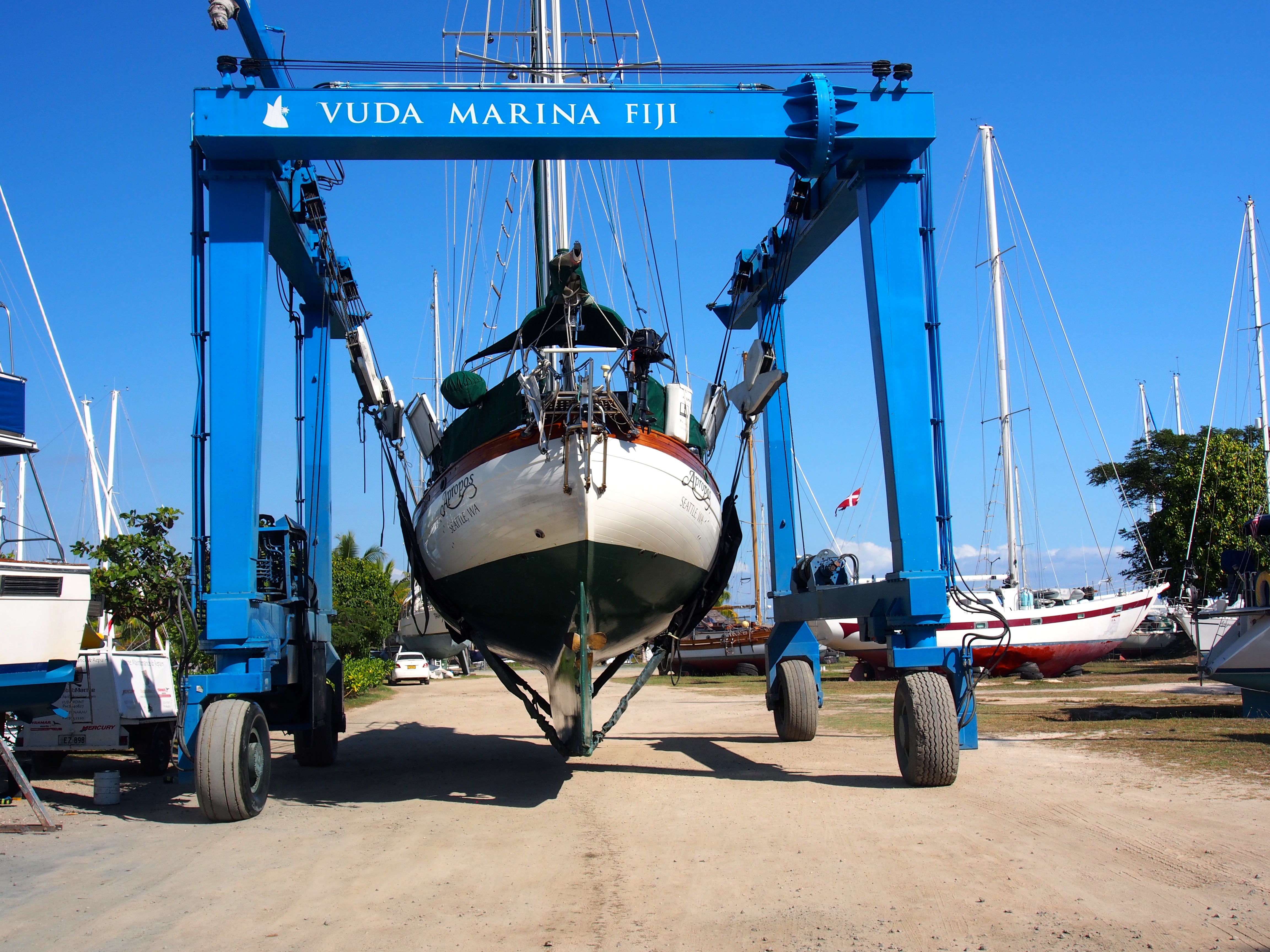
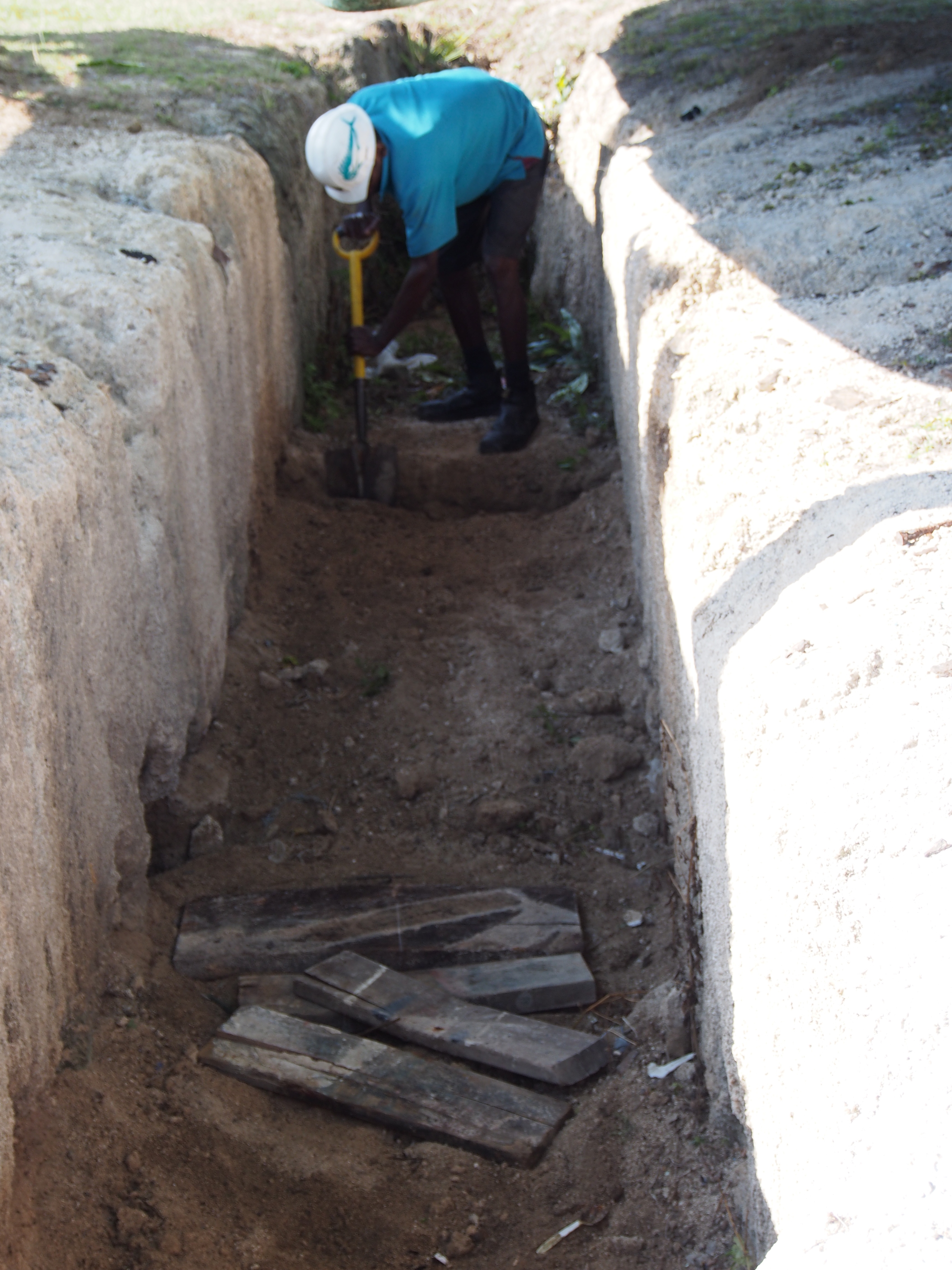
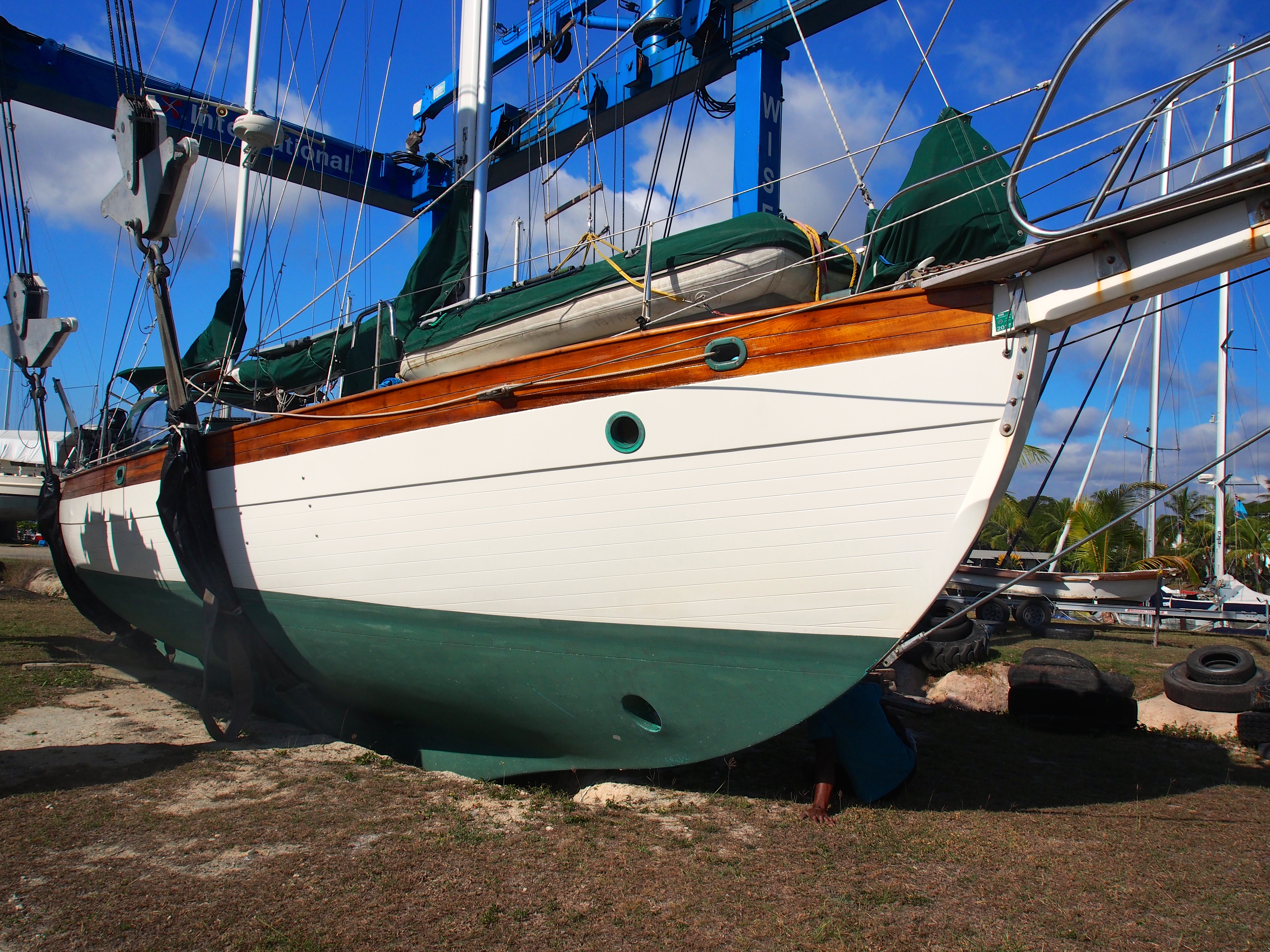
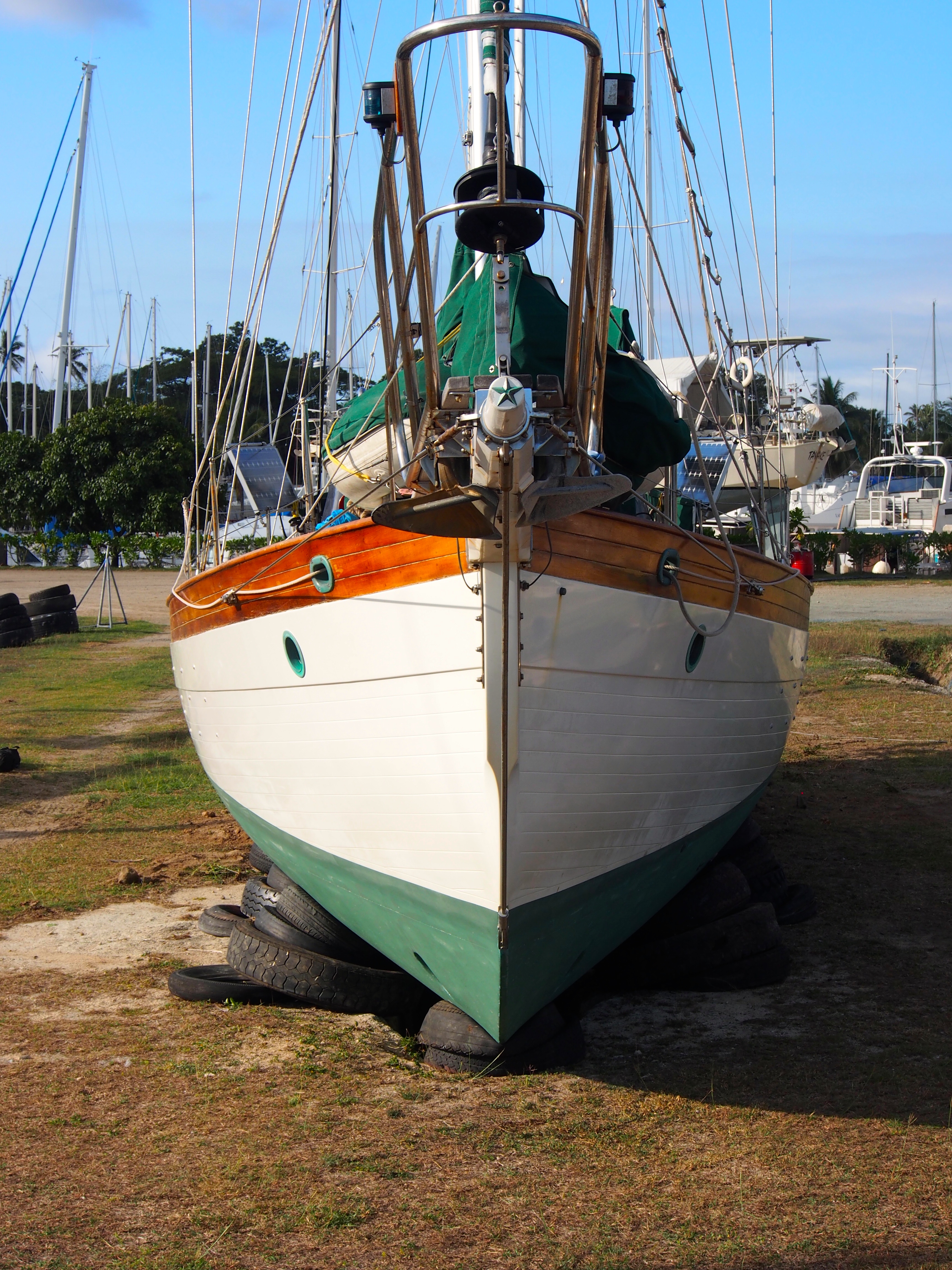
We hauled out Apropos at Vuda Point Marina on September 4, 2015, a little over a year from when we left Seattle. The travel lift took us to the wash-down area and the bottom paint looked better after a good pressure washing (we’ll re-paint the bottom in 6 months before departing Fiji). Next was the drive to pit #40, where Apropos will remain for the cyclone season. The workers were very meticulous with adjusting the tires to keep the boat upright and level. It was a bittersweet moment–on one hand we realize a direct hit from a big cyclone could severely damage Apropos, but on the other hand we are ready for a break from living on a boat and looking forward to visiting Sydney and returning home to Seattle.
Haulout at Vuda MarinaPressure washing the bottomDelivery to the cyclone pitFinal adjustments to the pitApropos being lowered into the cyclone pit A low-tech but effective and proven solution!
Vuda Point Marina
But first, there is a lot of work to do! Not that sailing and maintaining a boat for 10,000 miles is all play, but we did get used to a slower pace of life while visiting lots of cool places and meeting lots of nice people. Now we had a long list of things that needed to get done in a short amount of time. I decided to spend an extra week after Karen and Jacintha fly to Sydney so I could get everything done before leaving Apropos for 6-1/2 months. Here’s the task list (strikethrough denotes completed):
Sort through a year’s worth of stuff that was added on the boat and decide what to keep.
Remove all 4 sails, fold, and STORE BELOW.
Clean, deflate, pack up the dinghy, and STORE BELOW.
Change engine oil and filter.
Empty and clean Racor diesel filter bowls, replace filters.
A common theme in the above tasks is STORE BELOW, the problem is, there is only so much room for storing things below! With the rainy summer season in Fiji approaching, humidity and moisture become an issue. If things are packed too tightly, air flow gets reduced and mold could grow on things. We ended up donating a lot of things (clothing, food, toys, etc) to different people working at the marina. We also filled up 6 duffel bags to carry and check in on our flights out.
With 4 days left before I fly to Sydney to join Karen and Jacintha, 16 of the above tasks are completed. Should be a fun 4 days!
Jacintha’s friend Polly from a liveaboard boat at Vuda Marina