This video was shot off the Washington coast as we approached Cape Flattery. The large following sea is the result from the sudden depth change near the continental shelf.
This video was shot about 1000 nautical miles from Washington. We were sailing close-hauled with all 4 sails (1320 sq ft of sail area).
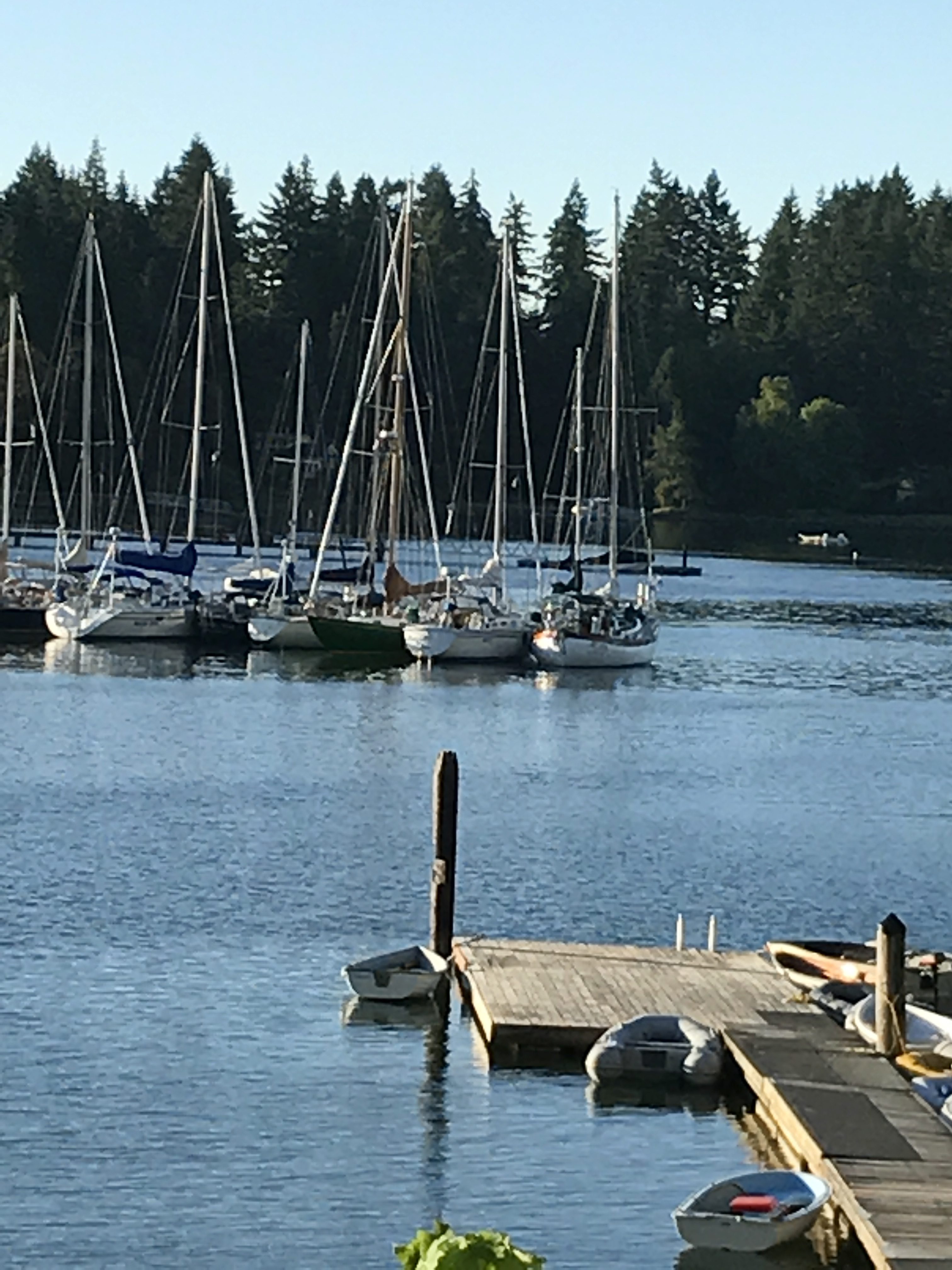
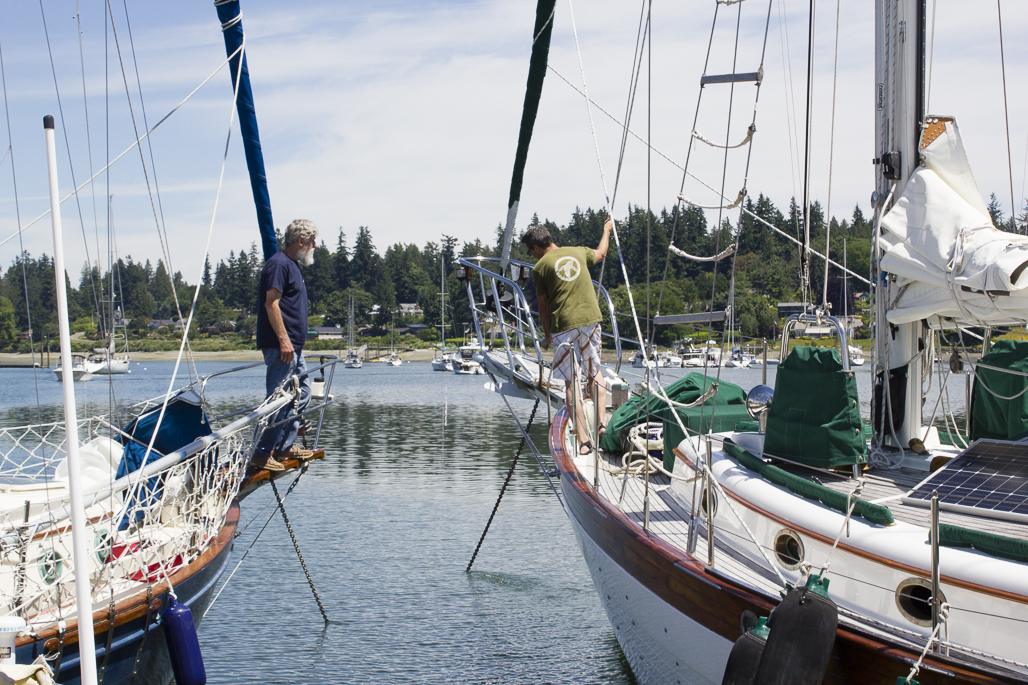
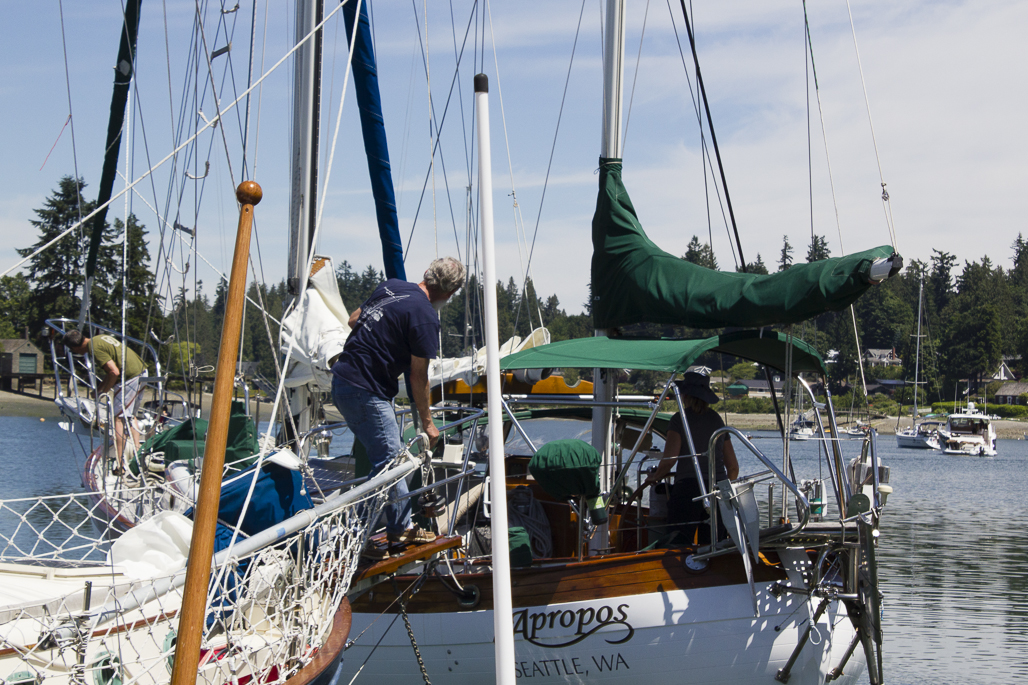
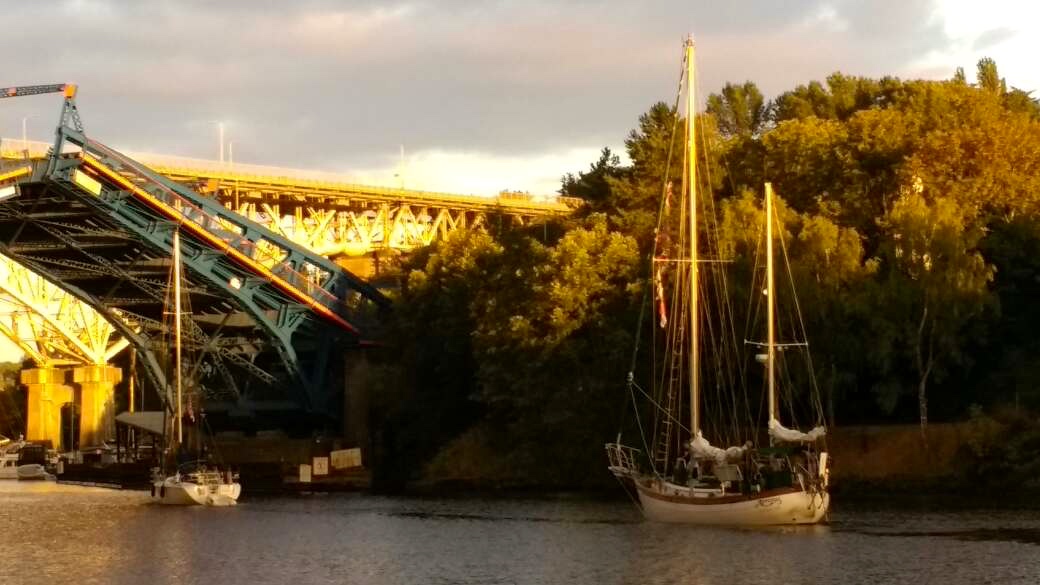
We had a wonderful weekend raft-up with the Puget Sound Cruising Club at Hidden Cove on the north end of Bainbridge Island. Nice northerly winds both Saturday and Sunday crossing Puget Sound. Didn’t get very lucky with the Ballard Locks with 1-hour waits both ways, but at least we were in the small lock.
Raft-up with 12 boats from PSCC
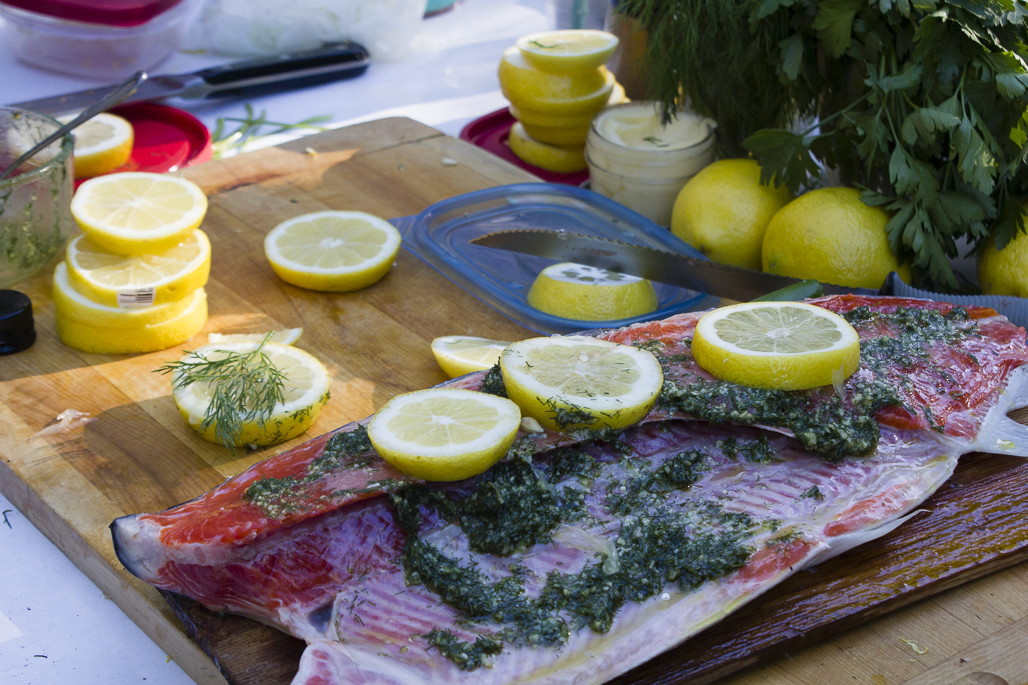
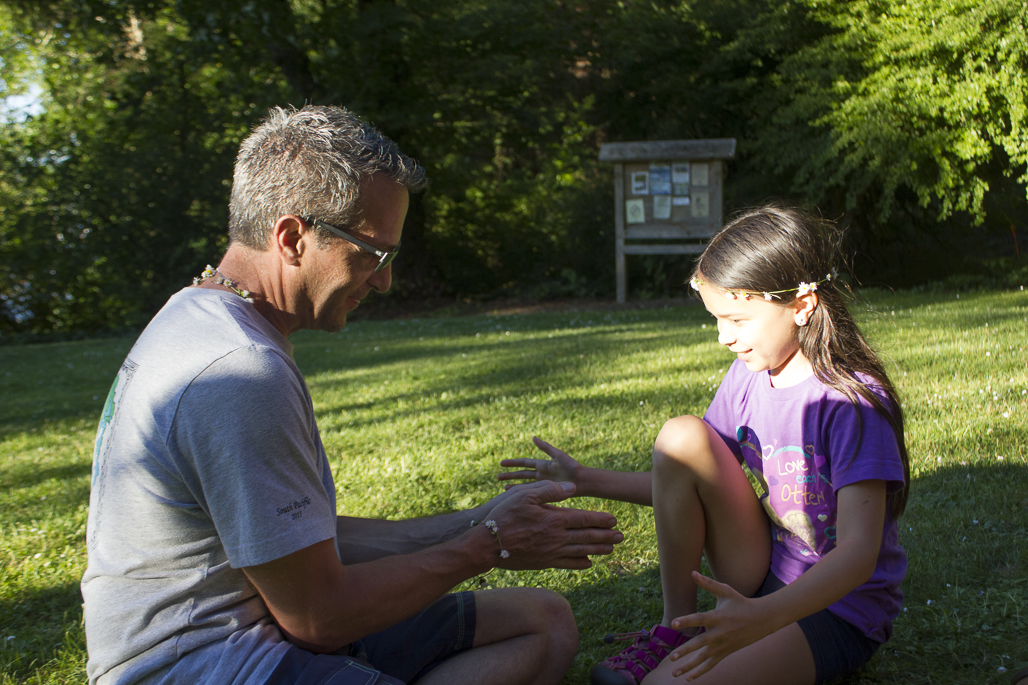
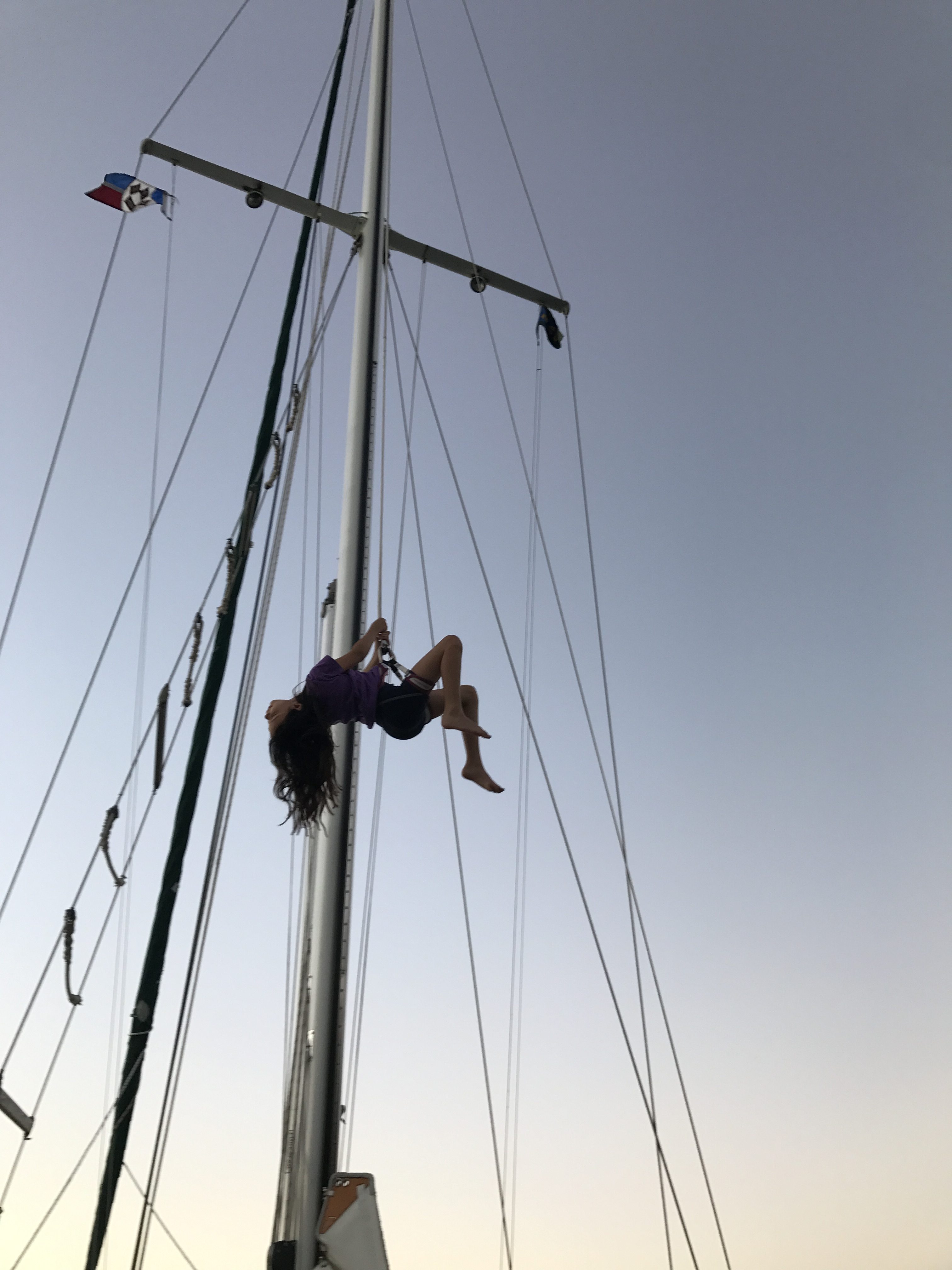
The salmon bake & potluck were great as always. Unfortunately there were no kids Jacintha’s age, but I helped keep her entertained playing games then letting her swing aloft using her climbing harness and a halyard.
Figuring out how to untangle our anchor chains.We eventually were able to up-anchor
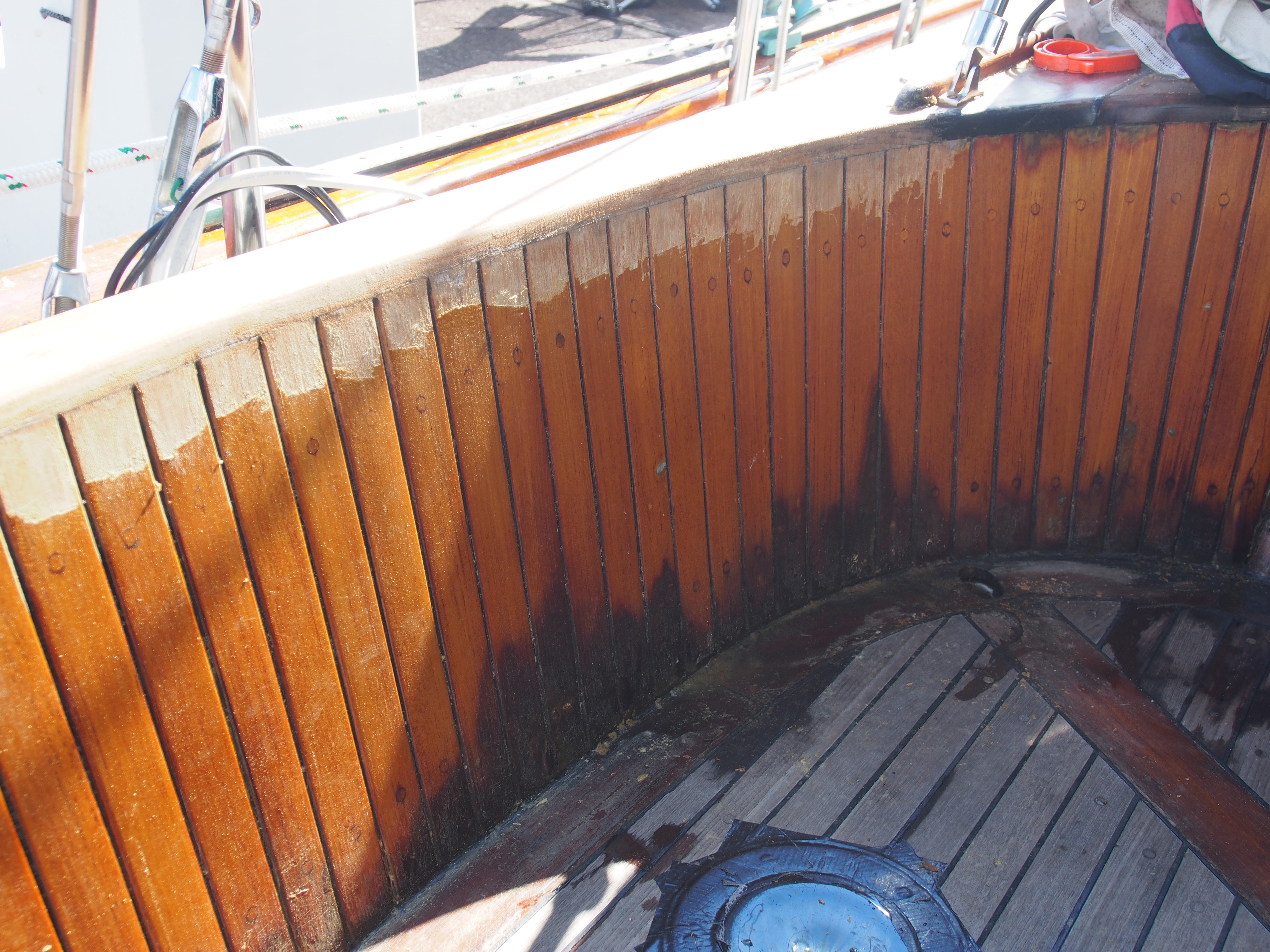
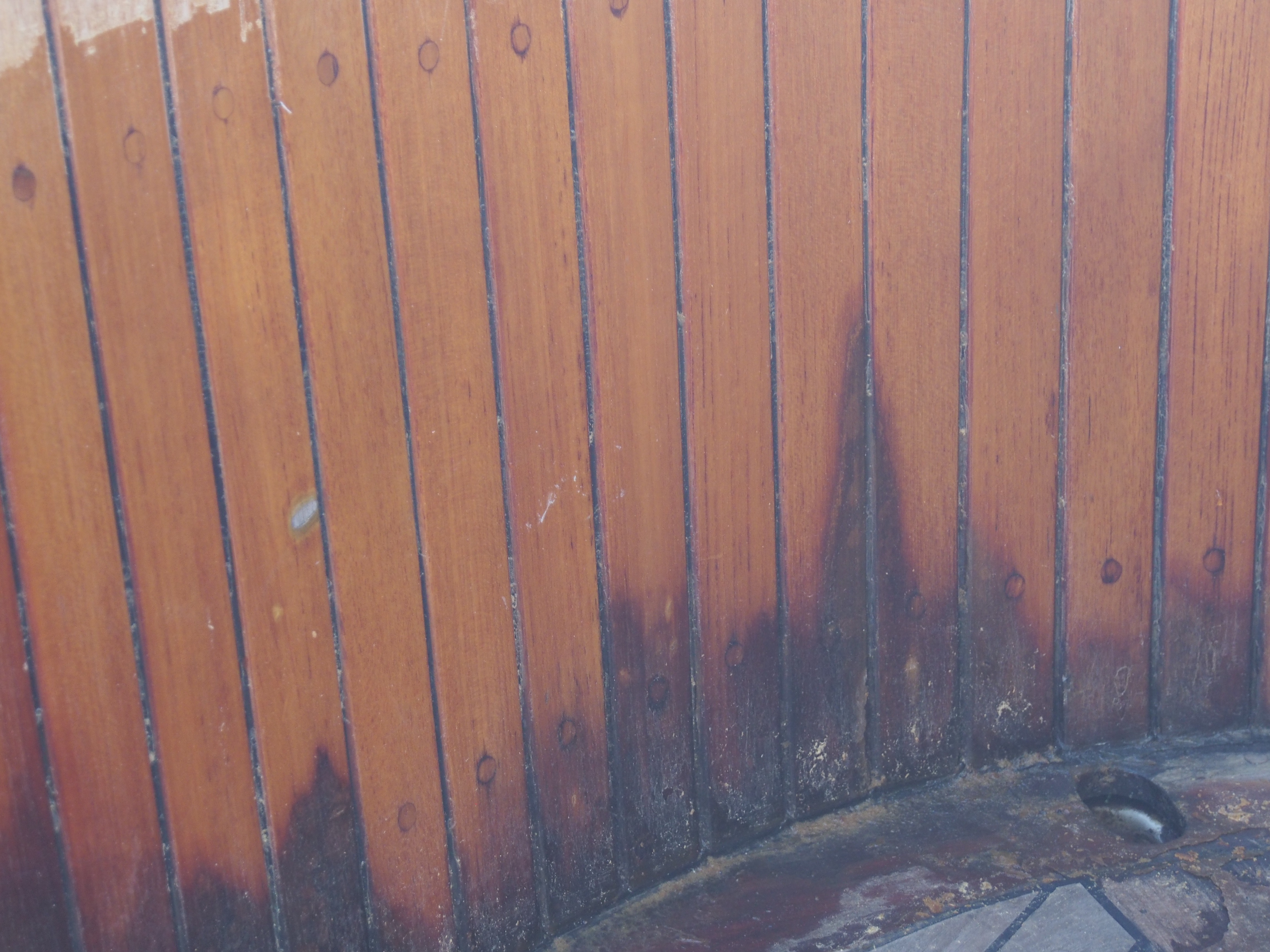
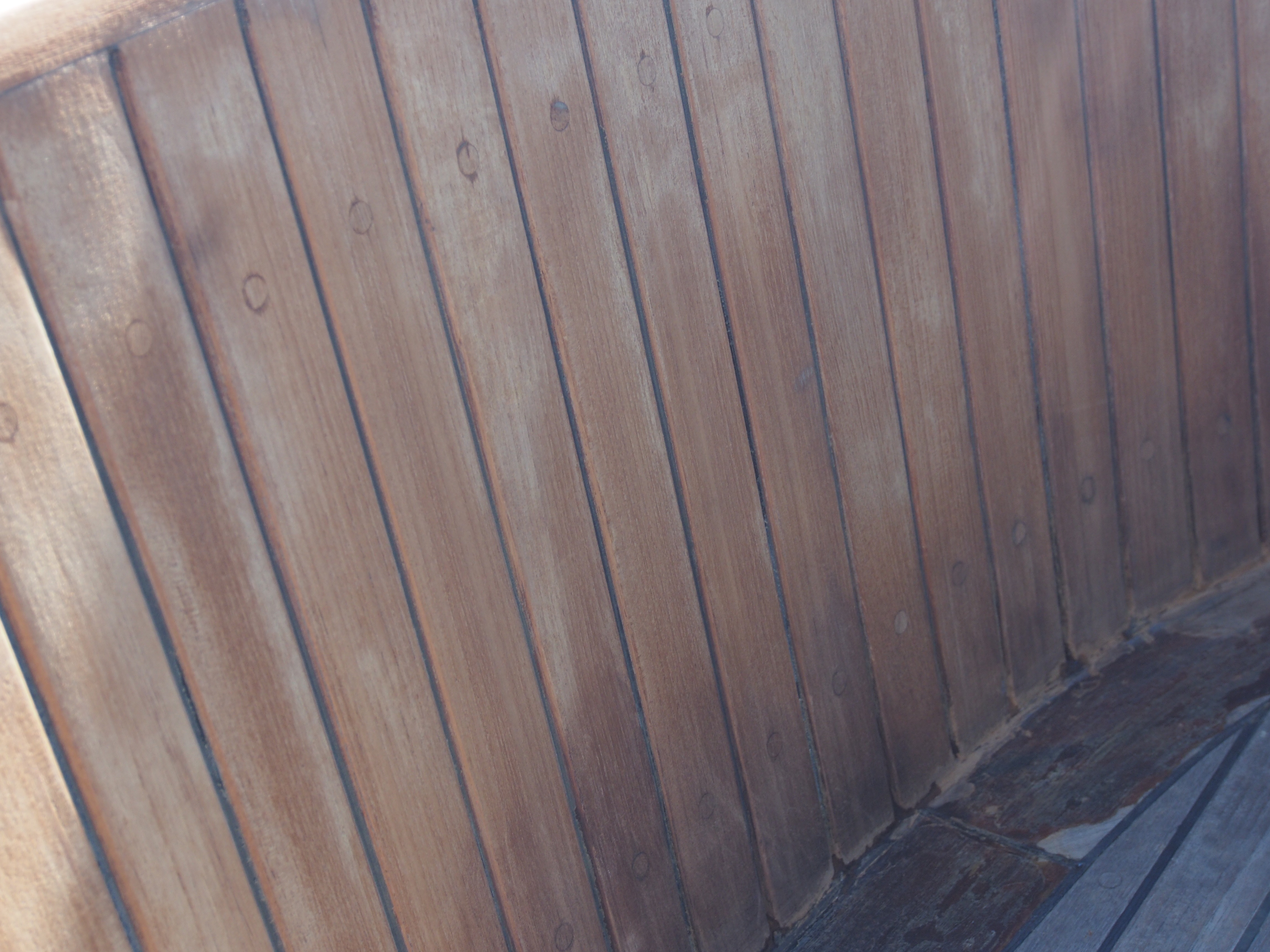
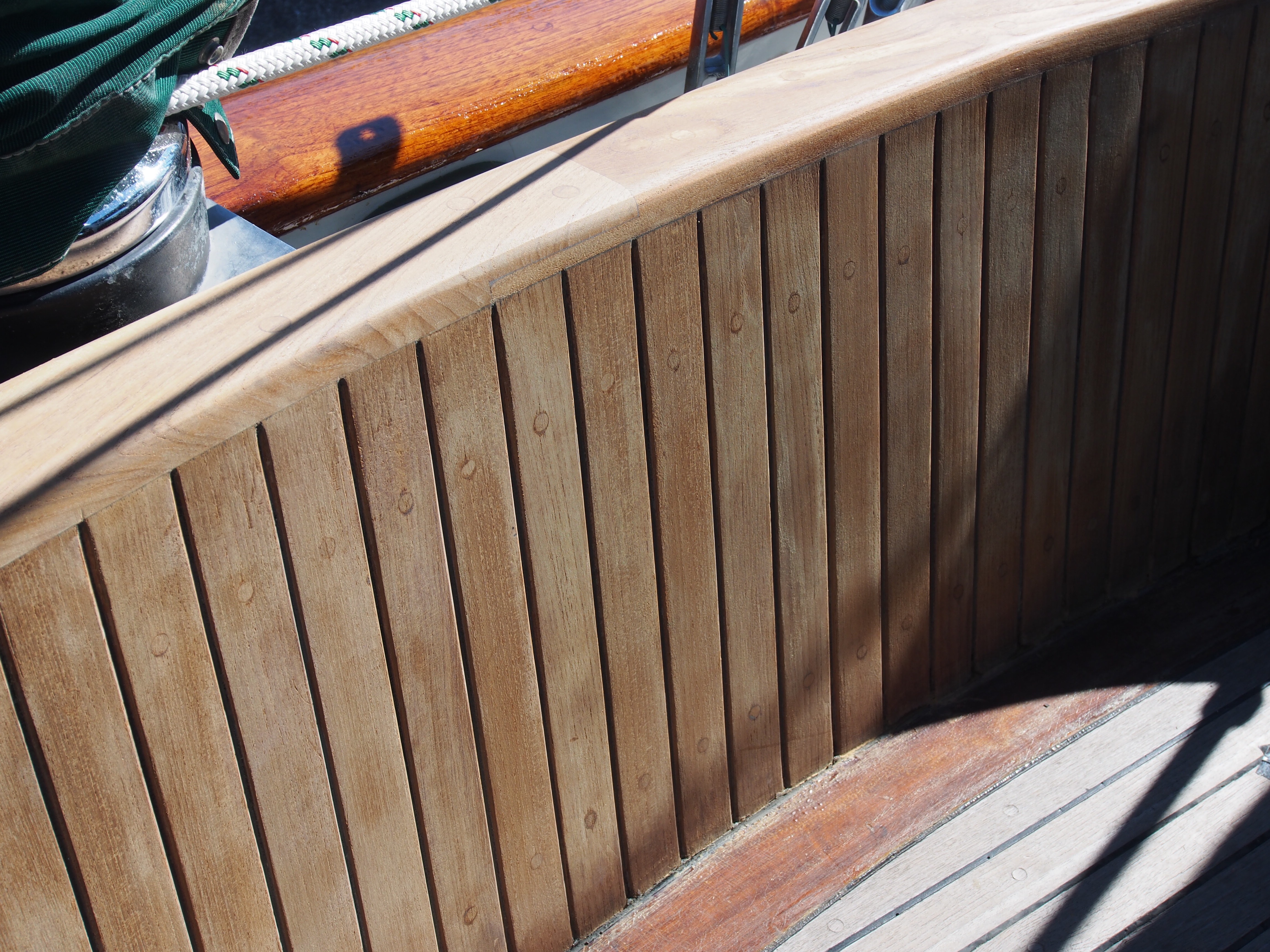
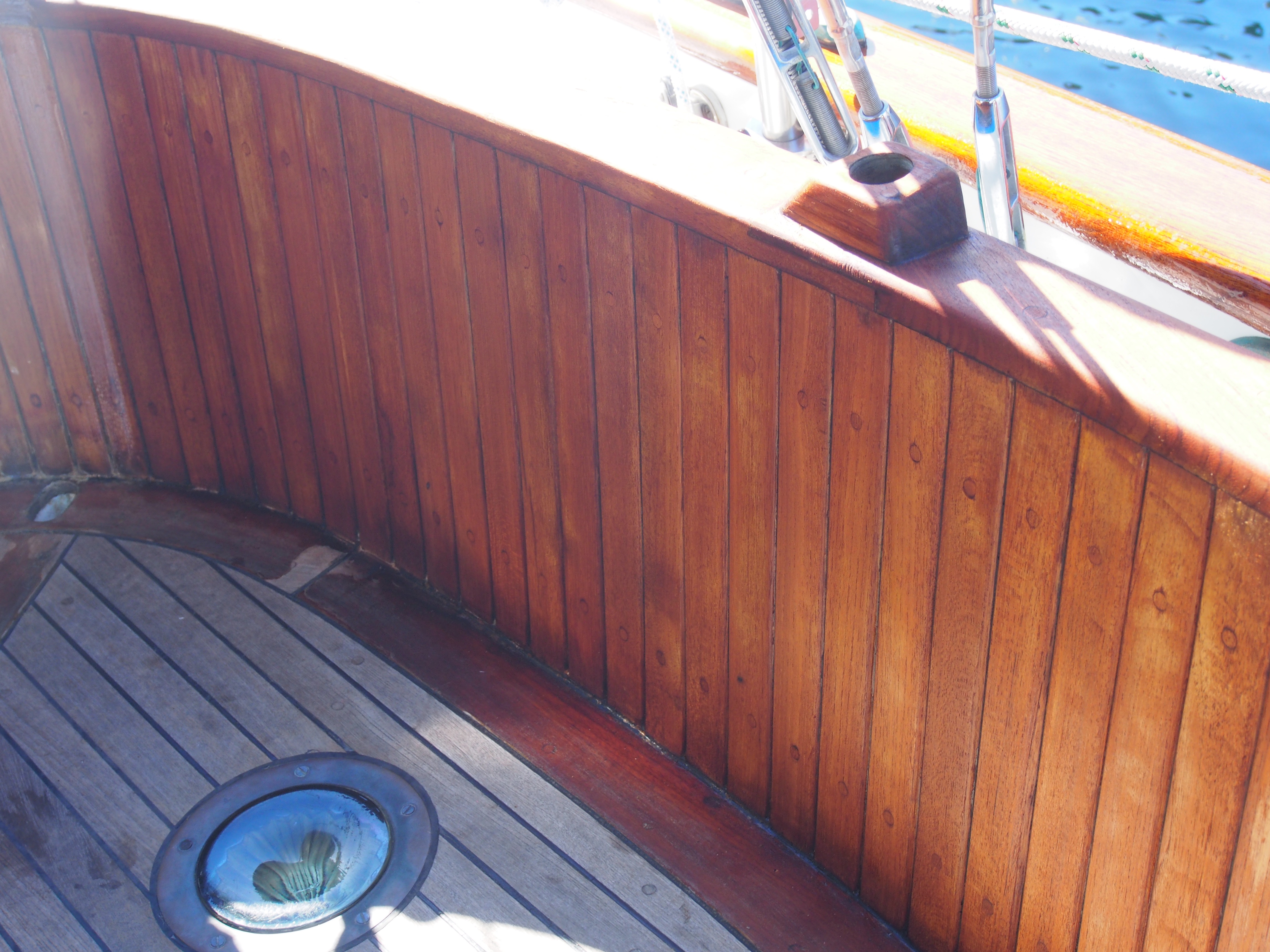
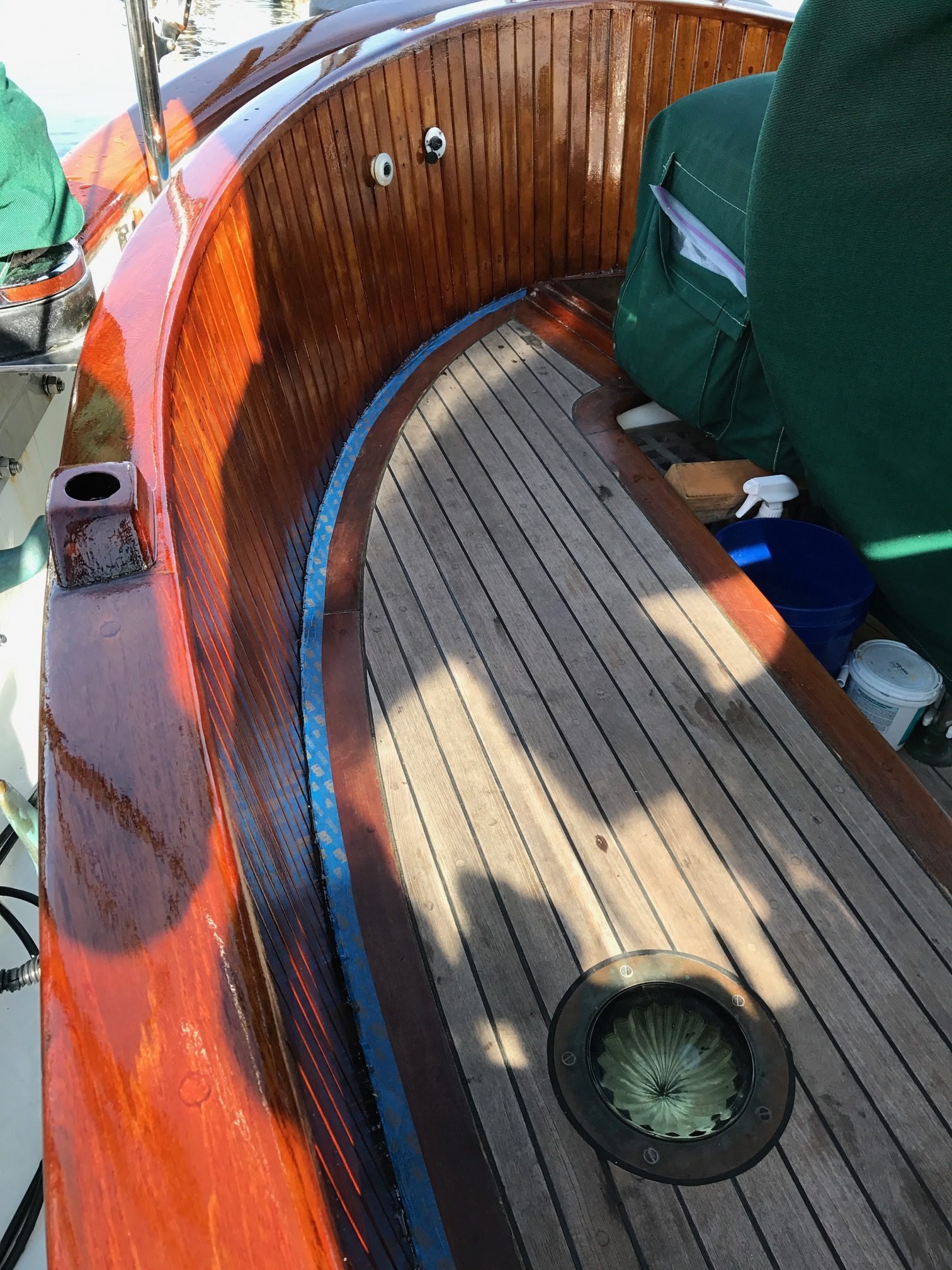
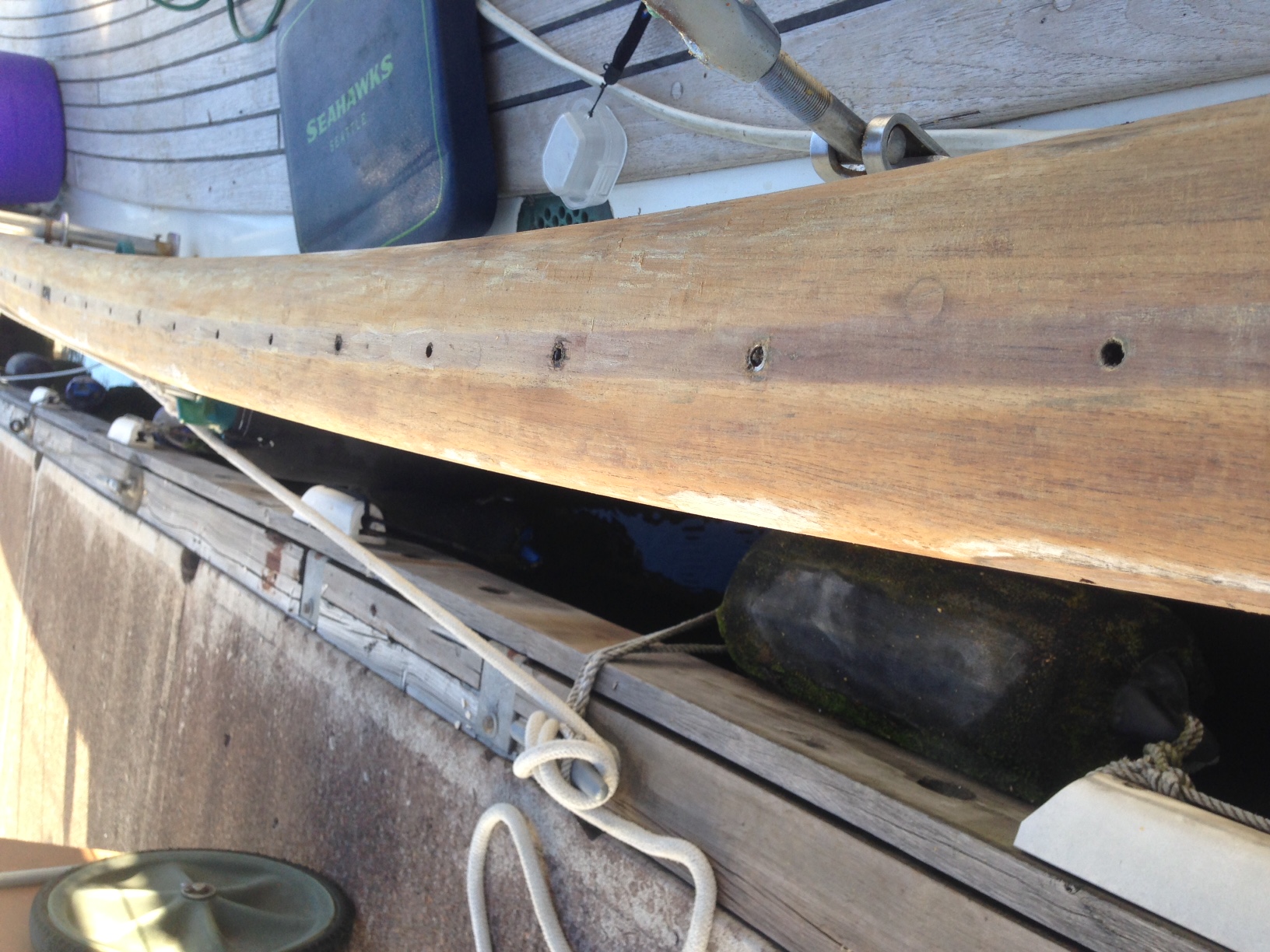
I decided to refinish another section of brightwork during a small window of good weather. As long as I got the section stripped and sanded, applied the primer and 2 coats of Awlwood Clear, the remaining coats could be done as the weather allowed. So in a fury of 3 sunny days, I stripped, sanded, primered, and got 2 coats of clear on the cockpit inner cap rail and the cockpit vertical teak planks (the cockpit horizontal planks will be done later). The lower parts of the vertical planks have been an eyesore for some years due to water wicking under the varnish at the joint between the vertical and horizontal planks.
Removed varnish from cockpit inner cap railDark areas are where water penetrated under the varnishRemoved varnish from cockpit vertical planksAfter final sandingAfter applying Alwood Primer
After the 3 sunny days, it rained in Seattle for almost 2 weeks until we finally got another few days of clear weather, during which time I applied Awlwood Clear coats 3 through 8.
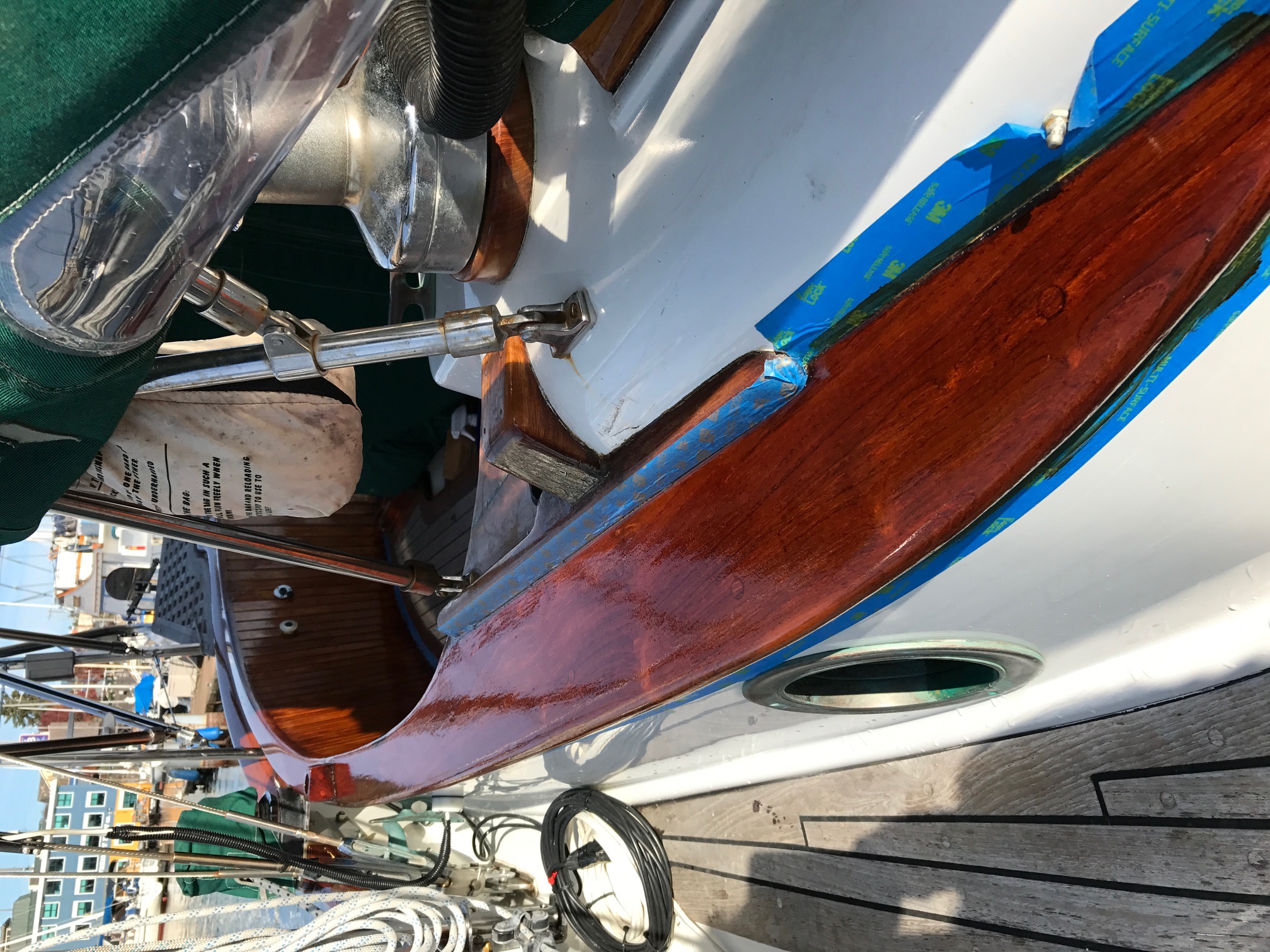
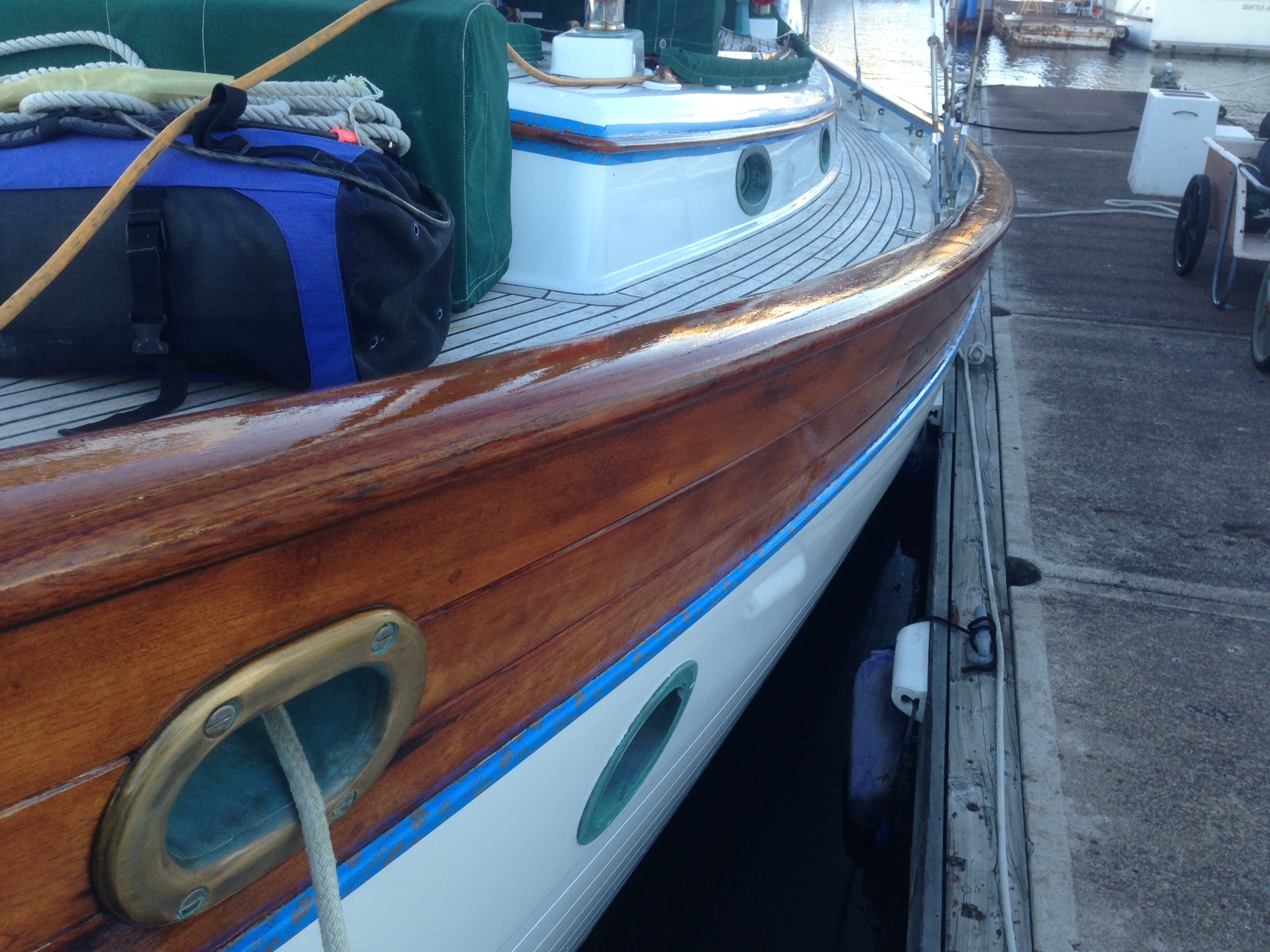
Cockpit combing finished with 8 coats of Awlwood Clear
In my last post, I wrote about how bad Apropos’ teak brightwork looked and how I would have to tackle it “some day”. Well, I decided to get started on it after seeing the long-range weather forecast showing sunny conditions for most of September and into October.
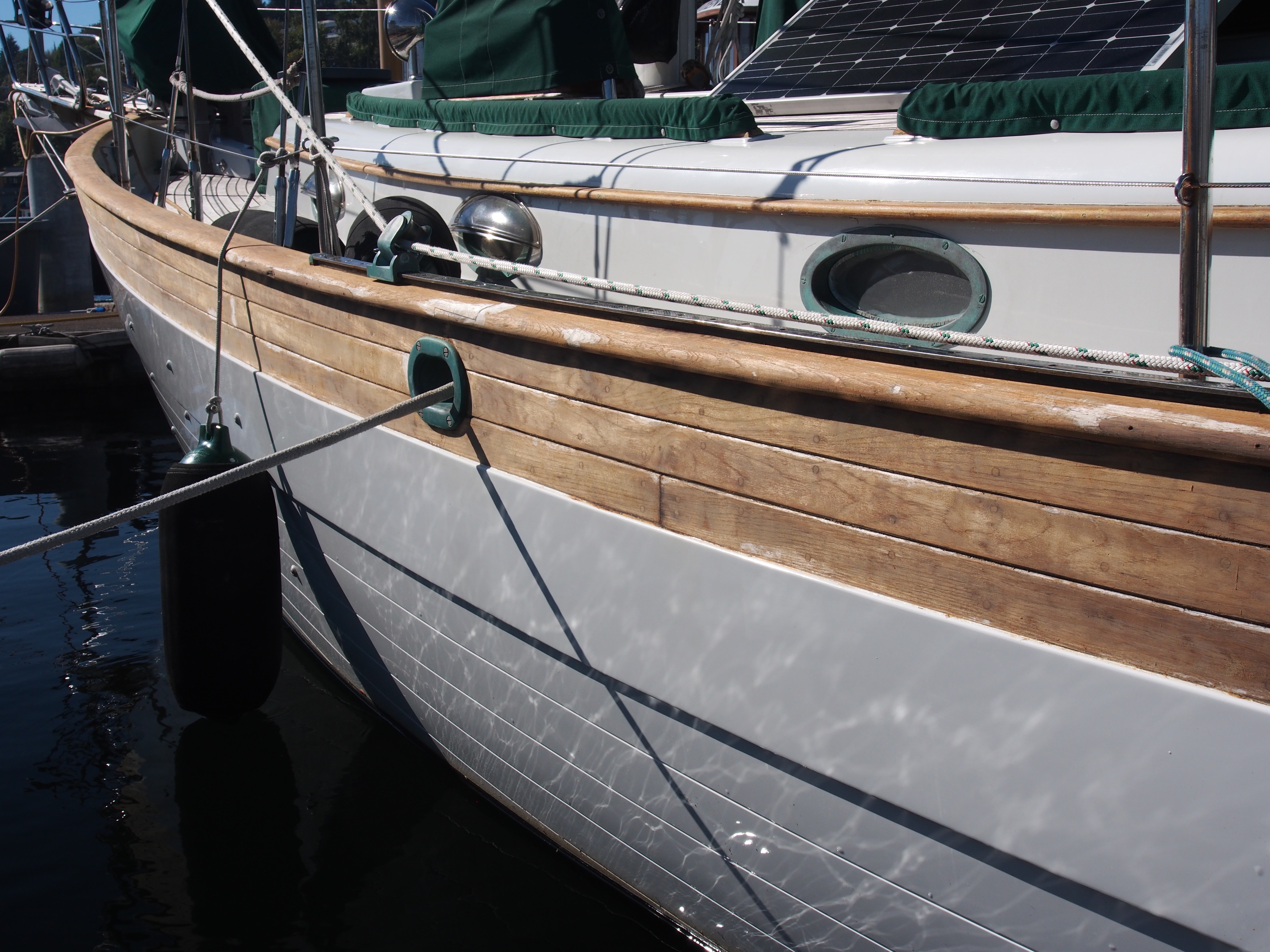
Over the previous 12 years, I applied 2 “refresher coats” to most of the exposed brightwork–cap rails, turtle/hatch, coach-roof trim, cockpit, boom gallows, etc. The brightwork that was normally covered by canvas would get refresher coats every other year–deck boxes, grab-rails, helm seat, butterfly hatch, etc. But after spending 2 years in the tropics, sitting on land for 6 months in Fiji, and sailing 16,000 nautical miles in the ocean, all of the varnish was in very poor condition. The worst were the cap rails, outer planks, cockpit, and coach-roof trim since they were exposed to UV rays most of the time. I decided to attack these first.
Cap-rail, outer planks, and coach-roof trim
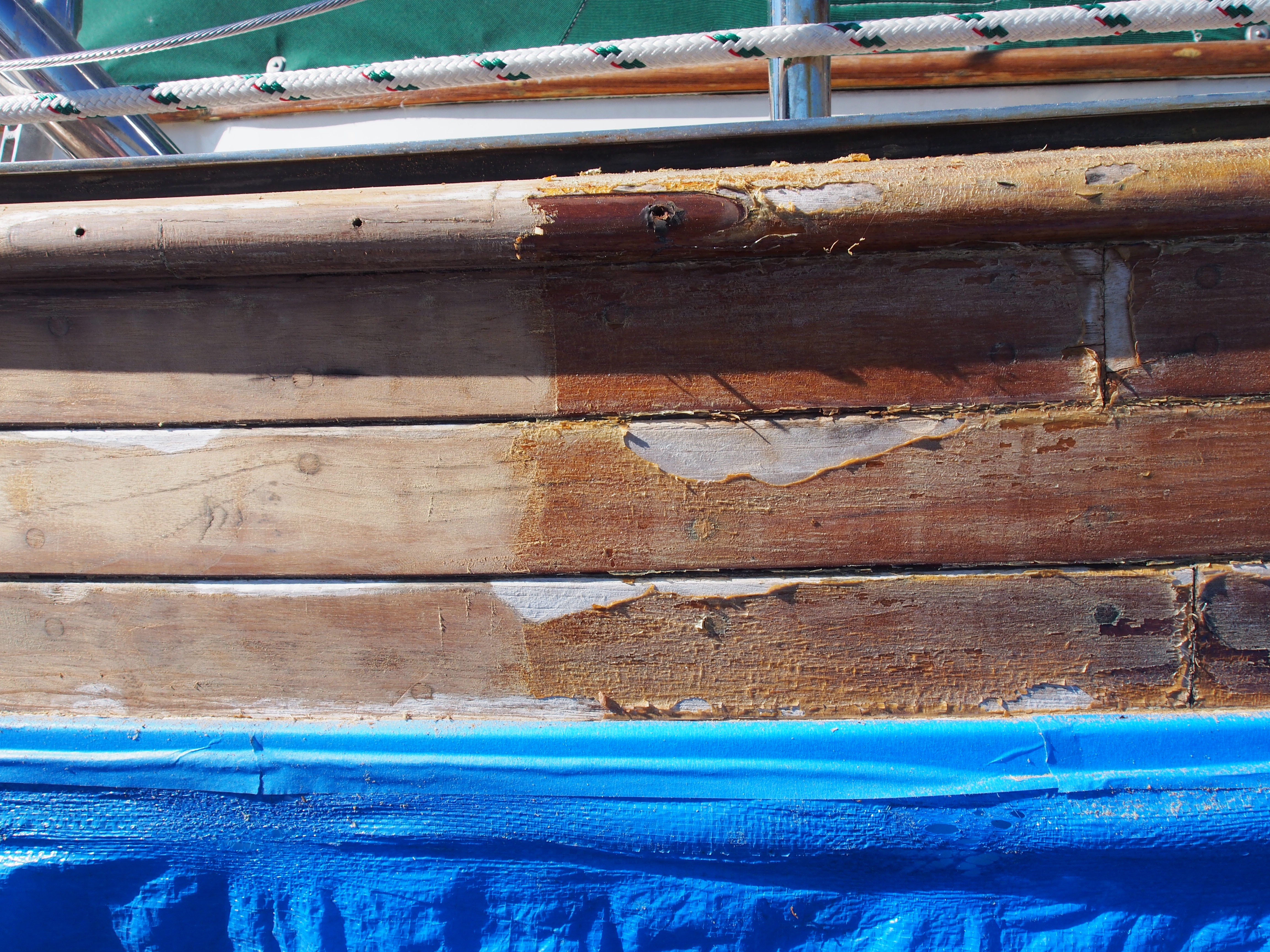
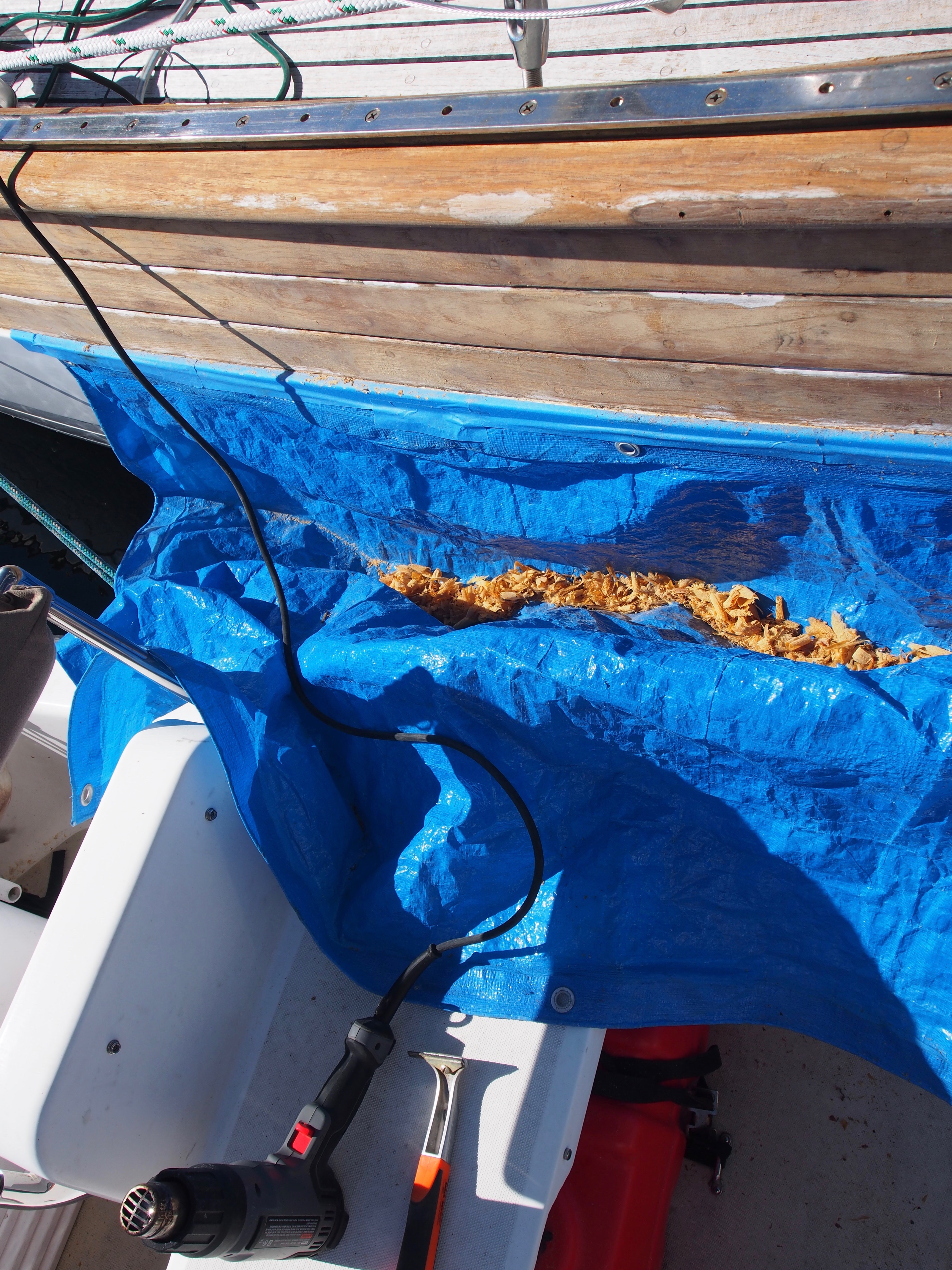
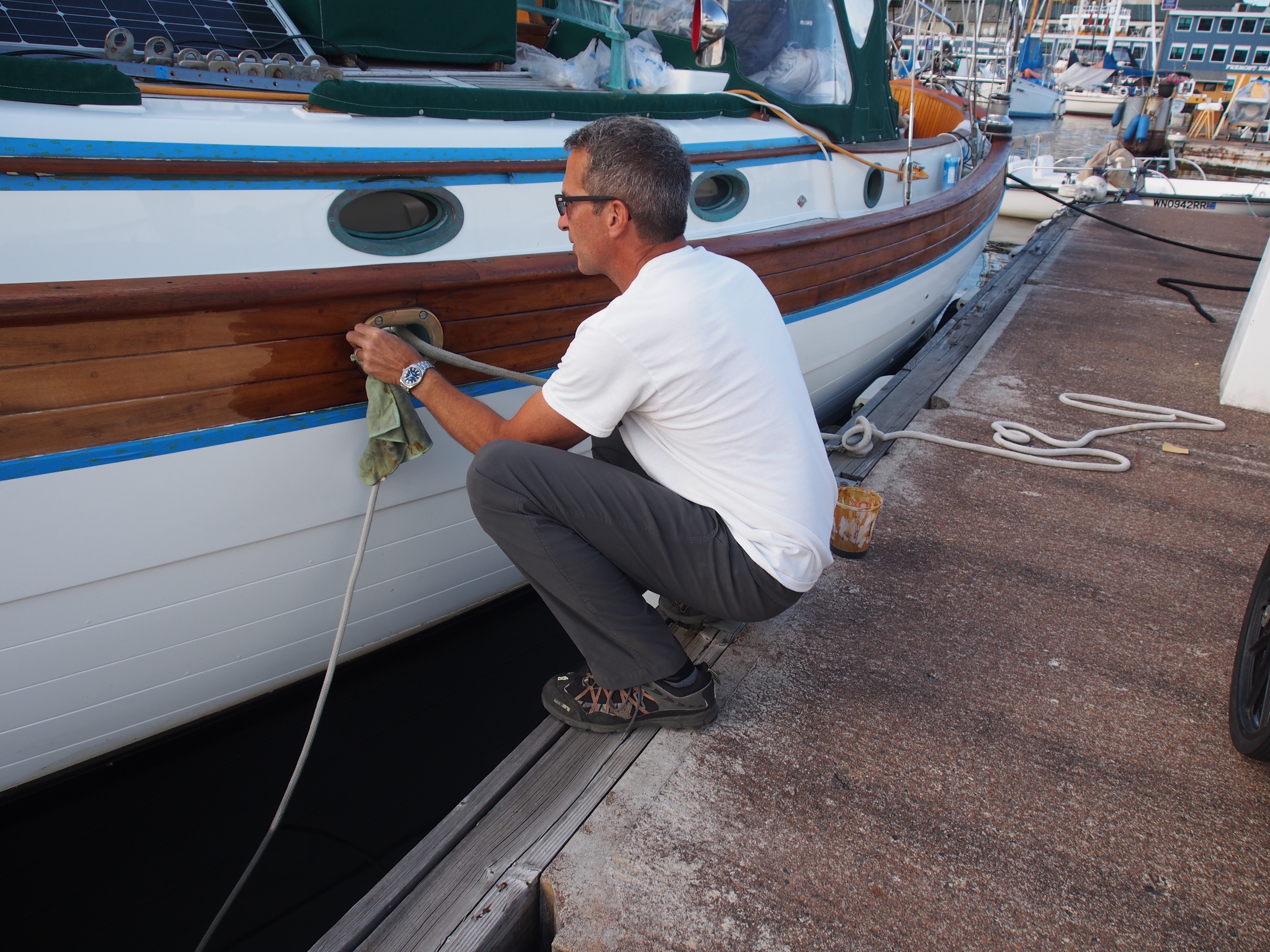
I used a heat gun and scraper to remove the old varnish. It’s time-consuming but effective, and I got better at it the more I did. When I first started, I hadn’t removed much from the boat besides small things like cleats and fender protectors. But as time went on, I realized how much easier (and how much better of a job) it would be to remove as much as possible, so I ended up removing the stanchions, lifelines, bimini, genoa tracks, whisker stays, and the stern pushpit. Even though it took over a day, it was worth it as it made the varnish removing, sanding, taping, and applying the new finish much easier and faster. Since I was working with the boat in the water, I was able to use the finger dock when working on the port side. For the starboard side, I borrowed a small Boston Whaler from a friend and used it to move along-side Apropos. I tarped below the outer planks to keep the removed varnish chips from reaching the water and vacuumed up gallons of it from the tarp. It took about a week of full-time (10-hour days) work to remove the varnish from the cap rail, outer planks, and coach-roof trim.
Heating and scraping the old varnishDown to bare teakCap rail with the genoa track removed
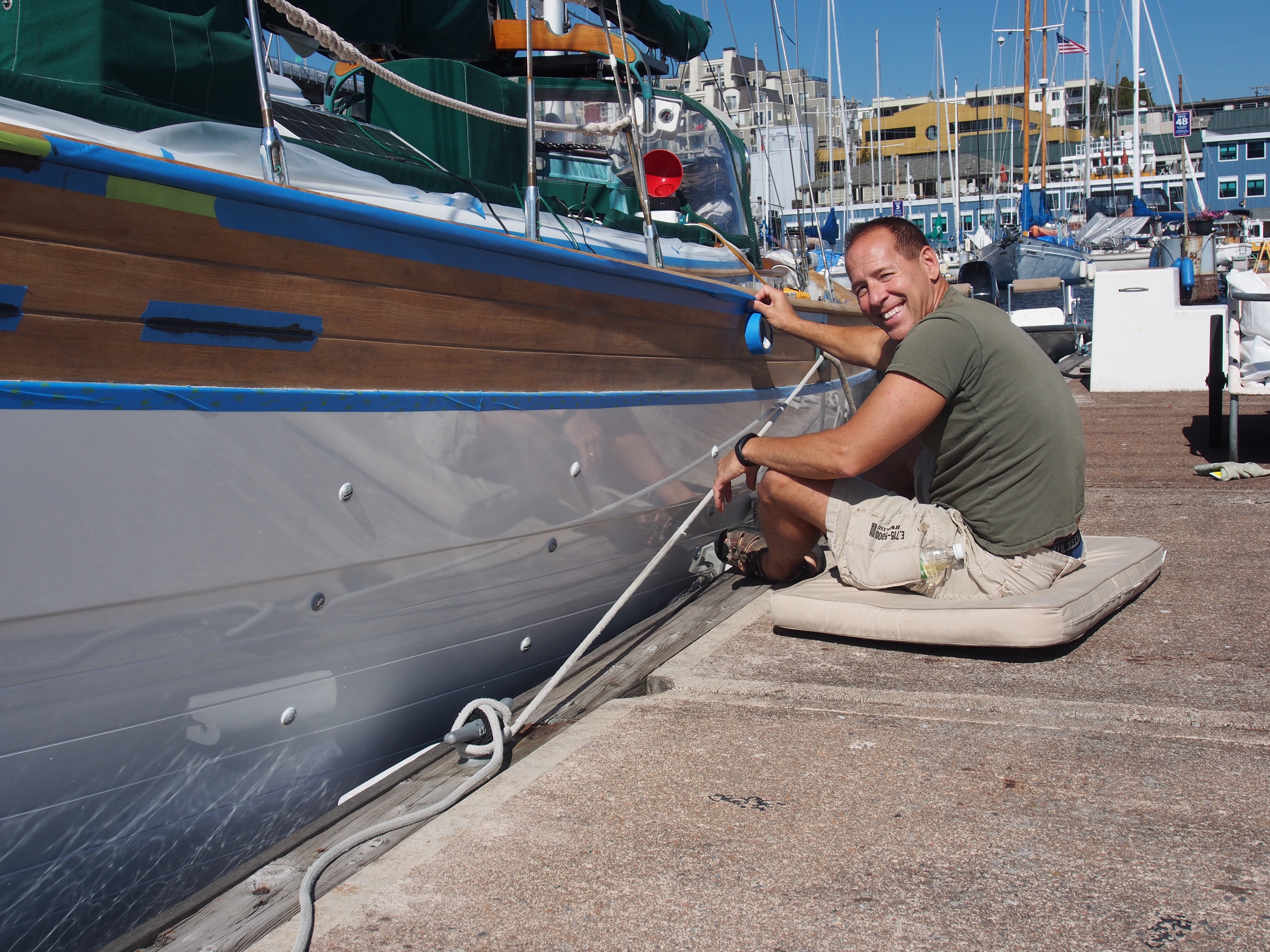
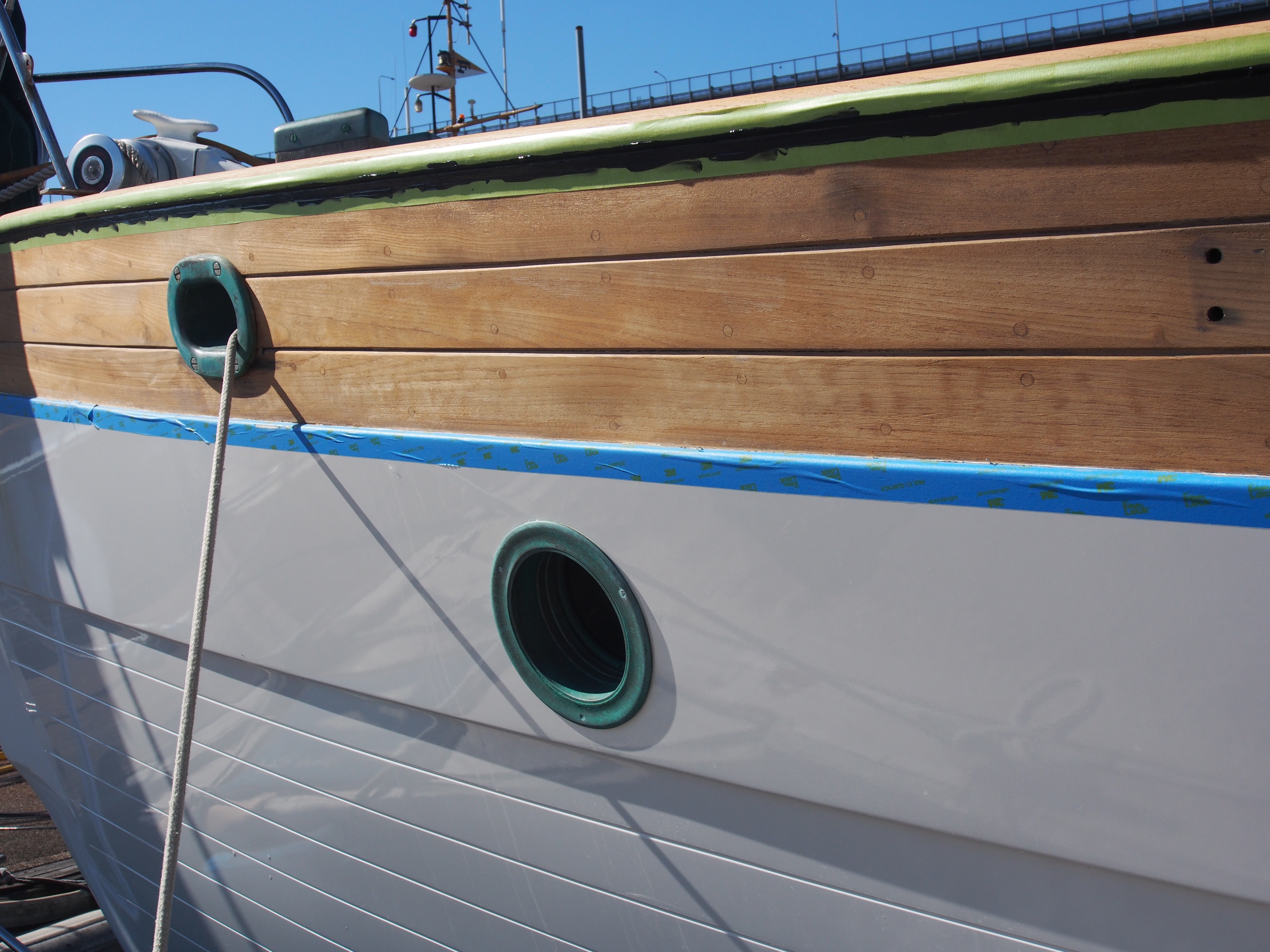
Next came the sanding to remove any scrape marks left behind after melting and scraping off the old varnish. This also removed the gray areas where the varnish had completely lifted, exposing bare teak to the elements. I first used a 5″ orbital sander with 120 grit paper and followed it by hand sanding with a 15″ long-board to get the surfaces as level as possible. This took a couple of days. A friend helped with masking the joint between the cap rail and outer planks and I applied a marine sealant to fill the small void, possibly the cause of some of the water entry we experienced during the trip.
Mike was an expert with the masking tapeSealant applied between the cap rail and outer planks
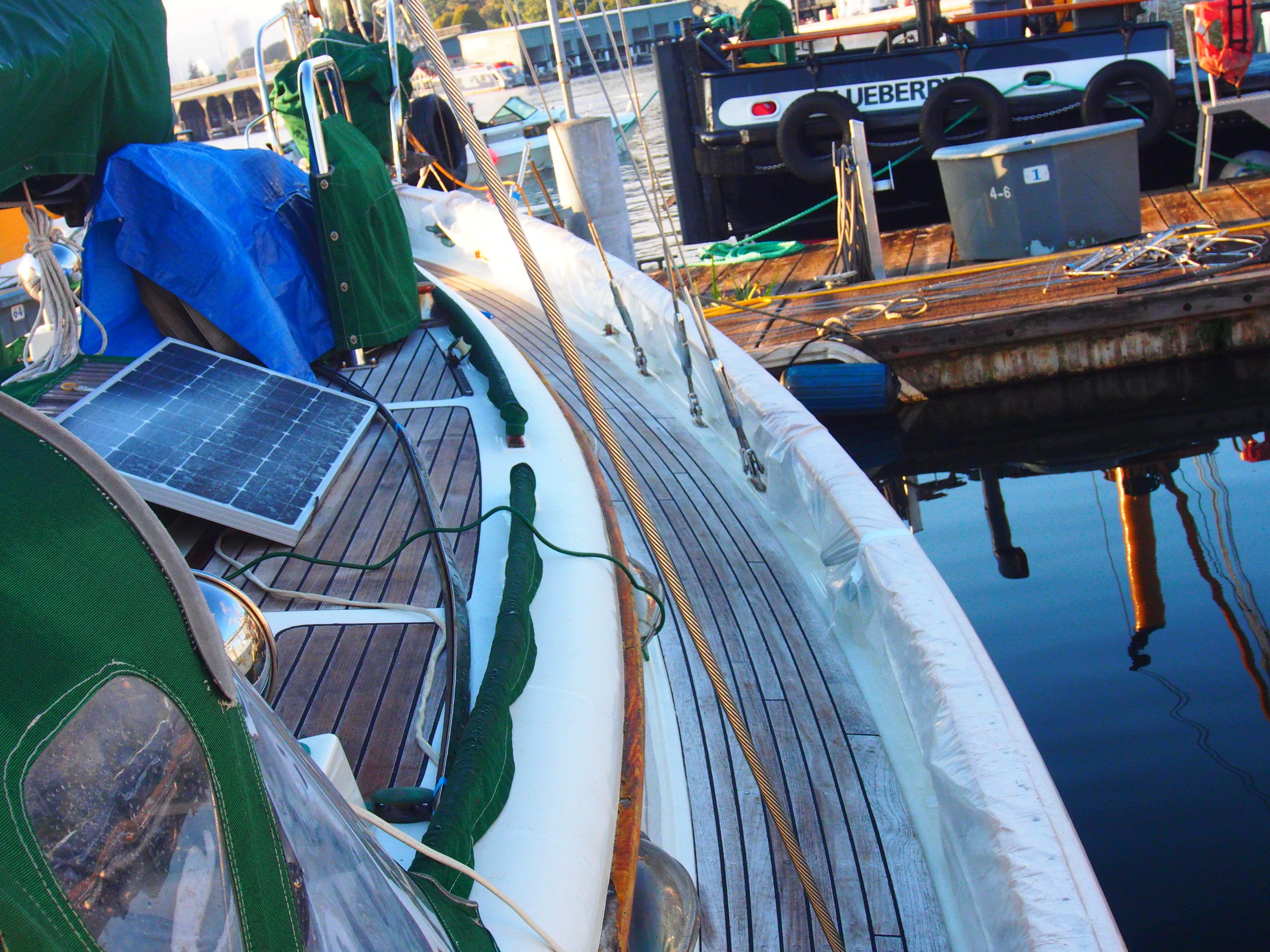
Now that the surface was ready for re-finishing, I made sure to cover it with plastic to keep the overnight dew from reaching the bare teak.
Covering the bare teak
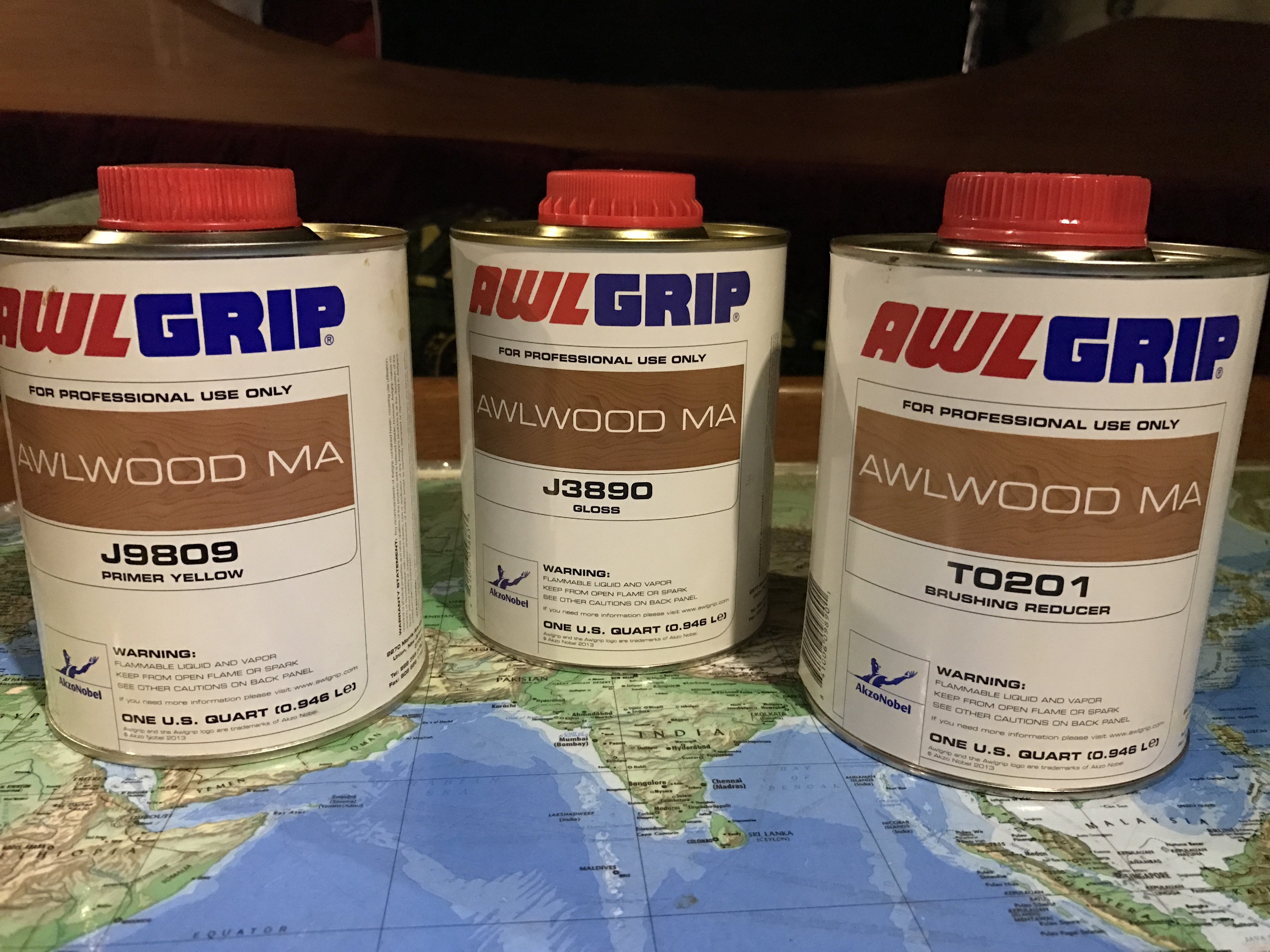
Finally it was time to apply the new finish. I looked into alternatives to varnish, and decided on a product called Awlwood system made by AwlGrip. It’s a one-part system that catalyzes by the moisture in the air (as opposed to a 2-part system that requires a hardener). It’s relatively new, but testing claims it outlasts traditional varnish and can go several years between refresher coats. Some of the downfalls with it–it’s expensive at $65/quart, and it takes some getting used to applying. Since it catalyzes with moisture, you need to work with a small amount at a time. I settled on 4 ounces and found that I could apply that amount in 20-30 minutes, before it became too thick.
Awlwood System
The first step with the Awlwood system was to apply a primer coat for the clear coat to adhere to. The primer coat contains a yellow dye to give the teak a more consistent and deeper tone. It was easy to apply with a cloth–similar to applying stain. This was an important step and without it, the top coat would just peel right off.
Applying the primer coat
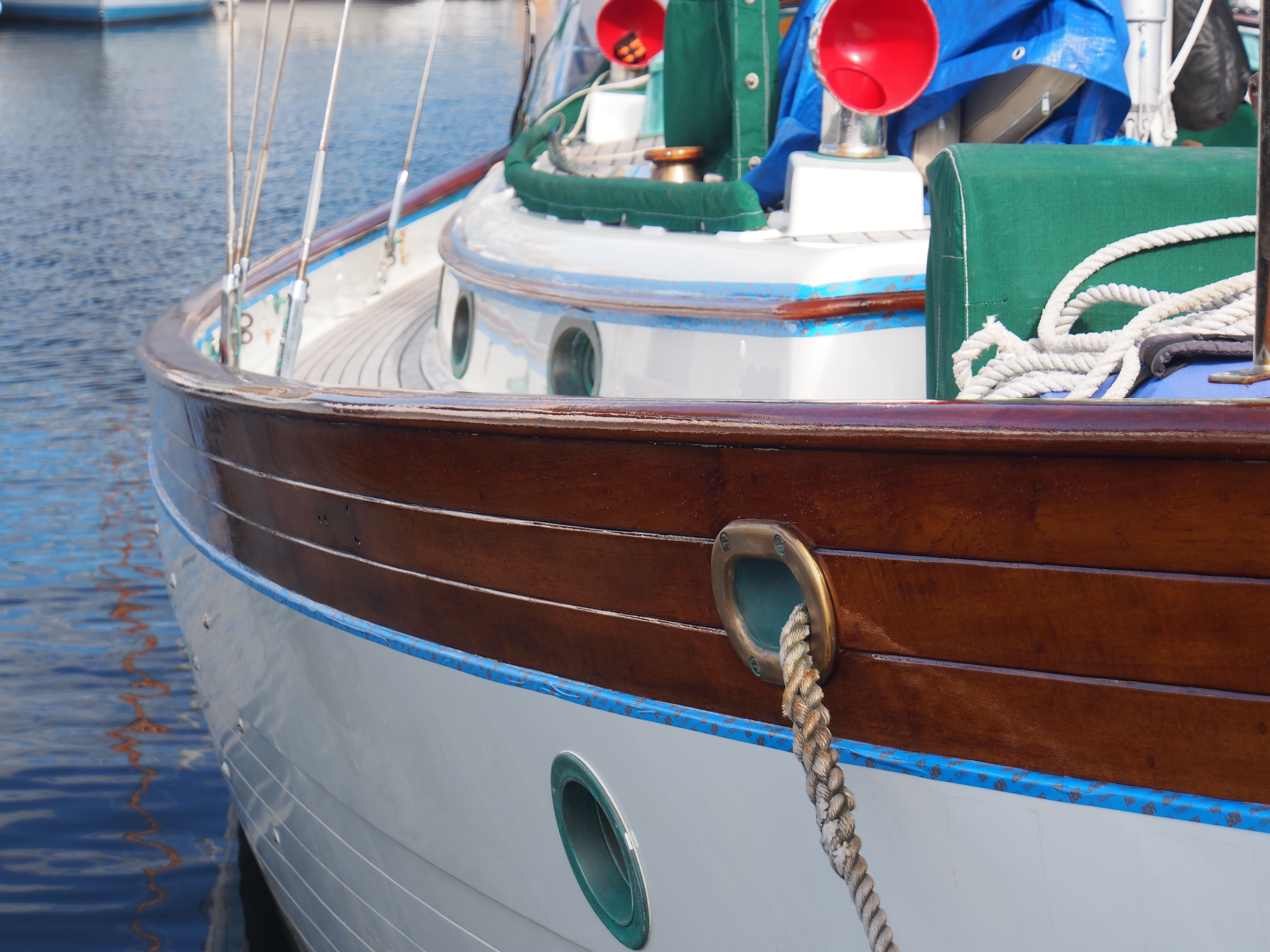
Finally, the clear top-coats were applied using Awlwood Clear. They recommend 8 coats, and one of the advantages of the product is that multiple coats can be applied in one day. A 4-hour dry time is needed between coats, and it took me 3 hours to apply, leaving an hour to rest in between! I settled in on applying 2 coats per day for 3 days, lightly sanding at the beginning of each day to remove imperfections. I found tiny bubbles forming in the first few clear coats (not sure why this happened, but a friend who used the same product on teak also found this). A light sanding each morning removed these imperfections and allowed the next coat to flow better. Prior to the 8th (final) coat, I let the 7th coat dry for 24 hours, gave it a final sanding, then applied Awlwood Clear thinned 5% with Awlwood Brushing Reducer and was pleased with the final outcome.
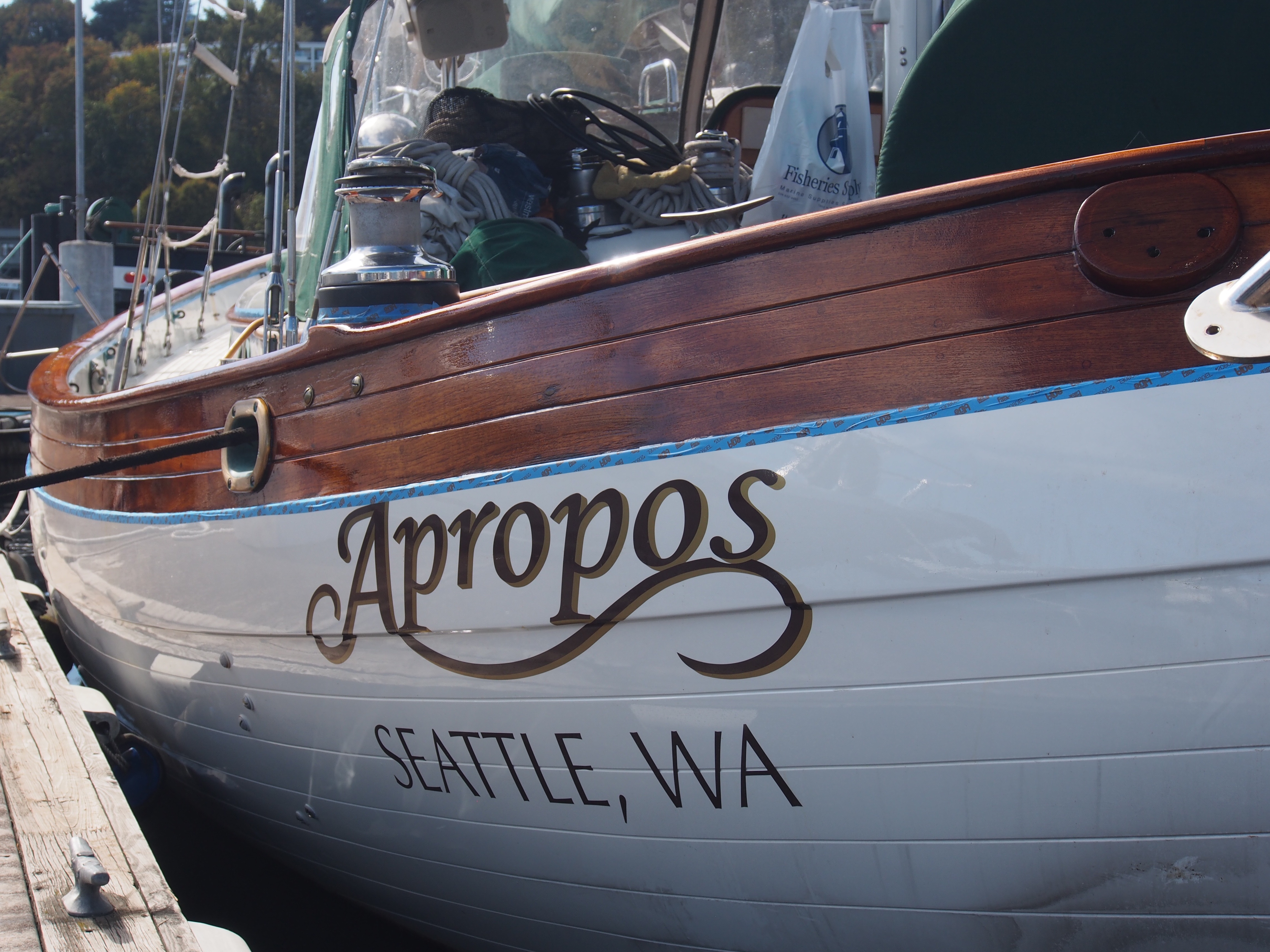
After 8 coats of Awlwood ClearAfter 8 coats of Awlwood ClearAfter 8 coats of Awlwood Clear
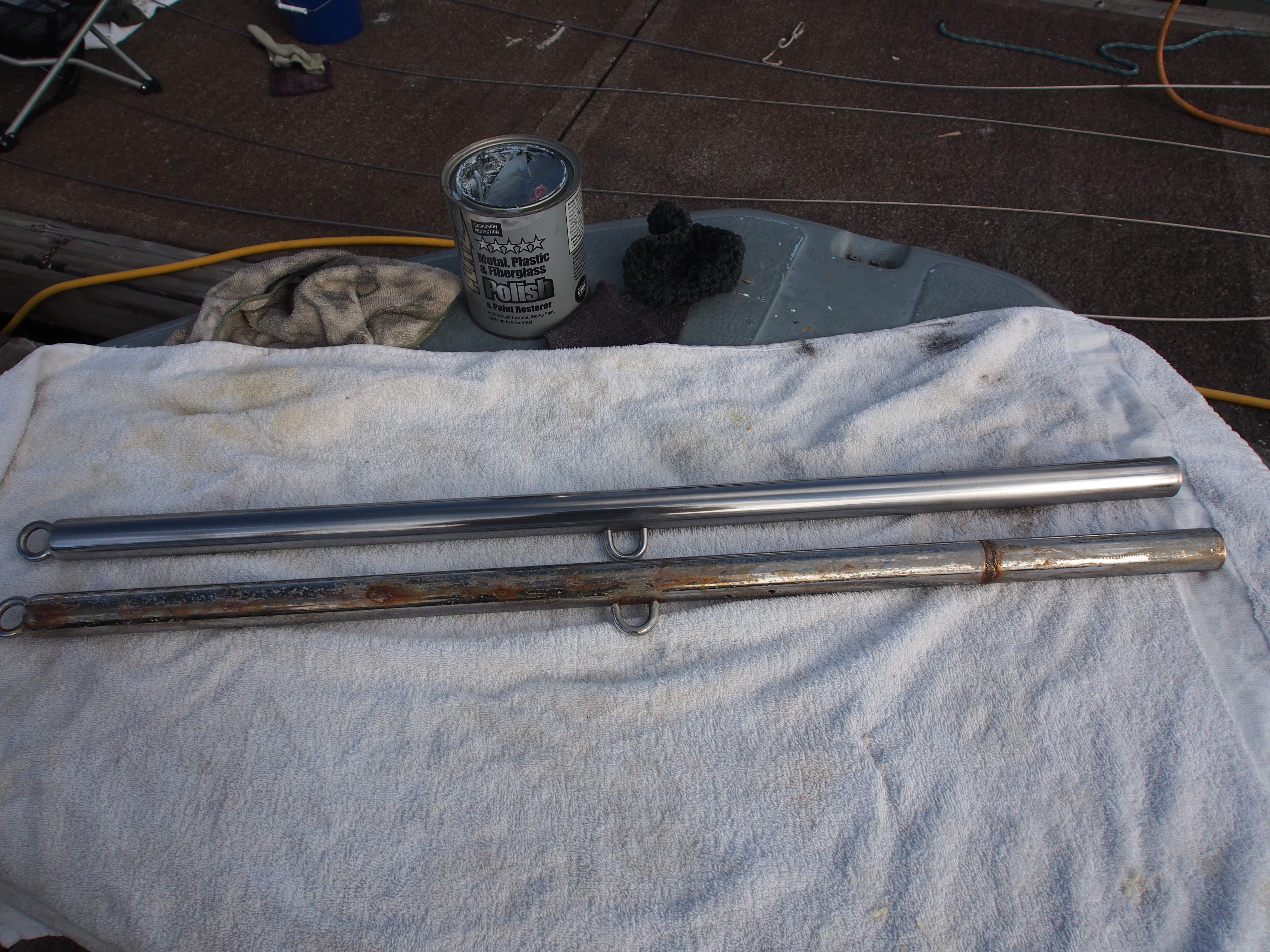
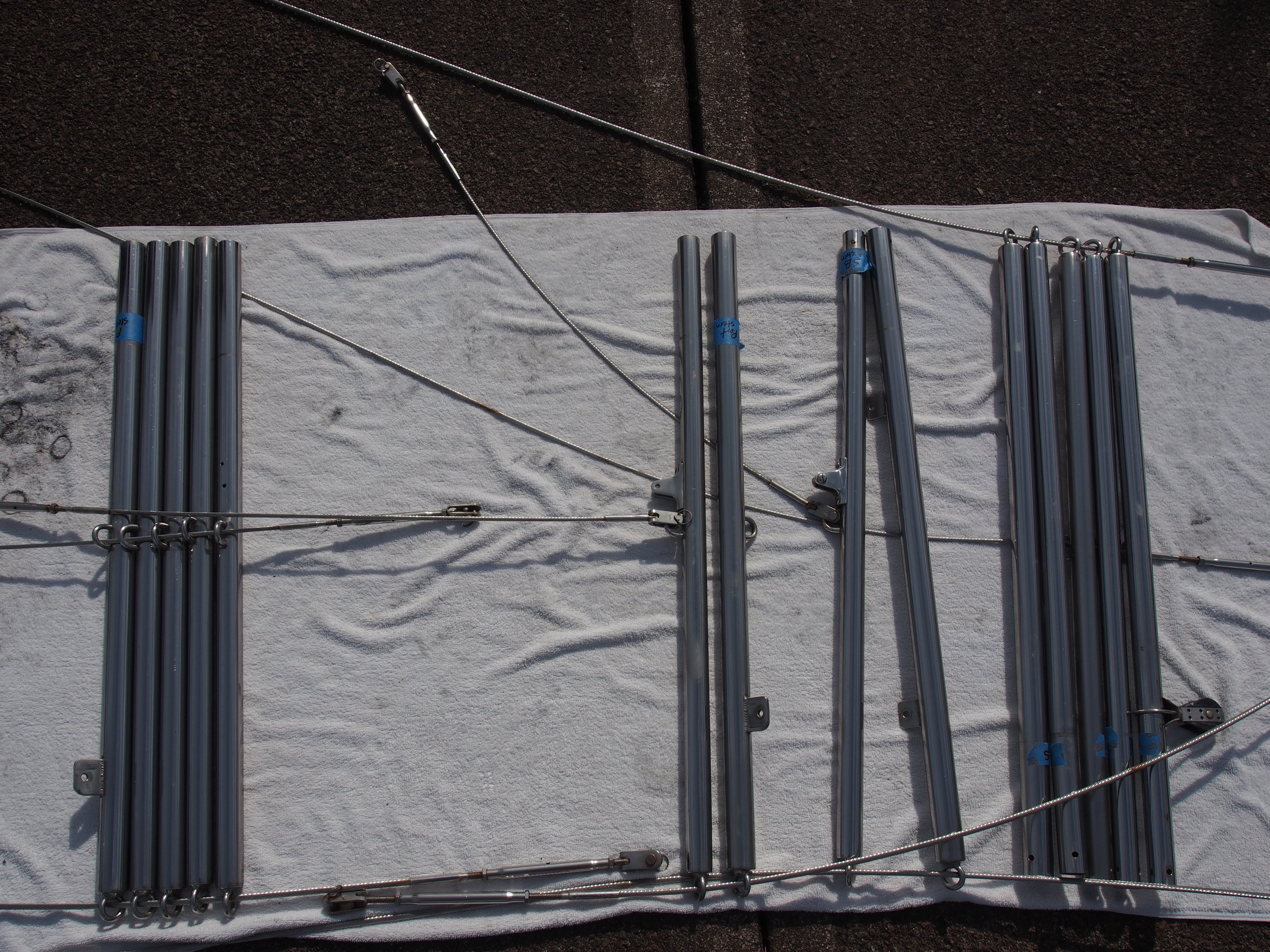
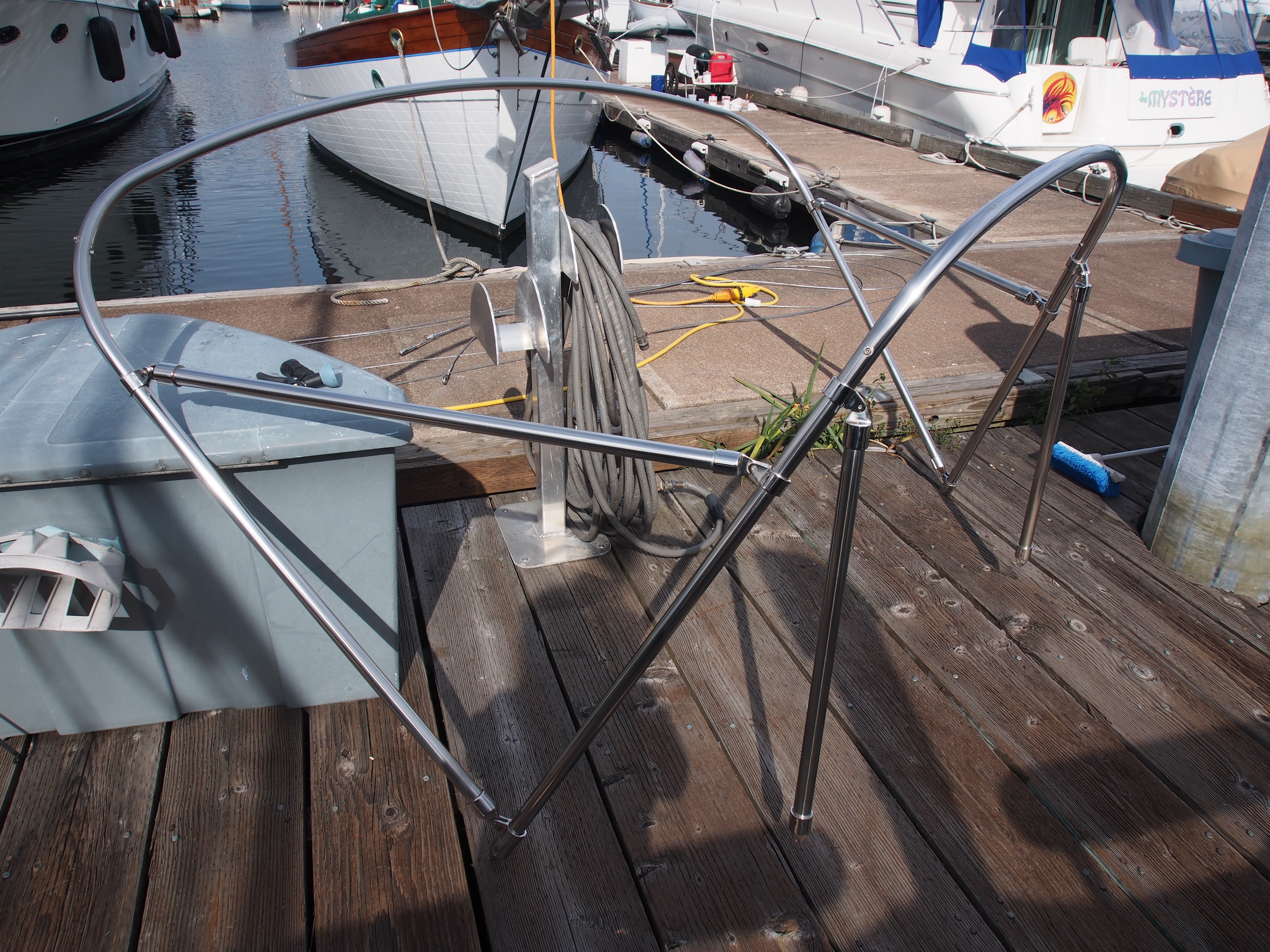
The final step was to re-bed the stanchion brackets, genoa tracks, whisker stay bases, etc. I polished all the stainless steel stanchions, push-pit, bimini, and genoa tracks using Fitz Polishing Compound prior to re-installing them.
Stainless steel stanchions really needed polishingStanchions after polishingStainless steel bimini frame after polishing
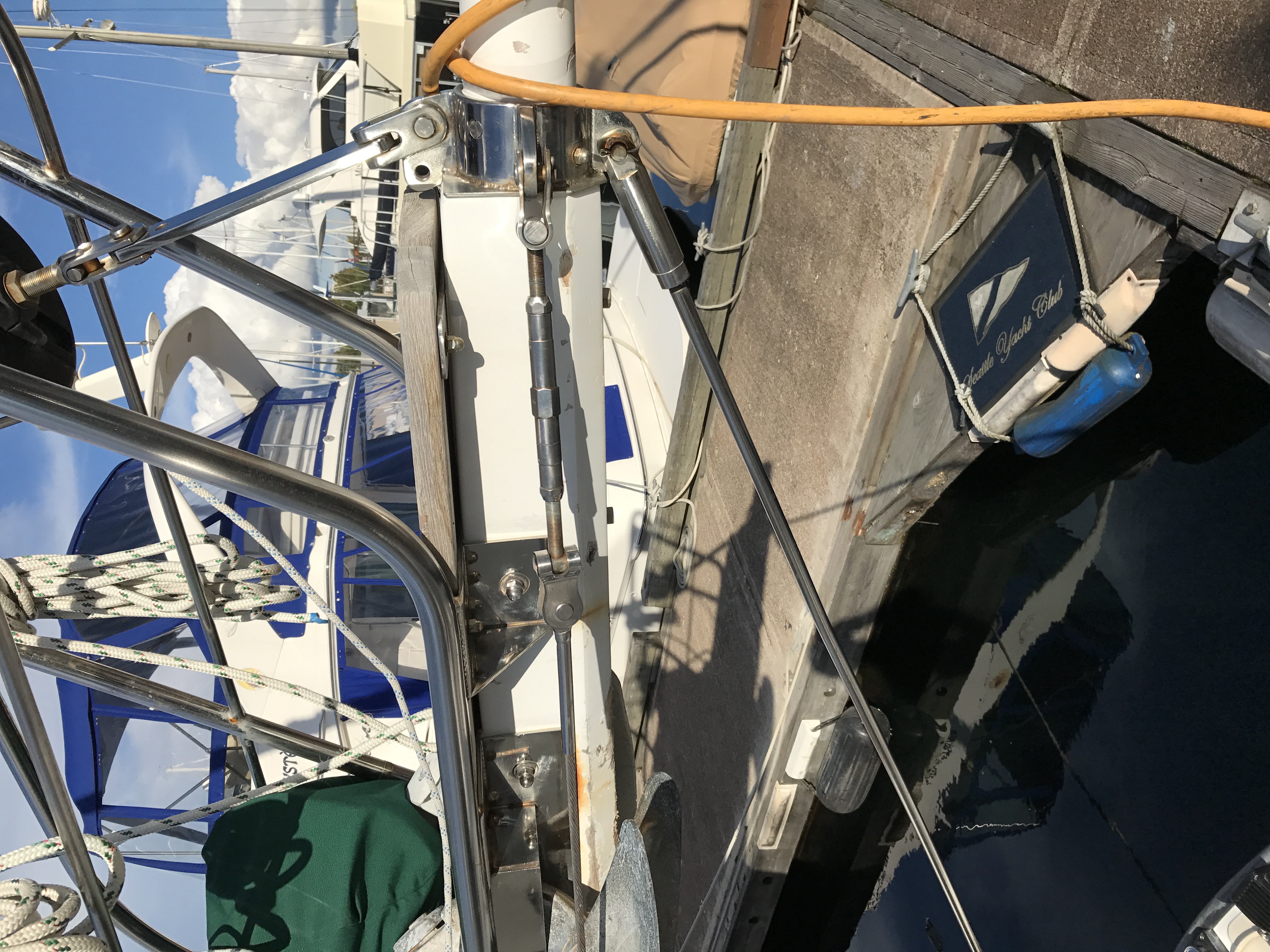
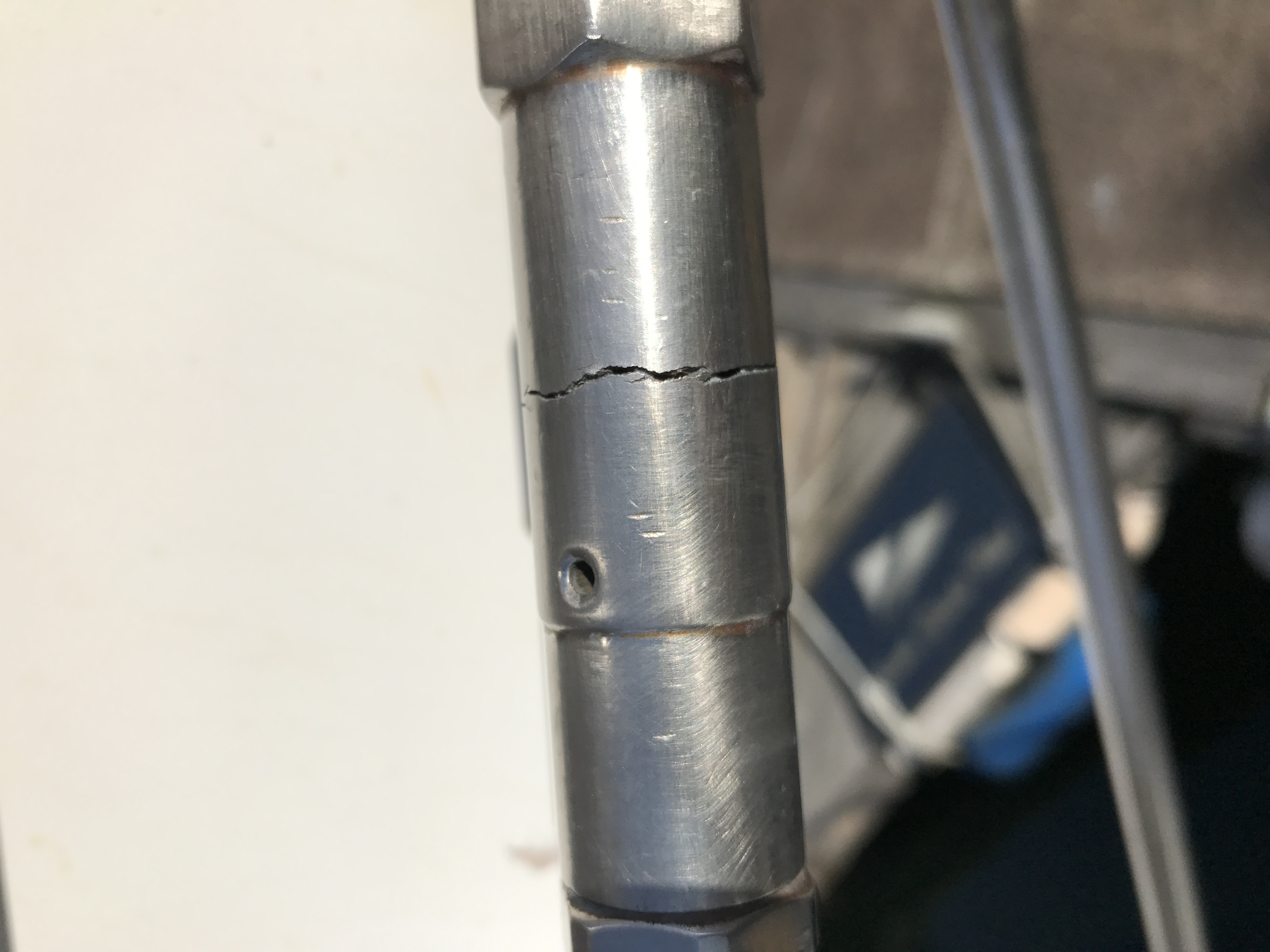
While polishing the stainless steel around the bowsprit, I noticed that one of the whisker stay stainless steel turnbuckle bodies had nearly failed. A stress crack on the starboard turnbuckle probably occurred somewhere between Fiji and Seattle on a starboard tack due to heavy shock-loads on the bowsprit when beating upwind with the genoa. A complete failure of the turnbuckle could have overloaded the bowsprit and, in a worst case scenario, brought down the rig!
Starboard whisker stay turnbuckleStress crack in turnbuckle body
The entire job took about a month of full-time work and covered the largest area of brightwork on Apropos. But there is still lots to do–cockpit, deck boxes, butterfly hatch, grab rails, helm seat, instrument turtle box, winch bases, cabin doors, companion way hatch, wheel, boom crutch, and several small pieces of teak. These will have to wait until next spring when the weather is drier–phase 2.
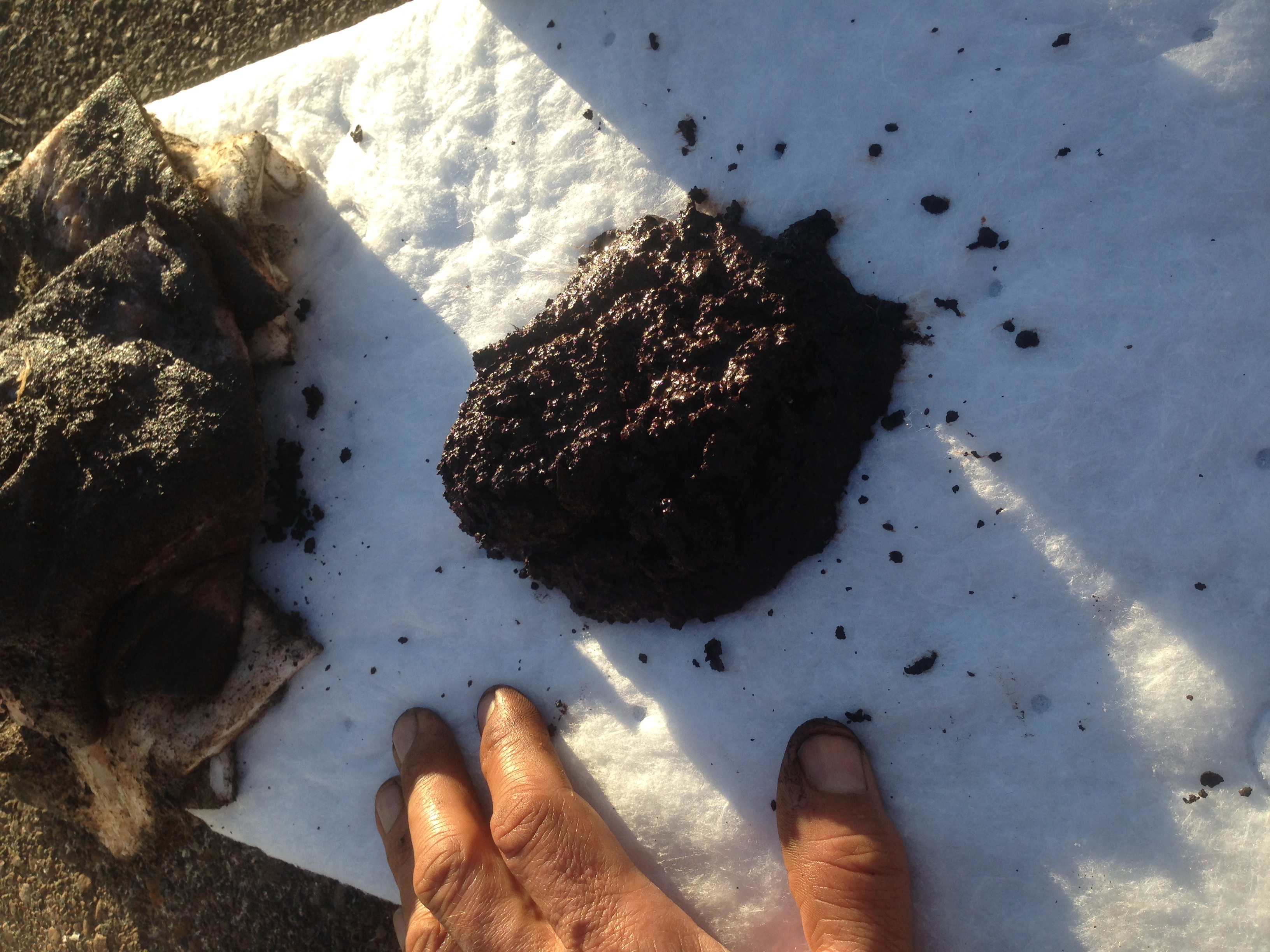
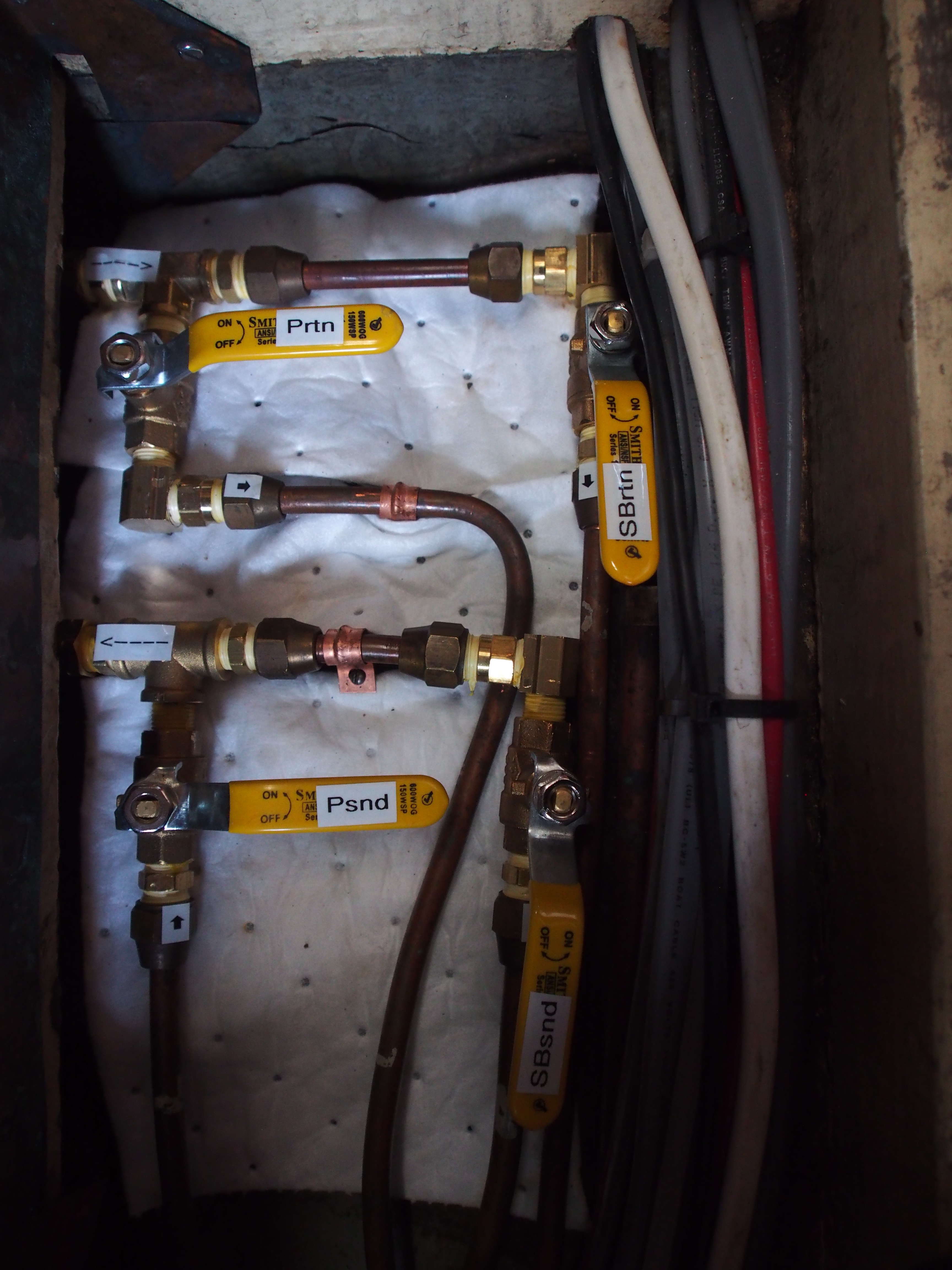
Now that we’re back from cruising, it’s time to clean, repair, and restore Apropos. Being in the tropics for almost 2 years and sailing 16,000nm in the ocean is hard on a boat. We had every nook and cranny of the boat packed–under floorboards, under cabinet drawers, the v-berth (“garage”), etc. The first thing I did was to remove a lot of “stuff” and give the boat a thorough cleaning. A solution of tea-tree oil and vinegar was used to wipe down all the walls and inside cabinets and drawers. Next I tackled some of the recent problems related to fuel. I emptied both fuel tanks and scooped out the debris at the bottom. Almost all the refueling outside the US was done with jerry cans and never did we see any sign of dirty fuel in the bottom of the cans, so I assume the debris was from the growth of microbes. I always add a small amount of Biobore fuel additive when refueling, but maybe the tropical heat, and having the boat sit in Fiji for 6 months, accelerated the microbe growth. While I had the tanks empty, I also took the opportunity to replace the 4 old gate-style valves with ball valves. Refueling the tanks from empty also allowed me to precisely measure the tank capacity. I’ve always knew the total diesel capacity to be about 120 gallons (from the boat specs), and assumed the 2 tanks were equal capacity. I now know the port tank holds 64.4 gallons and the starboard tank holds 55.6 gallons!
Debris taken from the empty diesel tanks4 new ball valves between diesel tanks and engine
Moving to the outside of the boat, I gave it a good wash to remove the salt that accumulated from the Hawaii to Seattle passage. I also removed some of the solar panels, the dinghy and outboard engine, the life raft and stored them in the garage until they’re needed next summer. Then I stepped back and looked at the poor state of the sun-wreaked varnish and thought about the monumental task “somewhere down the road”.
The 60nm passage from Port Angeles to Seattle began with a careful study of the tides and currents. Timing is important and can shave hours off this passage if done right. In the summer, this passage almost always requires motoring, and after 20 days of mostly sailing from Hawaii, I looked forward to relaxing with the autopilot doing the steering. We departed at 09:30 so that we would hit Dungeness Spit around slack, and Admiralty Inlet at mid-flood. This meant departing against an ebb tide, but by staying close to shore between Port Angeles and Dungeness, we actually had a slight positive current from back-eddies. We were also helped by a light westerly wind that gave us an extra half-knot by motor sailing with the Genoa. We passed Dungeness Spit moving at 8 knots, and were going 8-10 knots through Admiralty Inlet.
It had been 2 years since Apropos was in the Salish Sea. As we motored-sailed south towards Seattle, it was great seeing all the familiar landmarks–Dungeness Lighthouse, Port Townsend, Point No Point Lighthouse, the Edmonds-Kingston ferries, the cruise ships headed to Alaska, and finally, the Seattle skyline and Shilshole marina. Our trip to the South Pacific was amazing, but some of the best cruising grounds anywhere are in the Pacific Northwest.
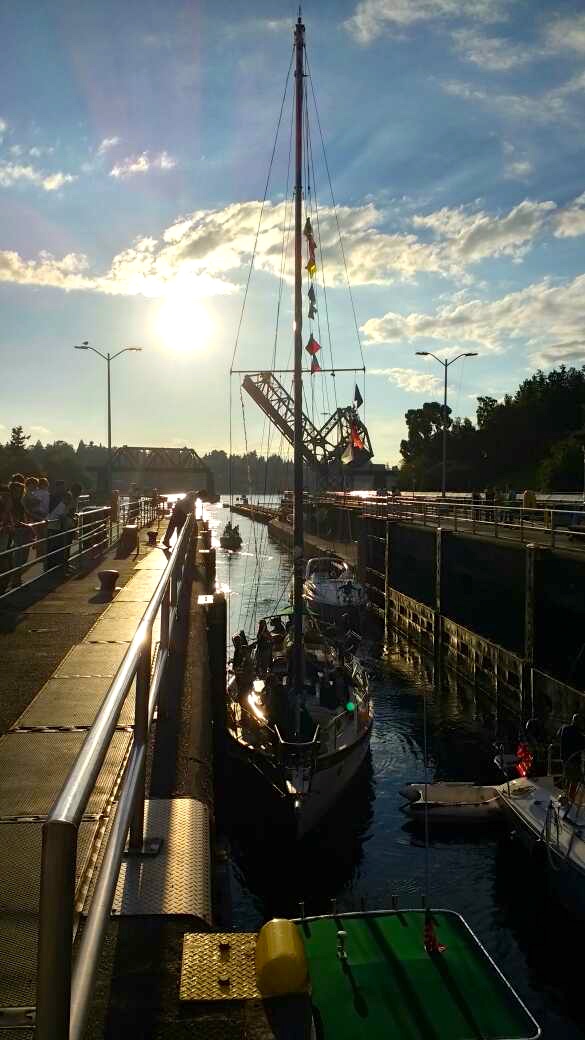
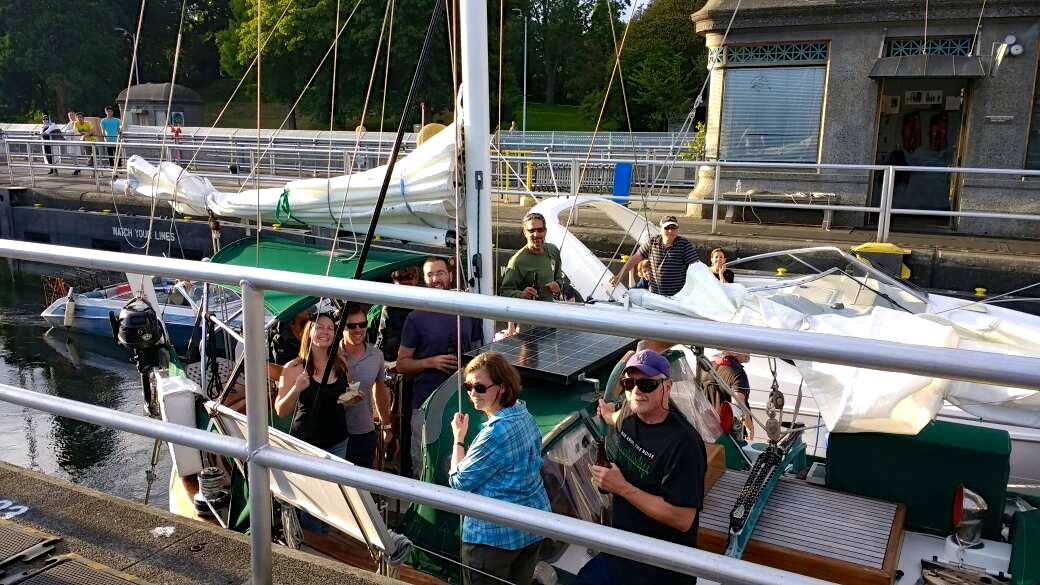
Anna Maria, who we hung out with when we were in Zihuatanejo, Mexico, joined us in Port Angeles for the final passage to Seattle. We reached Seattle by 7pm and pulled into Shilshole marina to pick up some of the crew from the Fiji, Samoa, and Christmas Island passages for the final 3 miles to Lake Union. Doug, Dave, Denise, Justin, and Adrea came aboard and we motored to the Ballard Locks, then through the canal to Lake Union. This completed a nearly 2-year, 16,000 nautical mile Pacific Ocean voyage with stops in 8 countries–Mexico, French Polynesia, Cook Islands, Nuie, Tonga, Fiji, Samoa, and Kiribati.
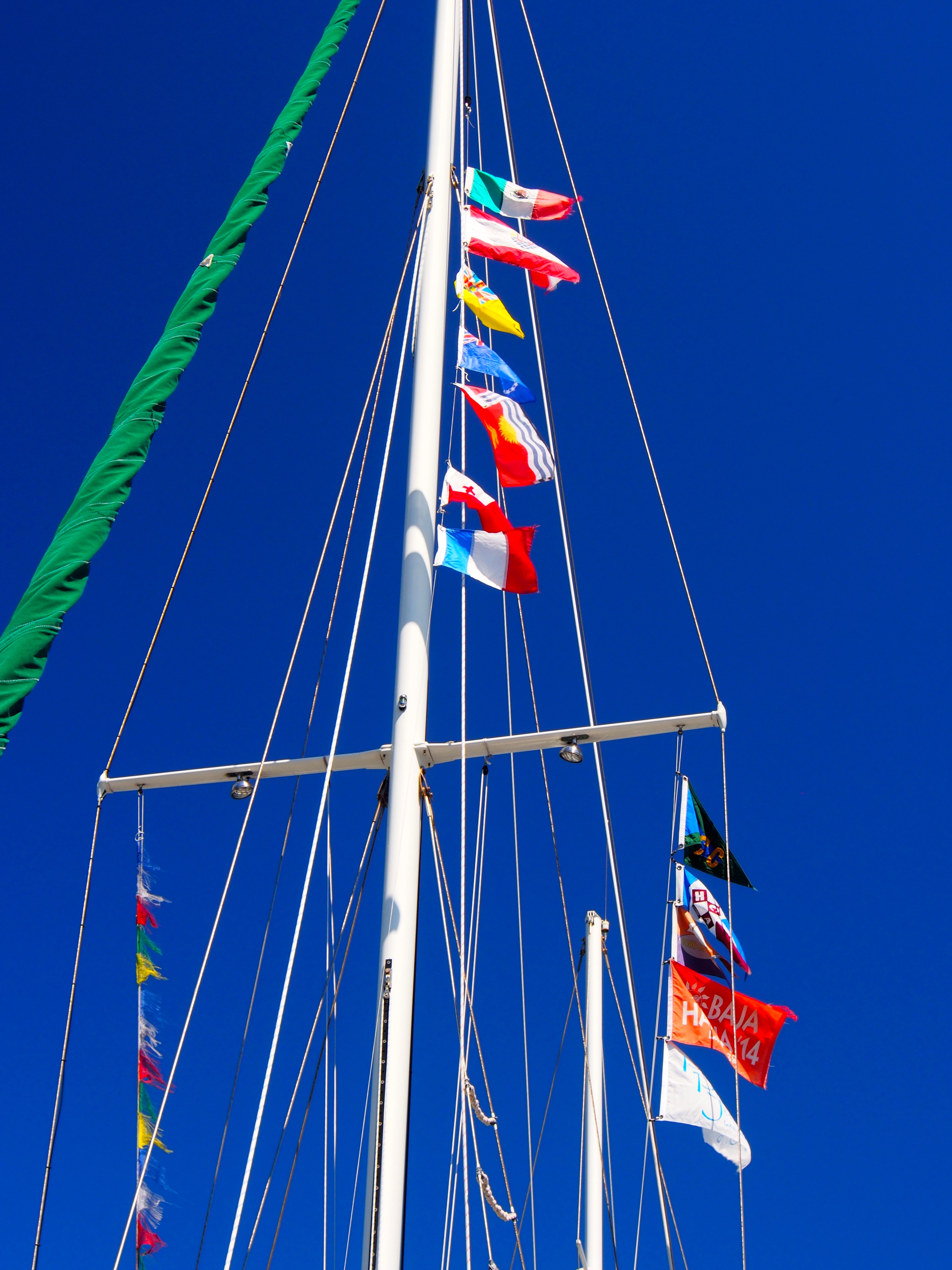
Country Courtesy Flags (top), Rally Flags (right), and what’s left of the Tibetan Prayer Flags (left)Inside the Ballard LocksSome of the crew joined us for the last 3 miles to Lake UnionFremont Drawbridge to Lake Union
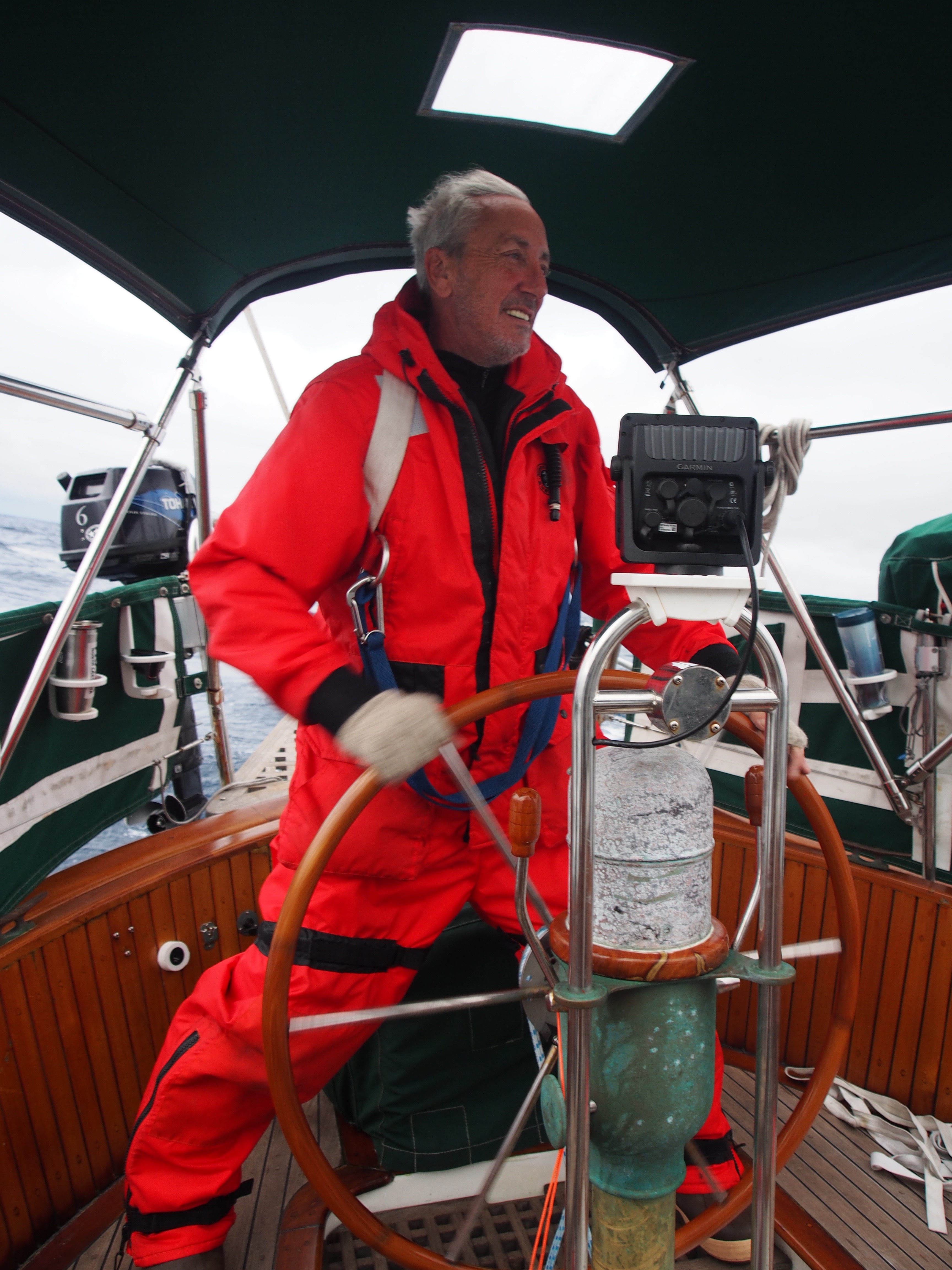
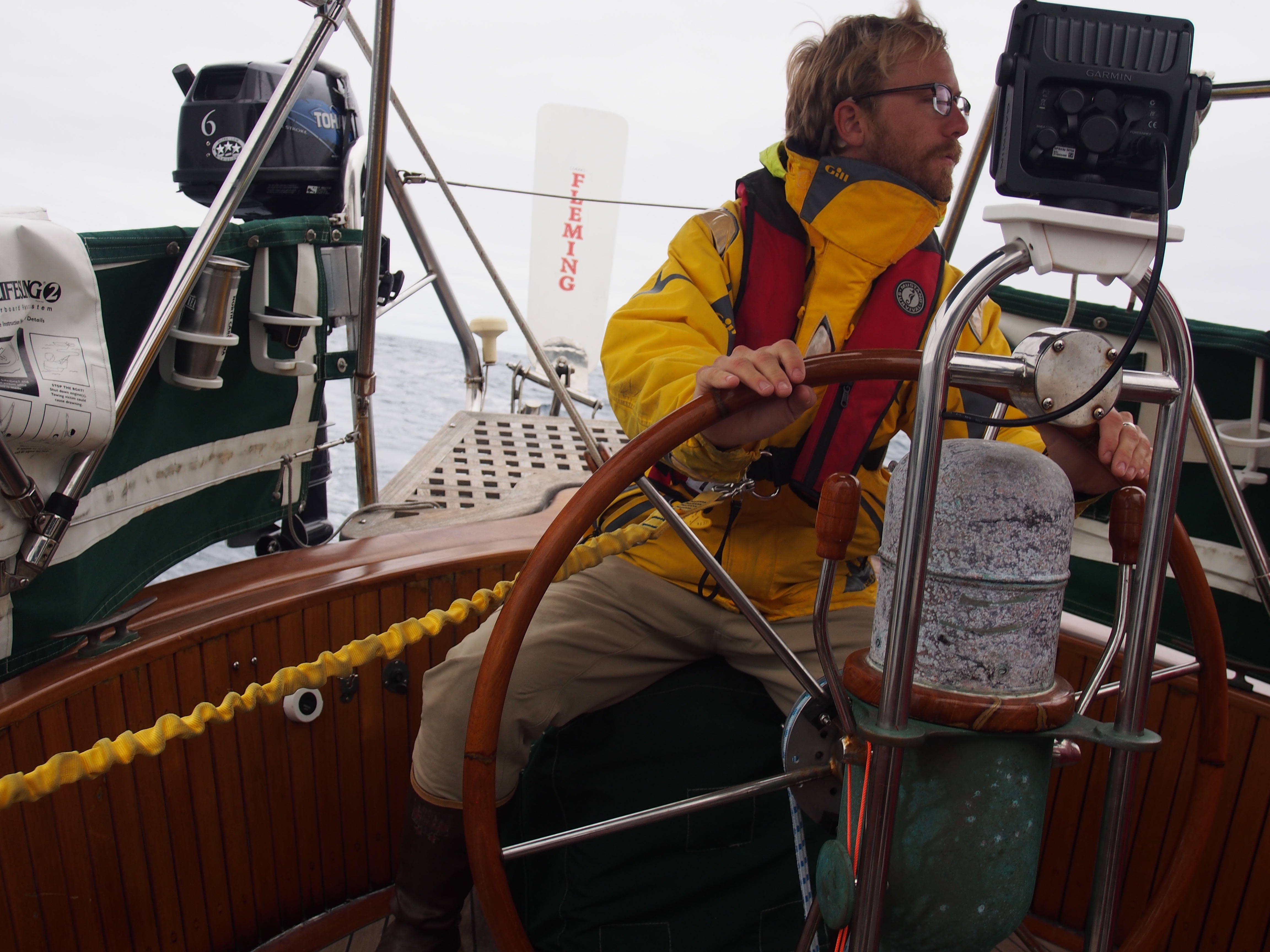
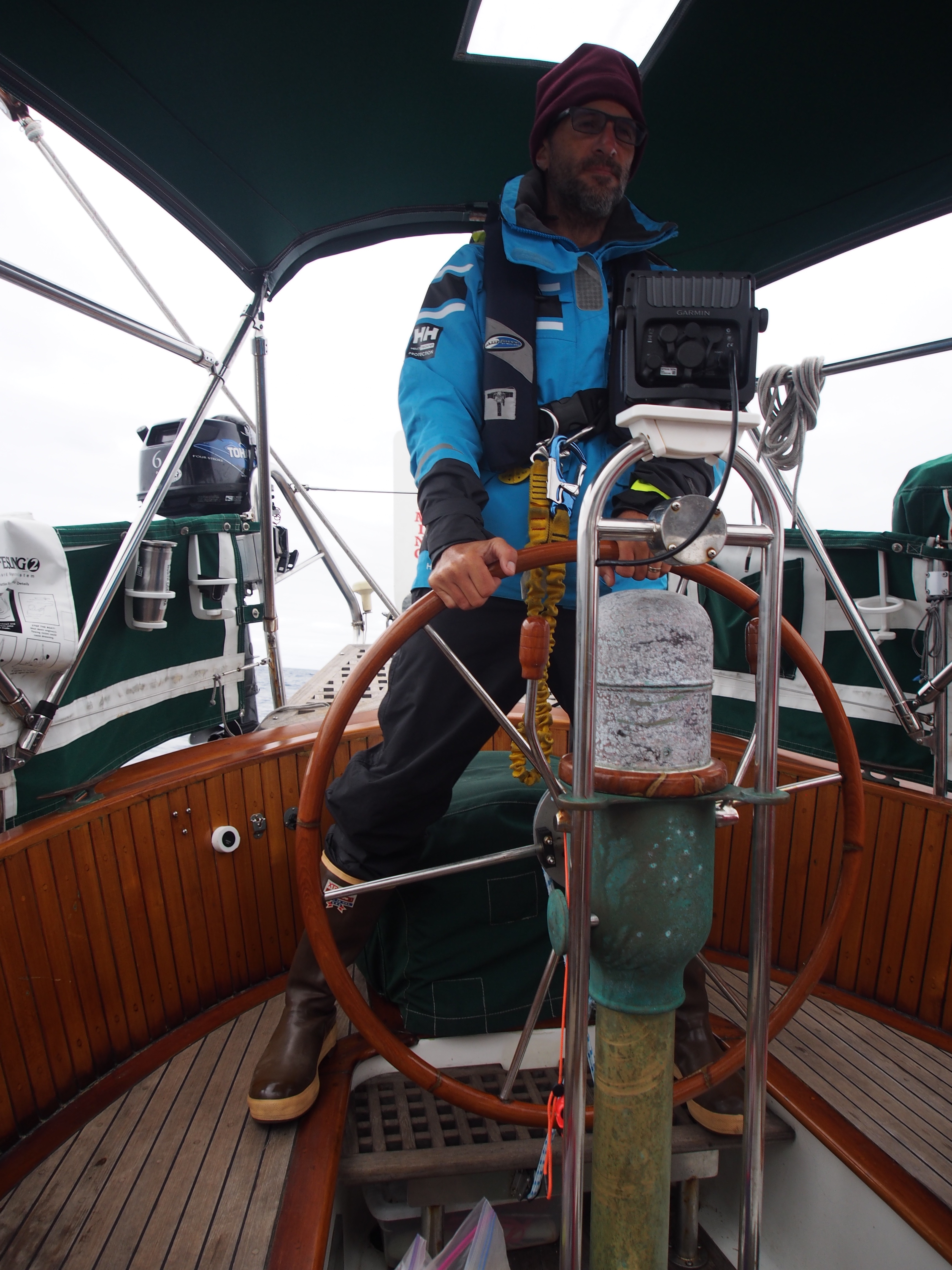
Today is day 14 on the Hawaii to Seattle passage. We are at 43deg30min N, 145deg27min W on a heading of 65 degrees. That puts us roughly 2/3 of the way there! We motored for another 20 hours last night before the wind returned at noon and we’ve been averaging a fast 6-6.5 knots since. Weather has drastically changed to slate-grey overcast days and cold, damp nights. We’re surrounded by fog now with visibility of a half mile. We’ve been in the shipping lanes for a few days now and spot 2-3 cargo vessels daily on AIS. Closest point of approach has been 20 miles or more, so no visual sightings. Some are going west to Asia and some are moving east to SF, LA, or Panama.
JohnBrianJim
Some issues we’ve been dealing with–
1. Engine is not running well when using the starboard tank. The rpm’s go up and down, signaling a flow restriction between the SB tank and engine. We circumvented the problem by running only on the port tank and pumping fuel from the SB tank into jerry cans, then topping up the port tank as needed. This worked until it didn’t–as the SB tank drew below half a tank, our fuel pump wasn’t able to lift the fuel to the jerry cans on deck. Today we removed the 12″ plate on the SB tank (located under the aft berth where Brian sleeps) and were able to pump the remaining 25 gallons out, emptying the tank. It was hard, tedious work with the pump filling a 5 gallon jerry can in 30 minutes. This was done in the morning when the seas were still flat, and was accomplished without spilling much in the cabin. We’re now happy that we have access to the remaining 80 gallons of fuel if needed.
2. We think we just figured out the cause of vomiting with John and Brian recently–both ate un-refrigerated cheese. We didn’t think those wax-wrapped cheese needed refrigerated. Problem is, I just ate one 2 hours ago (before we figured it out)! Will report back on this later…
3. Damp, damp, damp–without any sun to dry things out, most of our clothes and bedding are damp. Makes it a challenge to get out of bed for night watch. Then it takes 10 minutes to get prepared for the cold. I’m now wearing 3 layers top and bottom, Tuf neoprene boots with wool socks, gloves, wool hat, and foul weather top and bottoms. This ain’t the South Pacific I’m accustomed to! Despite the above issues, morale is great aboard. John and Brian have been awesome crew and fun mates. Both are boat owners and know lots about boat maintenance, engine issues, sail trim, etc. We still have plenty of food and even some fresh oranges and apples. I sliced up 1 of our 2 Hawaiian pineapples today. Brian has been chief cook and makes dinners like spaghetti and burritos. John’s specialty is pancakes. Mine is making coffee and doing dishes! I pull in GRIB files daily on the SSB radio to provide us with weather info. After sailing north from Hawaii for 1100 miles, we turned NE and set a great circle route to Cape Flattery. We use the daily weather updates to determine whether or not we can stay on the great circle route, and so far we have been. At our current rate (130nm daily average), we should enter the Strait of Juan de Fuca in 7 more days.
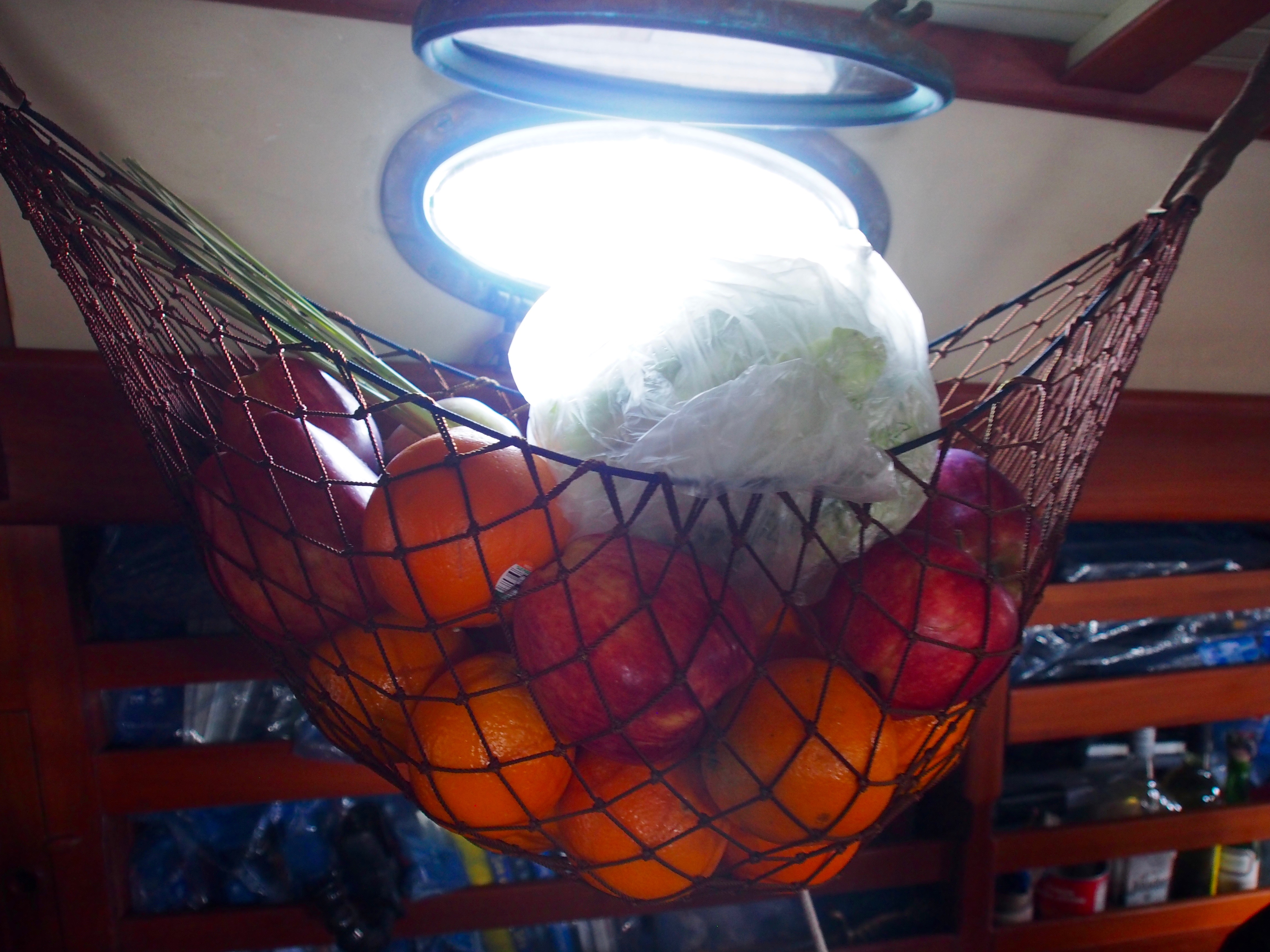
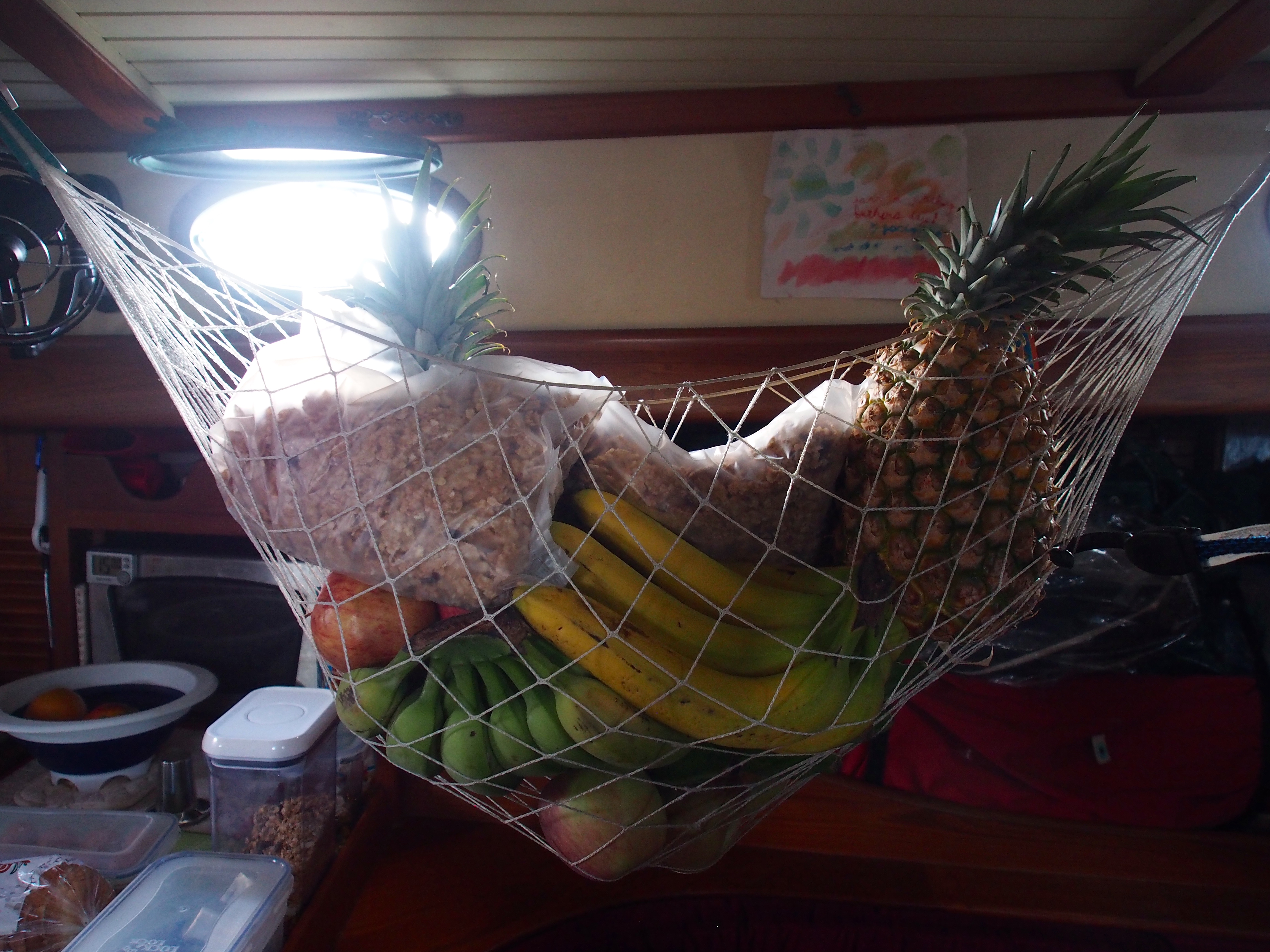
John and Brian, who are crew for the Hawaii to Seattle passage, flew in to Honolulu a few days ago. Provisioning was one of the main tasks and since the passage could take 25 days or more, we did a big shop at Costco. We also increased our fuel capacity by adding 3 more jerry cans on deck, so we now carry a total of 145 gallons of diesel. Other projects included getting the wind vane back on the boat with the new rudder and control lines, re-installing the masthead windex, re-filling the propane tanks, and stowing everything in the cabin.
Lots of fresh fruit and vegetablesApples, bananas, pineapplesSoup bowls and snack foods